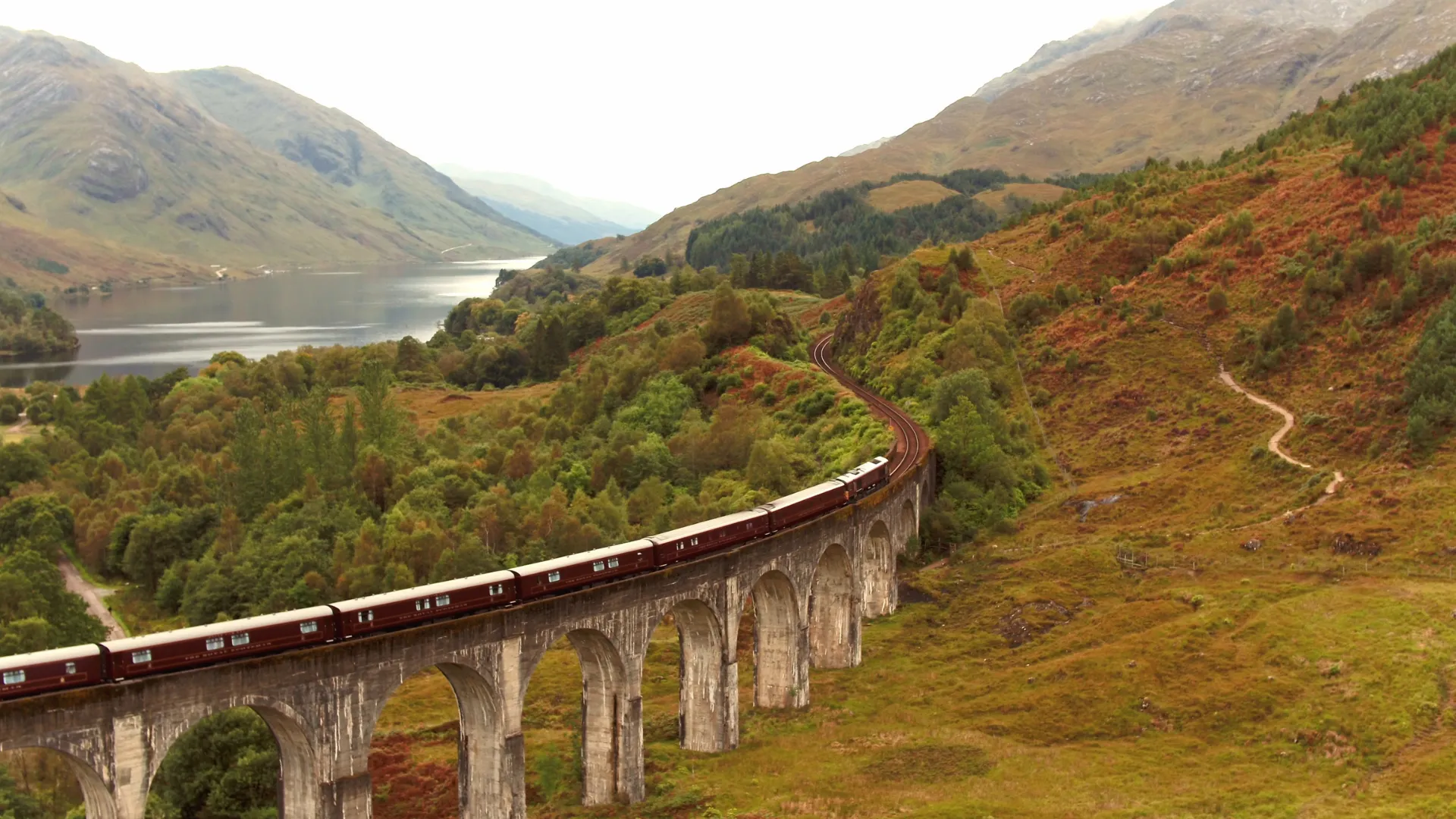
Scotland at the Speed of Looking
Aboard the Belmond Royal Scotsman, thirty-six guests, one maroon train and a timetable measured in views rather than minutes. From Edinburgh Waverley to Plockton and the Cairngorms, Scotland rolls past at the pace of conversation, and the landscape, for once, is allowed to finish its sentences.
JOURNEY AT A GLANCE
The Royal Scotsman
ROUTE
Edinburgh Waverley, Keith, Inverness, Plockton and Kyle of Lochalsh, Boat of Garten, Dundee, back to Edinburgh. Visits include Ballindalloch Castle, Rothiemurchus Estate and a morning walk to Skye. Routes vary by departure; west-coast journeys follow the West Highland Line, and some late-October departures may be amended for engineering works.
BEST SEASON
April to early November. Late spring for the long light, September and October for autumn colour.
DURATION
Four nights (five days) on this journey, leaving Waverley in the early afternoon and returning at around 09:40. Other itineraries run from two to seven nights.
STARTING FARE
From about £11,600 per person (Belmond lists £23,200 per double cabin, two sharing) for 2027 departures; two-night journeys have been listed from around £6,200 per person. Fares include an en suite cabin, all meals, drinks and excursions. Insurance, gratuities, hotels and transfers are extra, and fares vary by date.
Leaving Edinburgh Waverley Without Fuss
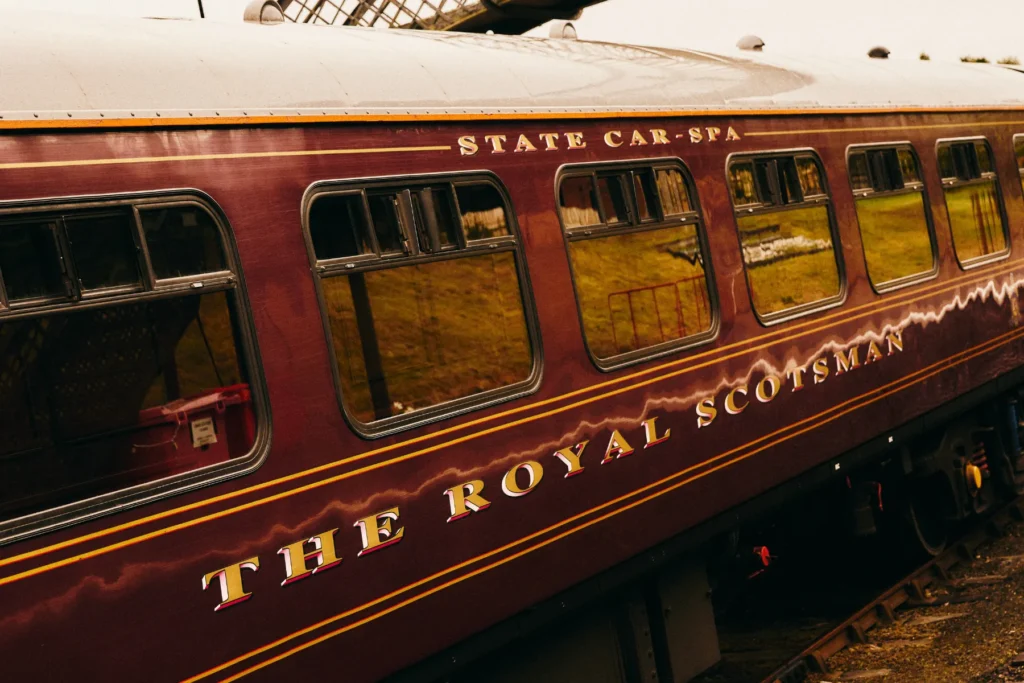
There is no whistle, or none that anyone on the platform appears to hear. At Edinburgh Waverley, in the slack hour after lunch, the Royal Scotsman simply stops being stationary. A glass is lifted, a station clock slides past, and the city’s soot-dark stone begins to retreat with the composure of a guest leaving a party he has enjoyed.
Waverley sits in a hollow, which is the first of Edinburgh’s small deceptions. The Old Town stacks itself overhead, spires and tenements laid down like sediment, and the train eases out beneath it all, past the backs of buildings never meant to be seen from this angle: washing lines, skylights, a gull on a chimney pot weighing its options. Then the cutting opens, the city thins to suburb, and the light, rationed all morning by masonry, is suddenly available in quantity.
This is the Royal Scotsman’s first lesson: nothing here is in a hurry, least of all you. The timetable puts departure in the early afternoon and the return, whichever route you choose, at twenty to ten on a later morning. Between those two moments lies a string of places that most of us would normally drive through on the way to somewhere else. Here, they are the destination.
Then comes the Forth. The train slows for it, or seems to. The great red cantilevers of the bridge rise ahead, a Victorian engineer’s argument conducted in steel, finished in 1890 and now a UNESCO World Heritage Site. The rhythm beneath the carriage changes key. The beat goes hollow, then steadier, and the estuary opens far below, pewter-coloured, with the road bridges standing by like younger relations who have been told to behave. Somebody in the observation car stops mid-sentence. Nobody finishes it for them.
On the far shore lies Fife, the old Kingdom, crossed at a pace that lets you notice its details: ploughed fields the colour of strong tea, a church tower, a farmer’s quad bike abandoned at a gate, the sea appearing and disappearing between hedgerows like a rumour. Afternoon tea arrives, as it should, before anyone has had time to be hungry.
Speed, you realise, has been quietly removed from the arrangements. Scotland is not being crossed; it is being read, line by line, by people who have finally been given the time.
A Country House on Rails
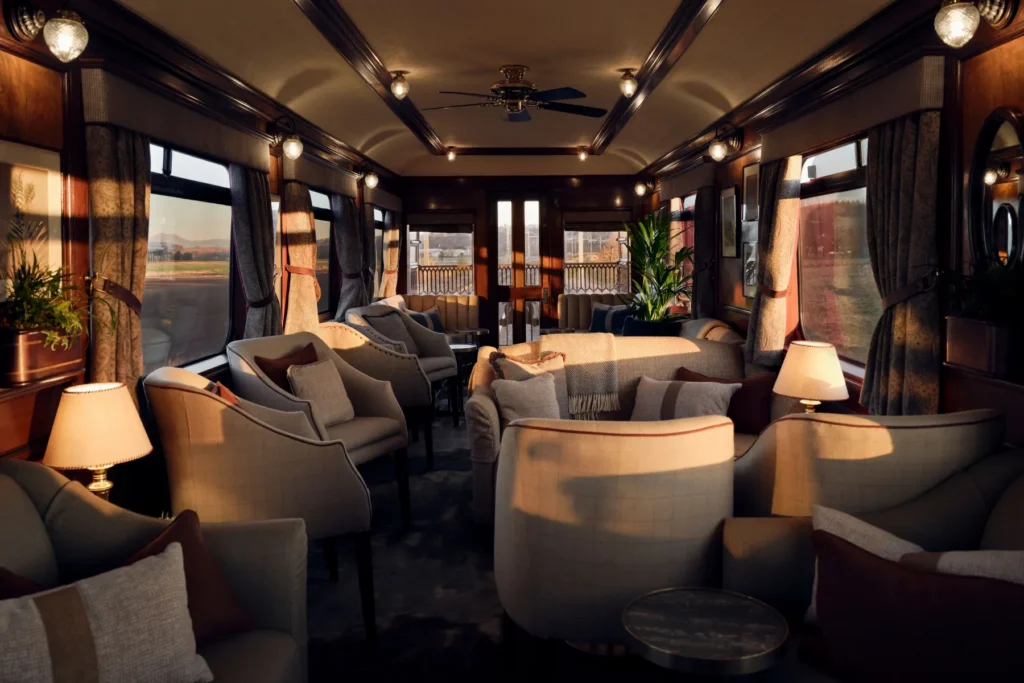
Inside, the first impression is of a house that has learned to travel. The corridor is narrow, as corridors on trains must be, but it is lined with polished wood and lit with the amber patience of a good hotel at dusk. The carriages are Edwardian in spirit and Scottish in detail, a deliberate conversation between the old railway age and the present one. Nothing has been hurried into place.
There are only thirty-six guests, which is the whole secret. A train of this size does not produce a crowd; it produces a household. By the first dinner you know who takes sugar, who has climbed the Munros and who is quietly nursing a theory about the Scottish weather. The stewards learn names within the hour and, more impressively, remember what comes after them.
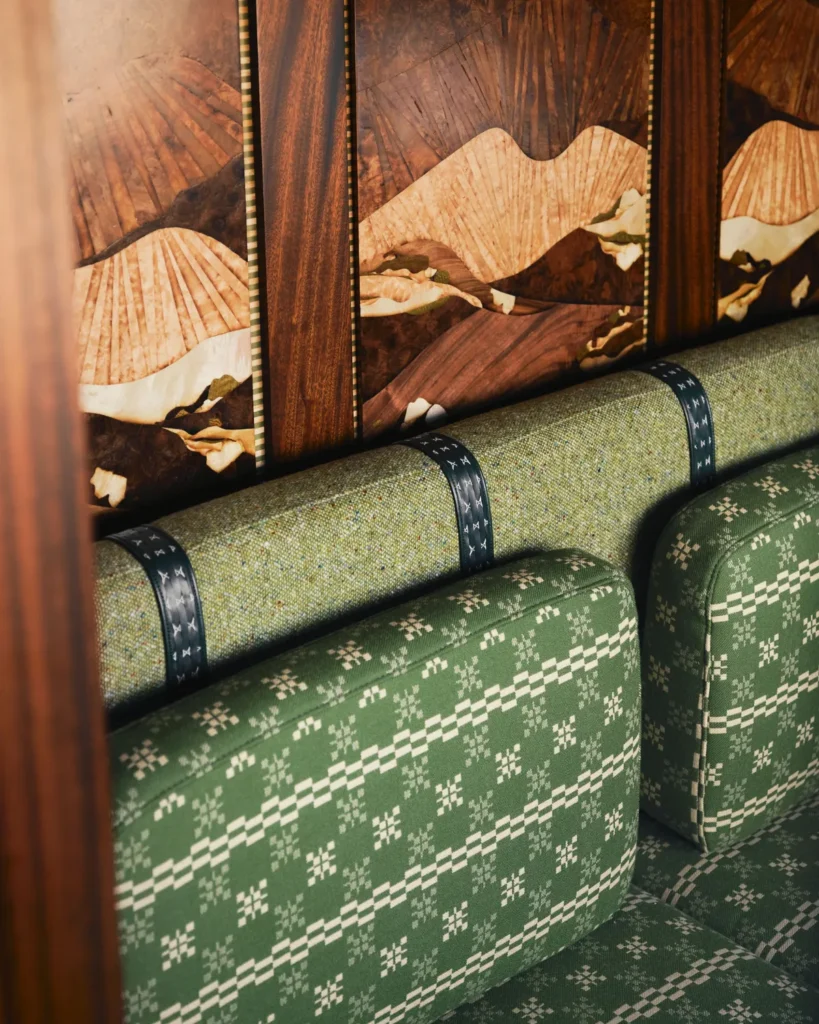
The cabins are small by hotel standards and unnervingly competent by railway ones: a bed made up with naval precision, a private bathroom, a window that frames the passing country like a commission. Draw back the blind at dawn and Scotland is already there, waiting with the patience of a landscape that has outlasted several empires.
Evenings belong to the observation car at the back of the train, where the last light follows you along the track and the rails unspool behind into a narrowing V. There is music, because there is always music in the Highlands: a fiddle, a piper, a ceilidh in which the swaying floor excuses any amount of improvised footwork. Dinner is taken in the State Dining Room, with Scottish produce on the plate and a wine list a guest might be tempted to read as fiction.
Before dinner there is the Dior Spa Royal Scotsman, a treatment room built into a train, which still strikes the uninitiated as a conjuring trick. Lying beneath warm towels while the Highland glens pass the window has no obvious precedent.
Afterwards, you sleep. The train is often stabled overnight at small stations, and the silence, after the day’s long glide, is total: no engine, only the tick of cooling metal and, if you are lucky, rain on the roof. The Royal Scotsman does not merely carry you through Scotland. It parks you in it.
North by Degrees, Through Speyside
The first night is spent at Keith|| a Moray town that has never troubled the front cover of a guidebook and is better for it. The train comes to rest at a quiet platform and dusk takes its time. Someone walks the length of the carriages in the half-light and returns with the news that the air smells of malt. It does. The town sits in the heart of whisky country, and the evening carries a warm, biscuity note of barley and woodsmoke that no candle-maker has quite managed to bottle.
Morning arrives with porridge and a view of low green hills folding into one another. The pace has settled. By now the body has stopped asking when it will arrive, a question that dissolves, somewhere around the second cup of coffee, into the pleasanter one of where it is.
A private visit to Ballindalloch Castle follows, and it is still a family home, which you sense the moment you cross the threshold. Portraits watch from the walls. The chill of old stone holds on to a hundred winters. This is a house that has been lived in rather than curated, and the difference is audible in the creak of the floorboards and the way the guide lowers her voice at the dining-room door.
The country here is shaped by the Spey, which slides over its stones with the unhurried glitter of something that has never been late for anything. Anglers stand waist-deep in it, motionless, in the posture of men awaiting a verdict. The landscape arranges itself in layers: river, then pasture, then the dark plush of conifer plantations, then bare hill, then sky. From the train these layers do not blur into one another, as they would from a car. They separate, politely, one at a time.
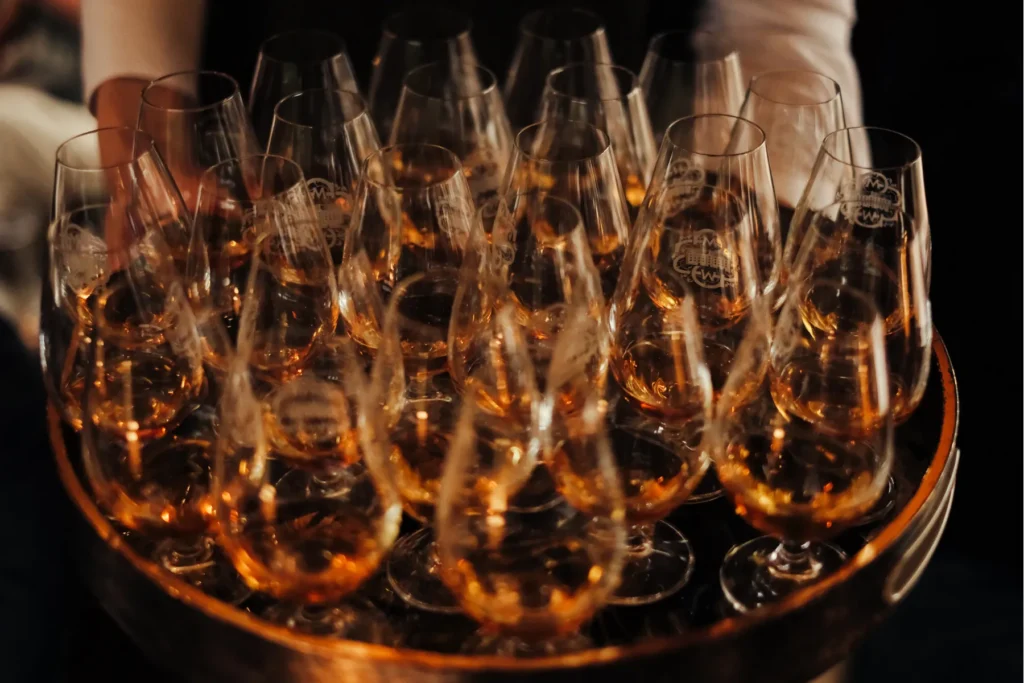
Whisky is the region’s way of measuring time, and a train with a taste for patience makes a natural companion to it. A dram, here, is less a drink than a duration: twelve years in oak, eighteen, thirty. Conversation in the observation car lengthens accordingly. Opinions on peat are held with the fervour of political convictions and abandoned, graciously, by the third glass.
The railway, you begin to see, is a way of arranging patience. Nobody on board is waiting for anything. They are simply being moved, at a civilised rate, from one good thing to the next, and discovering that the intervals between are not empty at all.
The Kyle Line to the Isles
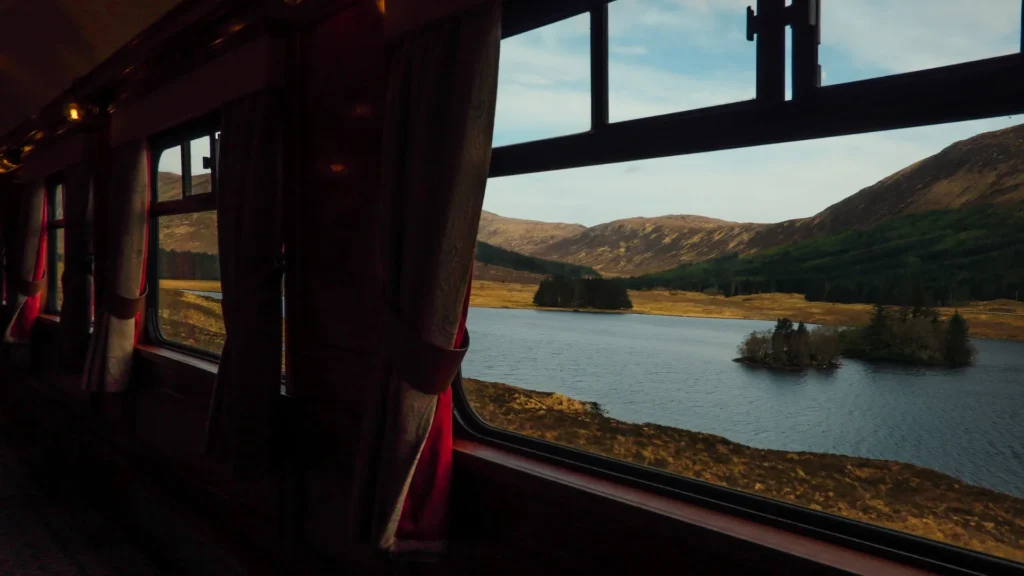
Heading west, the Royal Scotsman follows the Moray Firth towards Inverness, the capital of the Highlands. Lunch is served as the water slides along one side of the carriage, wide and metallic beneath a lid of cloud. Inverness comes and goes, a town of bridges and good stone. Then the train turns onto the line to Kyle of Lochalsh, widely regarded as one of the most beautiful railway journeys in Britain, and the conversation in the dining car quietly thins.
It is easy to see why. The line takes the scenery by the shoulders and turns it towards you. Glens narrow. Birch gives way to bare rock, and lochs appear without warning, black and still, with the occasional cloud caught in them like a thought. Deer stand on distant slopes with the indifference of people who have seen trains before. The carriage leans into a curve, and the whole view swings round like a stage set being turned for the next act.
Then Plockton, a village that seems to have been arranged by someone with a gift for composition. Whitewashed cottages curve around a sheltered bay. Boats sit on water so calm that each has a perfect twin beneath it. Palm trees, improbably, line the shore, a gift of the mild west coast climate that always startles visitors who have packed for sleet. You walk the front slowly, because everyone does, and because the Royal Scotsman has taught you how.
At Kyle of Lochalsh, a morning walk carries you to the Isle of Skye. In practice this means a stroll across the bridge, a crossing that once demanded a ferry and now asks only for sensible shoes. There is something faintly absurd and wholly satisfying about arriving on an island on foot, before breakfast has quite settled, with the sea moving beneath you and the Cuillin somewhere out in the weather.
From a small boat in the bay beneath the Applecross hills, seals regard you with the mild, appraising look of customers who have been kept waiting. The engine cuts out. For a few minutes the only sounds are water against the hull and somebody’s whispered, delighted profanity.
None of this would survive speed. Fast, the west coast is a smear of green and grey seen through a windscreen. Slow, it resolves into particulars: the weight of a loch, the white of a croft wall, the exact tilt of a heron’s neck. This, at bottom, is what the train is selling, though it would never be so vulgar as to say so.
The Long Table
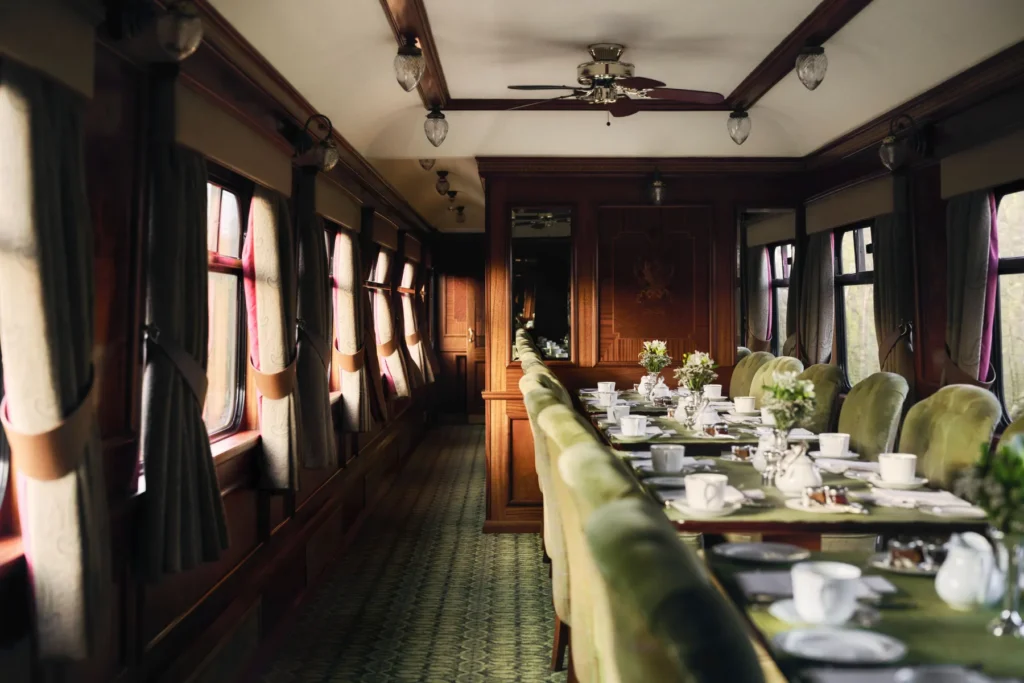
Dinner is the train’s argument for patience, and it makes the case nightly, at length. The kitchen works from what river, moor and sea provide, in a galley that ought to be too small for the ambition, and the courses arrive at a tempo closer to conversation than to timetable. Outside the windows the glass darkens. Candle flames take over from the view, and the wine, as promised, never seems to run out.
On the third night the train settles at Boat of Garten, a Speyside village that still has a proper station and, in summer, ospreys fishing at nearby Loch Garten. It is the sort of place that makes its own quiet case for stopping. Somebody opens a window and the night comes in smelling of pine and cold water.
In the morning the Cairngorms stand at the end of every sightline, rounded and ancient and faintly amused by the fuss. The Rothiemurchus Estate offers a choice of pursuits: a walk with a ranger through remnant Caledonian pinewood, a lesson in clay pigeon shooting, or an hour standing in a river with a rod. Each asks for the same quality, which is stillness, and each repays it.
The forest floor is blaeberry and needle, the silence has texture, and the bark of the old Scots pines turns copper where the sun finds it. A ranger crouches to show you something small and unremarkable and, within a minute, it has become the most interesting thing in Scotland. This, too, is slow travel: the discovery that attention, once given, is rarely wasted.
Back on board, the household has acquired its customs and its in-jokes. Strangers of a few days ago now argue amiably about the best route home and who will be first to the observation car at six. There is a sense, faint but unmistakable, of a small society that will dissolve in a day or two and knows it, and is therefore making the most of the interval.
The train moves on south towards Perthshire and the sea, taking the afternoon with it. The mountains drop away behind, the glens widen, the land grows soft and agricultural, and one realises, with a small pang, that the journey has already begun to run out.
Twenty to Ten, Back at Waverley
Dundee, as a place to end, is a pleasing surprise. The train spends the final night there, quiet beside the Tay, while the city that once lent the world jute and jam goes about its evening, unaware that a small maroon fantasy has parked at its edge.
Before that, the last dinner: a gala affair, as these things are, in the State Dining Room, with everyone a little more polished than on the first night and a little less guarded. Speeches are made and not entirely heard. Somebody sings. The observation car holds its last, long, convivial hour, and the rails run away behind into the dark like thread being unwound.
Morning brings a final breakfast and the Tay Bridge. The train crosses the estuary on a long, pale curve, and beside it, if you look, stand the stumps of the first bridge, lost in a gale in December 1879 and left as a reminder that Victorian confidence was not always justified. It is an unexpectedly sobering note on which to leave the water, and it makes the calm of the carriage feel earned.
Then Fife again, the Kingdom in daylight this time, played back like a film run in reverse: the church tower, the ploughed fields, the road bridges, and finally the red cantilevers of the Forth, close enough to count the rivets.
At twenty to ten the Royal Scotsman slides back into Edinburgh Waverley, beneath the same hollow of the Old Town where, days earlier, it began. Doors open. Luggage appears. The city, loud and brisk, reasserts its tempo, and people hug a little longer than strangers should.
What stays is not a list of sights. It is a rate. For four nights Scotland has been experienced at the speed of looking, and the body, stepping onto the platform, finds that it has forgotten how to hurry and is in no particular rush to relearn. The landscape has moved from coast to glen to forest to firth without being conquered, collected or ticked off. It has simply been allowed, at last, to finish its sentences.
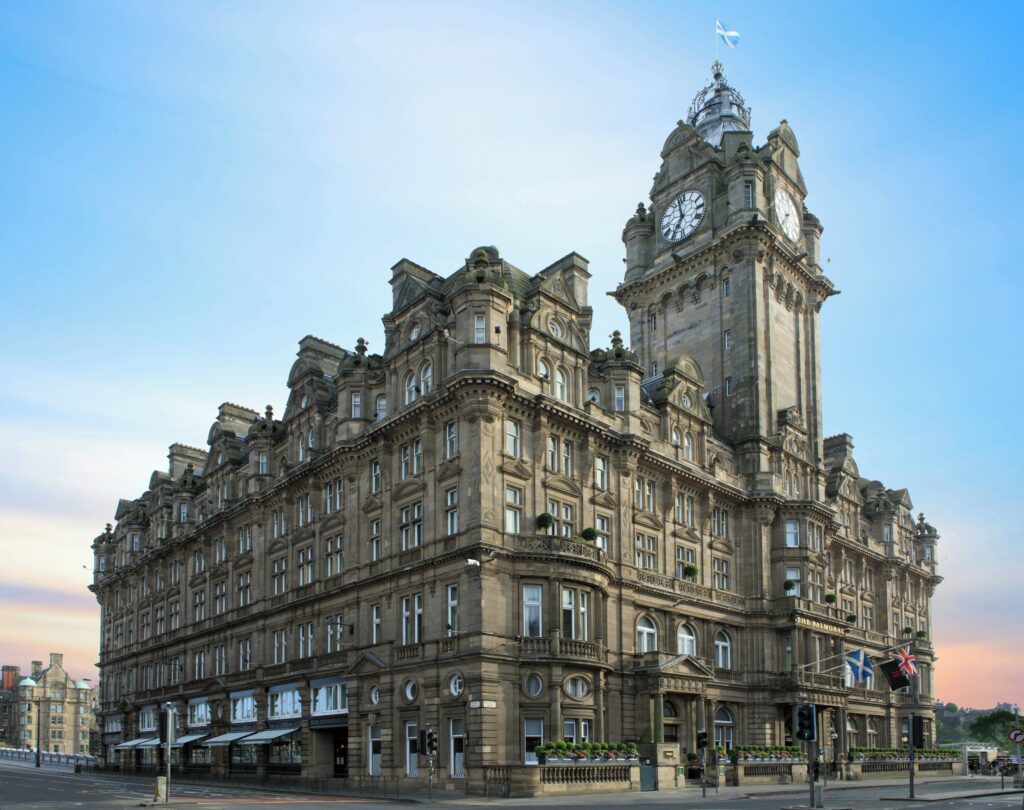
PRE-DEPARTURE STAY
The Balmoral, Edinburgh
An Edwardian railway hotel built in 1902, its clock tower rises directly above Waverley and, by tradition, runs three minutes fast to hurry travellers to the platform. Beginning here, with a dram and a short, dignified walk to the train, is the quintessential prelude.