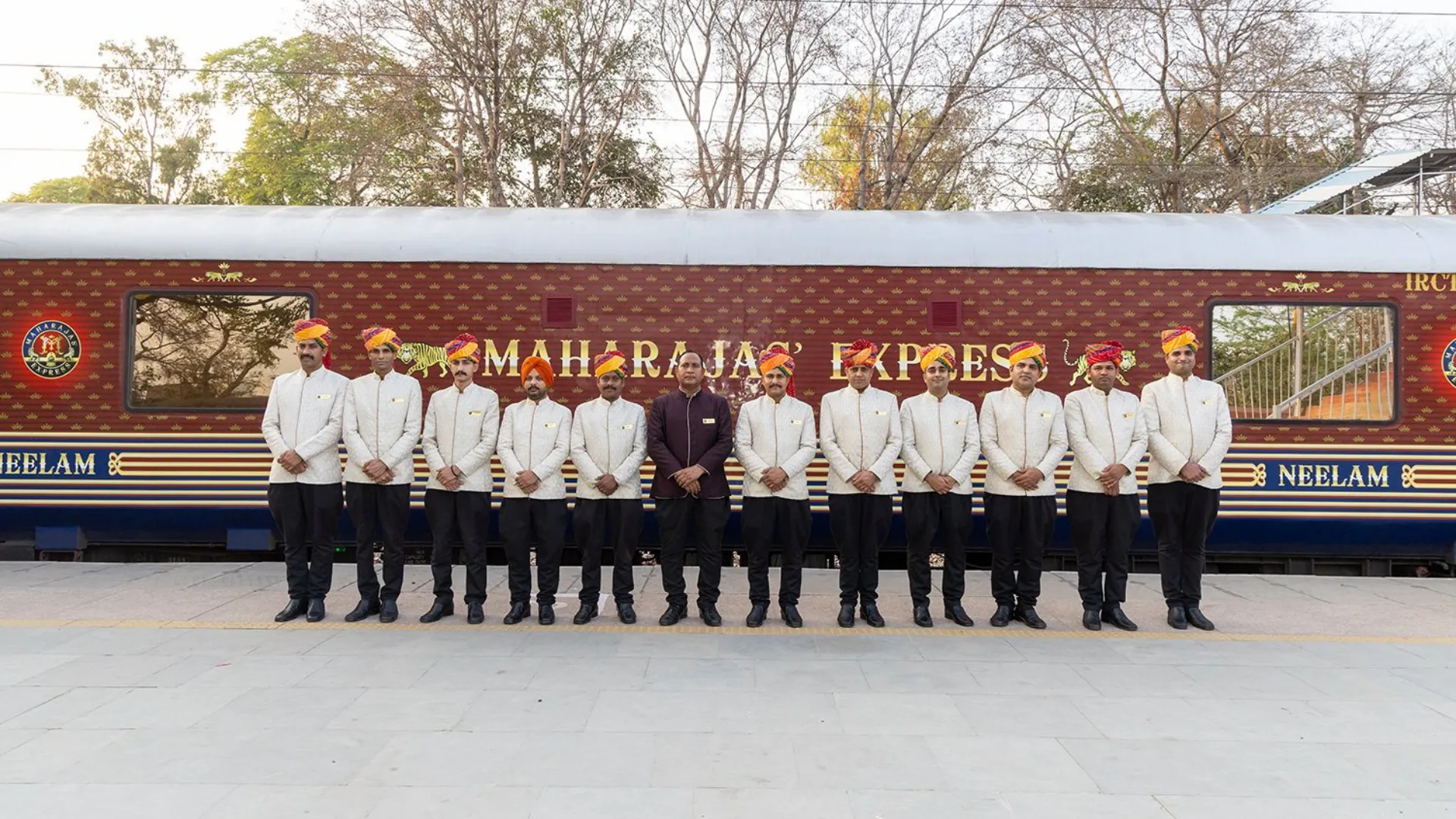
The long way to Mumbai aboard the Maharajas’ Express
Breakfast leaves Delhi at half past seven. Over the next six nights, the Maharajas’ Express crosses the Yamuna plain, skirts the Thar Desert and turns towards Mumbai. Between painted dining-car ceilings and afternoons ashore, the Indian Splendour gives the eye time to adjust to each change of country.
JOURNEY AT A GLANCE
Maharajas’ Express — The Indian Splendour
ROUTE
Delhi Safdarjung Railway Station → Agra → Ranthambore (Sawai Madhopur) → Jaipur → Bikaner → Jodhpur → Udaipur → Chhatrapati Shivaji Maharaj Terminus, Mumbai. Indian Splendour has selected departures from October to March. Other itineraries include a shorter Delhi circuit, a longer Delhi circuit via Varanasi, and a Mumbai-to-Delhi journey. Selected departures on the wider timetable extend into early April.
BEST SEASON
November or February for mild sightseeing weather and fewer fog days in Delhi on average than in December or January.
DURATION
Seven days and six nights for Indian Splendour. Across the four itineraries, journeys last four days and three nights or seven days and six nights.
STARTING FARE
Approximately £6,371 per person for Indian Splendour in an en-suite Deluxe Cabin, based on two sharing. This is the operator’s US$8,400 fare converted on 17 November 2026, before 5% Indian GST. Meals, house drinks, butler service and scheduled guided excursions are included.
Breakfast out of Delhi
At half past seven on a Sunday morning, the Maharajas’ Express is due out of Delhi Safdarjung. Breakfast is served as the train pulls away. There are gold crowns on the sides of the carriages and several hours before Agra. For a journey that will take in two Mughal monuments in its first twenty-four hours, it begins with the pleasingly modest prospect of finishing a cup of tea.
This is the Indian Splendour, a six-night journey to Mumbai by way of Ranthambore and four Rajasthani cities. The first morning belongs to the flat country of the Yamuna. On a clear day, the openness of the plain changes the scale of what catches the eye. A stand of trees, a wall at the edge of a field, the backs of buildings as the railway enters a town. From a carriage, the spaces between settlements are as legible as the settlements themselves. There is time to notice how much of the journey a route map leaves blank.
Lunch is scheduled for the train’s arrival in Agra, with the Taj Mahal visit in the afternoon. The great southern gateway does a good deal of work. Its red sandstone gives the eye a frame through which to take in the white marble of the mausoleum Shah Jahan commissioned for Mumtaz Mahal. From a distance, the symmetry seems to settle everything. Close up, the stone inlay draws attention to smaller decisions. A petal bends at its tip. A stem narrows to a line. Colour sits flush with the marble. In nearby Taj Ganj, artisans still practise the craft, known as parchin kari.
The train stays in Agra overnight. That is an agreeable detail in a day that begins with a railway check-in at quarter past six. Dinner is back aboard, and the same cabin will be waiting after the early visit to Agra Fort the following morning. Over the week, those returns give the journey its rhythm. A whole afternoon can pass among crowds and stone courtyards. Then comes the familiar turn into the corridor, the cabin door and a window whose view will be different by the time breakfast comes round again.
A room with a moving view
There is a hand-painted ceiling in Rang Mahal, one of the train’s two dining carriages. It is an extravagant use of a surface that most railway passengers have occasion to examine only when retrieving a bag. In Mayur Mahal, the other restaurant, peacock colours run through the furnishings. Both have tables for two as well as four, a small courtesy on a week-long journey. At breakfast, there is much to be said for a table where both people are happy to look out of the window.
Indian Railways introduced the Maharajas’ Express in 2010, drawing on the private carriages of India’s former rulers. There is also a familiar note of the British club in the Rajah Club lounge, with its deep armchairs and polished wood. A few steps away, the painted ceiling brings the eye back to India. The two idioms sit quite comfortably together. The train gives each room its own character, something that matters after several days aboard, when the place where you read begins to feel distinct from the place where you have a drink.
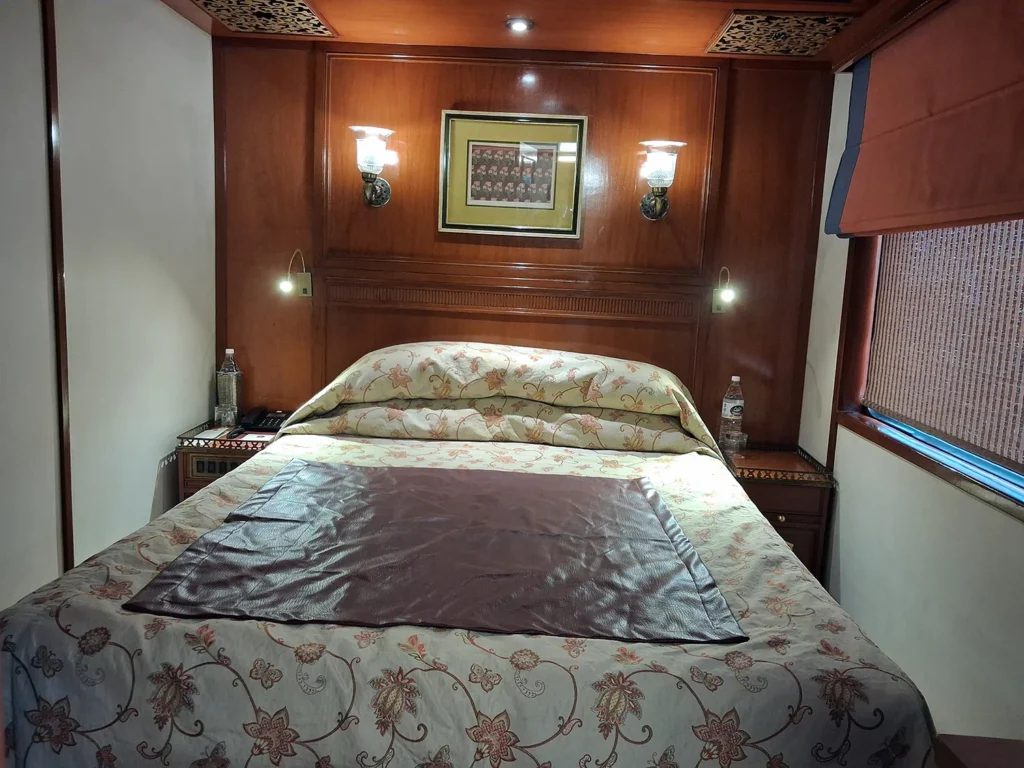
The cleverest decision is in the cabins. Even the Deluxe, at just over ten square metres, has a broad window and a private bathroom. At the other end of the scale, the Presidential Suite takes up a carriage, with two bedrooms and a sitting room. Space changes what you can do behind a closed door. The window changes what you notice. It is a particularly good piece of design because it gives the smallest room the same claim on the passing country as the largest.
The worth of that window becomes clearer on the second morning. The itinerary calls for a six o’clock visit to Agra Fort, then breakfast aboard as the train heads for Sawai Madhopur. The fort’s red sandstone walls enclose palaces, audience halls and mosques. By breakfast, those enclosed spaces give way to open country again. Later there will be a game drive at Ranthambore, where everyone will have a particular thing they hope to see. For the hours in between, the pleasures of looking are less exacting. A cup on the table, a chair by the glass and whatever happens to be on the other side.
Lunch between the fort and the forest
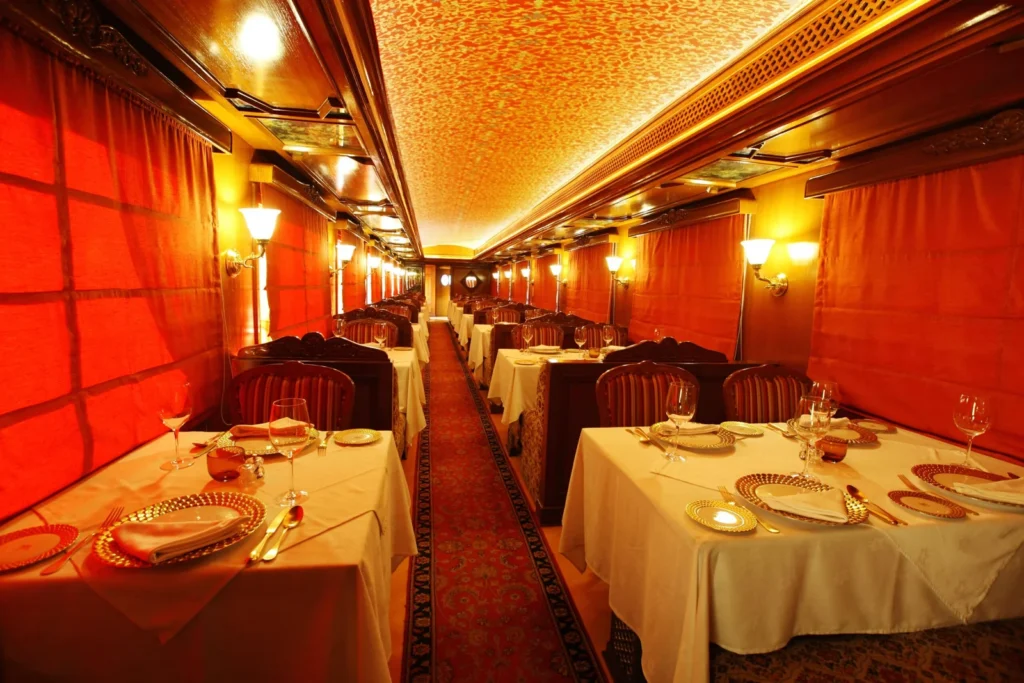
The train leaves Agra after the morning visit to the fort. At lunchtime it is bound for Sawai Madhopur, the railhead for Ranthambore. There is an afternoon game drive ahead, but for the moment the most interesting thing in motion may be a plate. In the galley, metal bars hold the crockery in its racks. In the dining carriage, a table laid for two gives very little away about what it takes to get lunch to it.
On a journey in the opposite direction, the rail writer Monisha Rajesh visited the galley for National Geographic Traveller. She found executive chef John Stone and his team cooking dal and mutton rogan josh, with lobster thermidor also in their repertoire. Stone makes yoghurt and bread aboard. Those last two details say more about the kitchen than the lobster does. Bread needs time to prove, and yoghurt has its own timetable. The dining car keeps to the railway’s. Somewhere between the two, a team has to get lunch out while the floor rocks beneath it.
The train serves Indian and international menus across its two restaurants. Over six nights, the breadth makes sense. So does ordering Indian dishes when they appear. A bowl of dal, with the savour of fried onion and fenugreek that Rajesh describes in the galley, offers a more intimate sense of the cooking than a procession of ingredients chosen for their price. And a leisurely lunch earns its place on this particular day. The morning has already required an early start. The afternoon calls for a different sort of attention.
Ranthambore was once a hunting reserve of Jaipur’s rulers. Its dry woodland gives way to crags and lakes, with the old fort above. A game drive tends to begin with one animal in mind, but the country quickly offers other things to watch. Chital can show up in the clearings, and langurs and sambar belong to the same patchwork of woods and water. A call from the trees can turn every head in a vehicle. The train is scheduled to leave for Jaipur at six, with dinner served on the move. By then, the rocking floor is somebody else’s concern again.
Dinner at the edge of the Thar
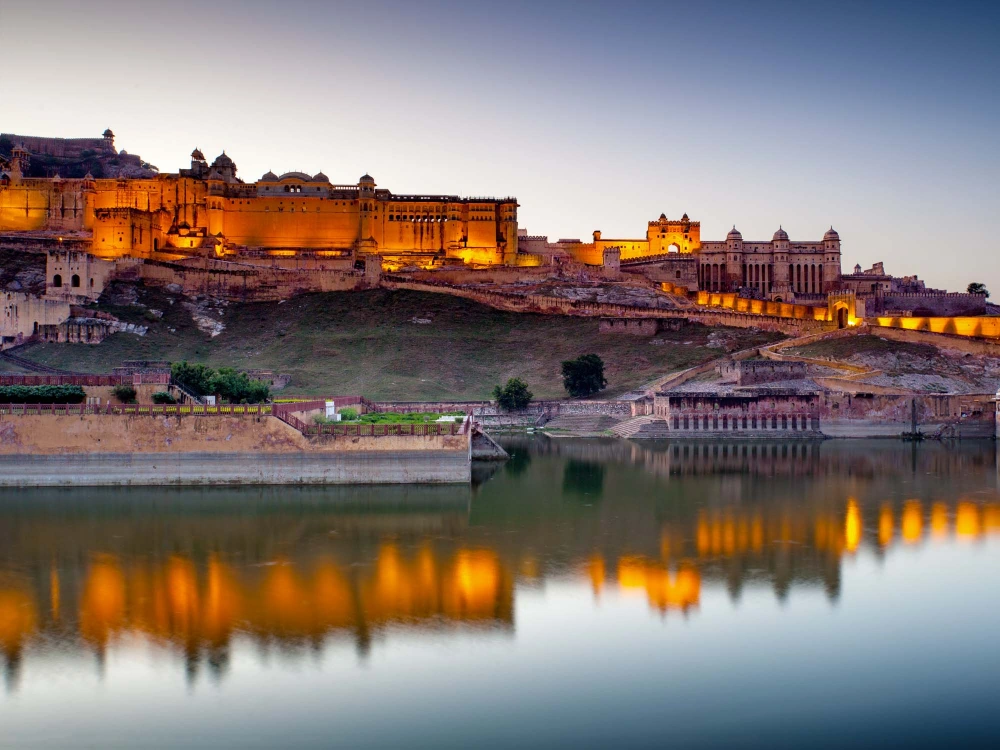
Jaipur gives the train a day in which to stand still. The Indian Splendour schedules Amber Fort and the City Palace in the morning, lunch aboard and the Albert Hall Museum in the afternoon. At the museum, the British engineer Samuel Swinton Jacob brought pointed arches and Indian domed pavilions into the same design. The Prince of Wales laid the foundation stone in 1876. It is one of the places on the journey where the British connection has a date and a building attached to it, and where the building itself is more interesting than the ceremony that began it.
The train leaves Jaipur late that evening. Breakfast the following morning is scheduled before Bikaner, which means a little of the approach to the Thar belongs to daylight. The desert here includes scrub and rough ground as well as dunes. From the window, its first impression may be an expanse of pale earth between low bushes. After Jaipur, where there is always another façade or courtyard to look into, there is a particular pleasure in letting the eye travel that much further.
Junagarh Fort sits in Bikaner itself. Its red and golden sandstone walls gather several palaces within them, built and altered by successive rulers. Pause beneath one of the carved balconies and the scale of the workmanship becomes apparent. There is the weight of the wall and then the fineness of the carving where it projects into the light. Having spent several days under painted ceilings and beside polished panelling, it is natural to notice the smaller surfaces here, too. The carriage has been quietly training the eye.
The day ends outside the city, with drinks among the dunes, a barbecue dinner and folk dancing on the published itinerary. There is a moment worth leaving room for between arriving and sitting down to eat. As the light falls, the ridges in the sand become easier to pick out, their shadows showing where the wind has worked on them. Dinner has a setting as carefully chosen as either of the train’s dining rooms, and the evening air is part of it. Later comes the return to the carriage. The run to Jodhpur takes place overnight, with the next city due to arrive well before breakfast.
From Jodhpur’s fort to Lake Pichola
The Maharajas’ Express is due in Jodhpur at four in the morning, an hour best left to the railway. By the time breakfast is served, the train has been standing for several hours. There is time ashore for Mandore Garden and the Umaid Bhawan Museum before lunch back on board. Mehrangarh comes later, when the day has begun to cool and the fort’s position above the plain is easiest to appreciate from its ramparts.
Mehrangarh rises some 400 feet above the country around it. From below, the walls appear to continue the rock on which they stand. From the top, the eye drops to a much smaller scale. There are roofs and lanes to pick out, with patches of blue gathered below the fort. After Bikaner, where the palaces are enclosed within Junagarh’s walls, Jodhpur gives the itinerary a different relationship between the fortress and the city. Here you can look down and see how close ordinary life comes to the rock. A train window lets the country assemble itself a little at a time. Mehrangarh gives you much of Jodhpur at once.
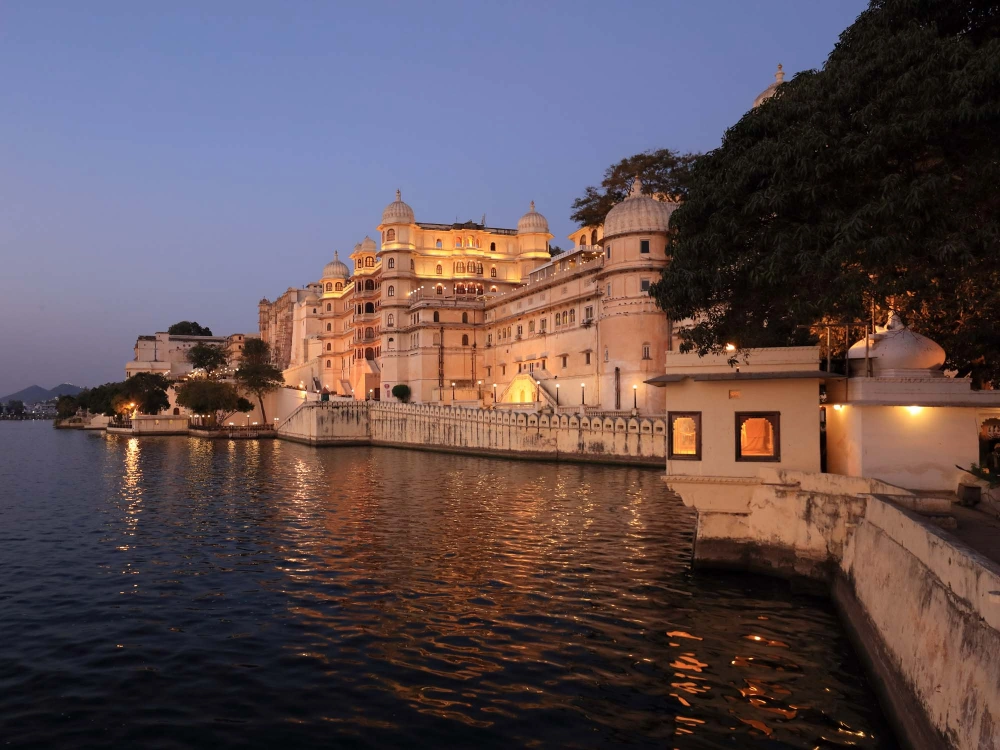
The overnight run to Udaipur makes for a particularly good change of scene. The morning’s first excursion is a boat ride on Lake Pichola, with the City Palace on the eastern shore. From the water, its balconies, towers and cupolas come into view as the boat changes position. Where Mehrangarh draws the eye up a single mass of stone, the palace at Udaipur spreads along the bank. You can follow its outline from one building to the next, and pick out the islands of Jagniwas and Jagmandir across the water.
The itinerary then takes you inside the City Palace and its Crystal Gallery, with lunch ashore and a walk through the old city. By the time dinner is served back aboard, the day has offered three distinct speeds. There is the boat’s steady progress, the stop and start of a walk through town, and the stillness of the dining car before the train leaves for Mumbai at half past nine. After a week of making connections between places, it is pleasant to sit down to dinner and let the railway make the last one.
The last lunch before Mumbai
On the last morning, there is no excursion between breakfast and lunch. Both meals are served aboard, with arrival in Mumbai scheduled for late afternoon. After several days in which the hours between meals have contained a fort, a game drive or a boat ride, an empty morning feels rather different. There is time to read a few pages, put the book down, and find that the view has changed while you were looking elsewhere.
By now, a favourite seat may owe as much to the height of its window as to the chair itself. The changing country has supplied a quiet argument for keeping a place by the glass. On the first morning, the Yamuna plain gave small details room to register. Near Bikaner, pale ground and low scrub gave the horizon more of the frame. In Udaipur, from the boat, the palace moved in and out of alignment with the shore. The approach to Mumbai brings buildings back into the foreground, where distance is measured once again in streets and stations.
The journey ends at Chhatrapati Shivaji Maharaj Terminus, the former Victoria Terminus. Work began in 1878 to a design by the British architect F. W. Stevens, who worked with Indian craftsmen. The pointed arches belong to the building’s Victorian Gothic vocabulary. The dome, turrets and palace-like silhouette owe much to Indian architecture. There is an echo of Jaipur’s Albert Hall in that mingling of forms, though here the building’s daily business is the movement of people. It is still a working station, which gives its grandest architectural gestures an appealing matter-of-factness. You can arrive under all that stonework and be chiefly concerned with keeping hold of your bag.
A week earlier at Safdarjung, breakfast was the first appointment. In Mumbai, the railway gives the train back to the city amid all the ordinary business of arrival. The Maharajas’ Express will be one train among many here. Its particular achievement is how much of the country it lets you see between the places you came to visit. Once on the platform, it is worth looking back along the carriages. The windows that have framed so much for six nights are, from here, just a row of windows again.
PRE-DEPARTURE STAY
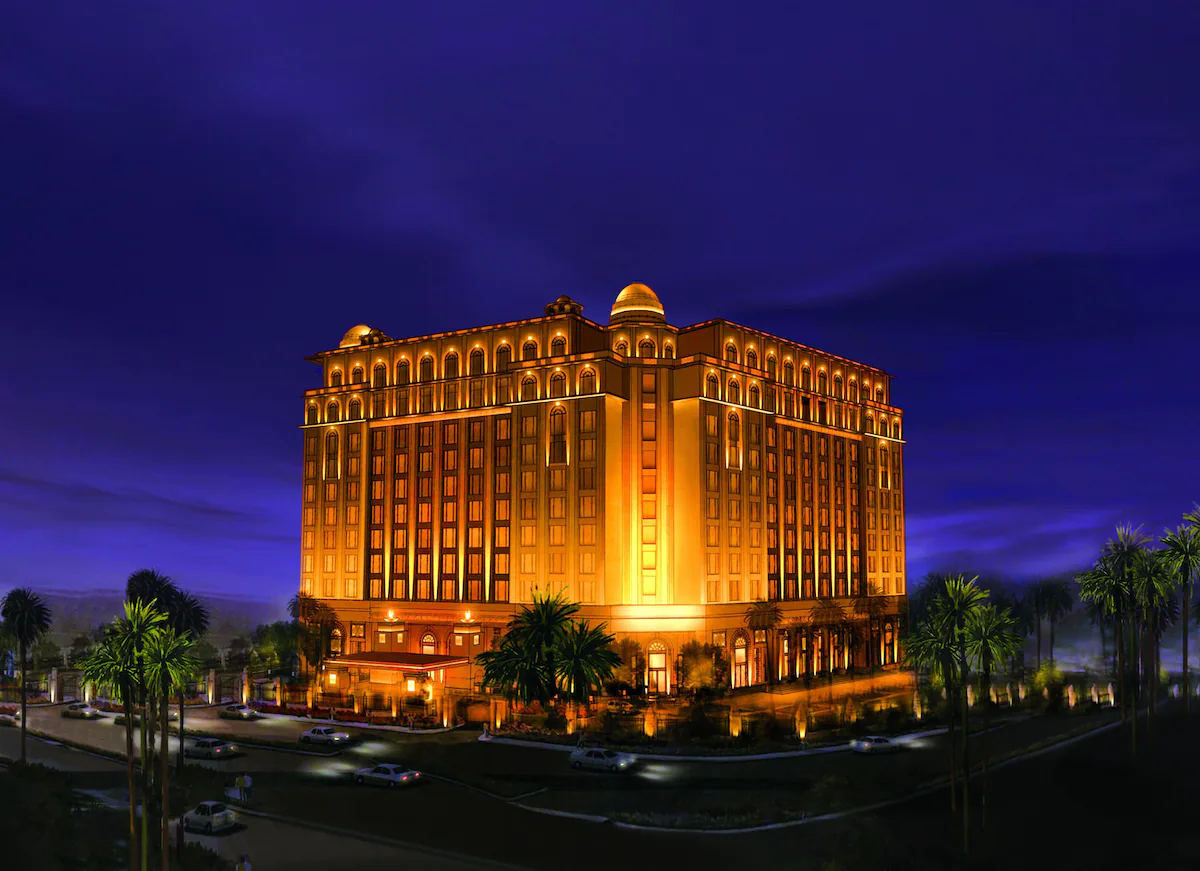
The Leela Palace New Delhi
In Chanakyapuri, a façade inspired by Lutyens’ Delhi gives way to glass chandeliers and paisley-lined walls at Jamavar. Dinner there makes a fitting prelude to the train, and Safdarjung Railway Station is about seven minutes on foot for the early check-in.