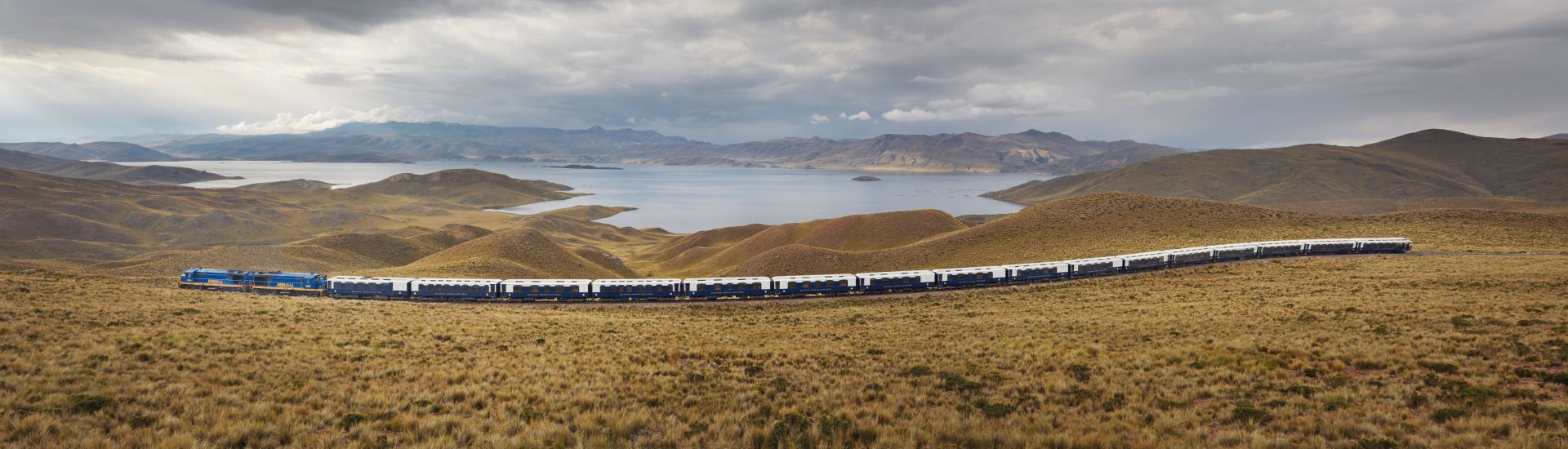
Andean Explorer, A Belmond Train — Peruvian Highlands
From Cusco to Arequipa, Belmond Andean Explorer takes two nights to cross Peru’s southern highlands. There is time to stand beneath an Inca temple wall, watch dawn spread across Lake Titicaca and see how the country beyond the carriage window finds its way into the dining car.
JOURNEY AT A GLANCE
Andean Explorer, A Belmond Train — Peruvian Highlands
ROUTE
Cusco (Wanchaq) → Puno Muelle and Lake Titicaca → Saracocha → Sumbay → Arequipa. The reverse two-night itinerary and selected one-night sectors are also published. PeruRail’s timetable specifies a February pause.
BEST SEASON
May to September for drier days in the Andes and clearer views. Nights can be cold.
DURATION
Three days and two nights for Peruvian Highlands, usually Thursday to Saturday. Shorter sectors take one night.
STARTING FARE
From about £2,800 per person for 2027, based on two sharing a bunk cabin. Sterling equivalent of World Journeys’ published US$3,700 fare, checked 18 November 2026. Includes the cabin, on-board meals and drinks, entertainment and scheduled excursions. Fares vary by departure and cabin.
1. The wall at Raqchi
At Raqchi, an Inca temple wall stands high above the grass. Its base is stone, its upper reaches adobe, and along either side the round stone footings of columns mark out the building that once enclosed it. You can walk towards the wall and still misjudge its height. It was the central support of a temple dedicated to Wiracocha, and the scale of it becomes clearer when someone crosses the grass in front of you. Belmond’s Andean Explorer stops here on its first afternoon out of Cusco, between brunch and the climb to La Raya.
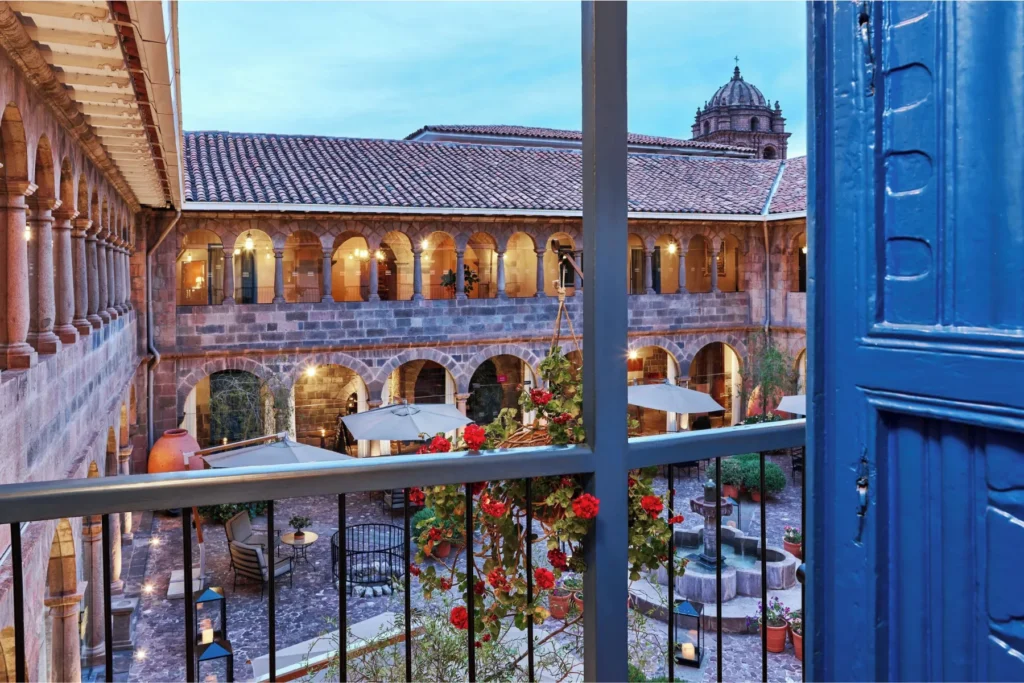
The morning starts in another courtyard, at Monasterio on Cusco’s Plazoleta Nazarenas. The hotel’s cloisters belong to the Spanish city built over the Inca capital, a layering still visible in the streets around the square. From the hotel, a short transfer takes passengers down to Wanchaq station, where they board the blue sleeper for its Thursday departure. By Saturday afternoon it is due in Arequipa. Between the two cities lie a pass more than 4,300 metres above sea level, a night beside Lake Titicaca and a second at Saracocha.
South-east of Cusco, the railway follows the Vilcanota valley. Eucalyptus rises above the fields, and adobe farmhouses show almost the same colour as the ground around them. This was the last stretch needed to bring the southern railway into Cusco. The British-registered Peruvian Corporation completed the link in 1908, connecting the old Inca capital to the line that already ran from the Pacific port of Mollendo to Puno. Raqchi had stood along an Inca road centuries before the sleepers went down. An afternoon’s progress takes in two ways of moving people and goods through the highlands, centuries apart.
The valley gives way to open grazing country towards La Raya. In dry-season light the grass turns the colour of straw, and the higher slopes can still carry snow. The train makes a late-afternoon stop at the pass. On the platform, the distance between the cold air and a warm carriage is only a few steps. Beyond La Raya comes the broad plateau and, several hours later, the lakeside tracks at Puno. The first sight of Titicaca in daylight can wait until morning. The train will be there all night.
2. A key cut for the Andes
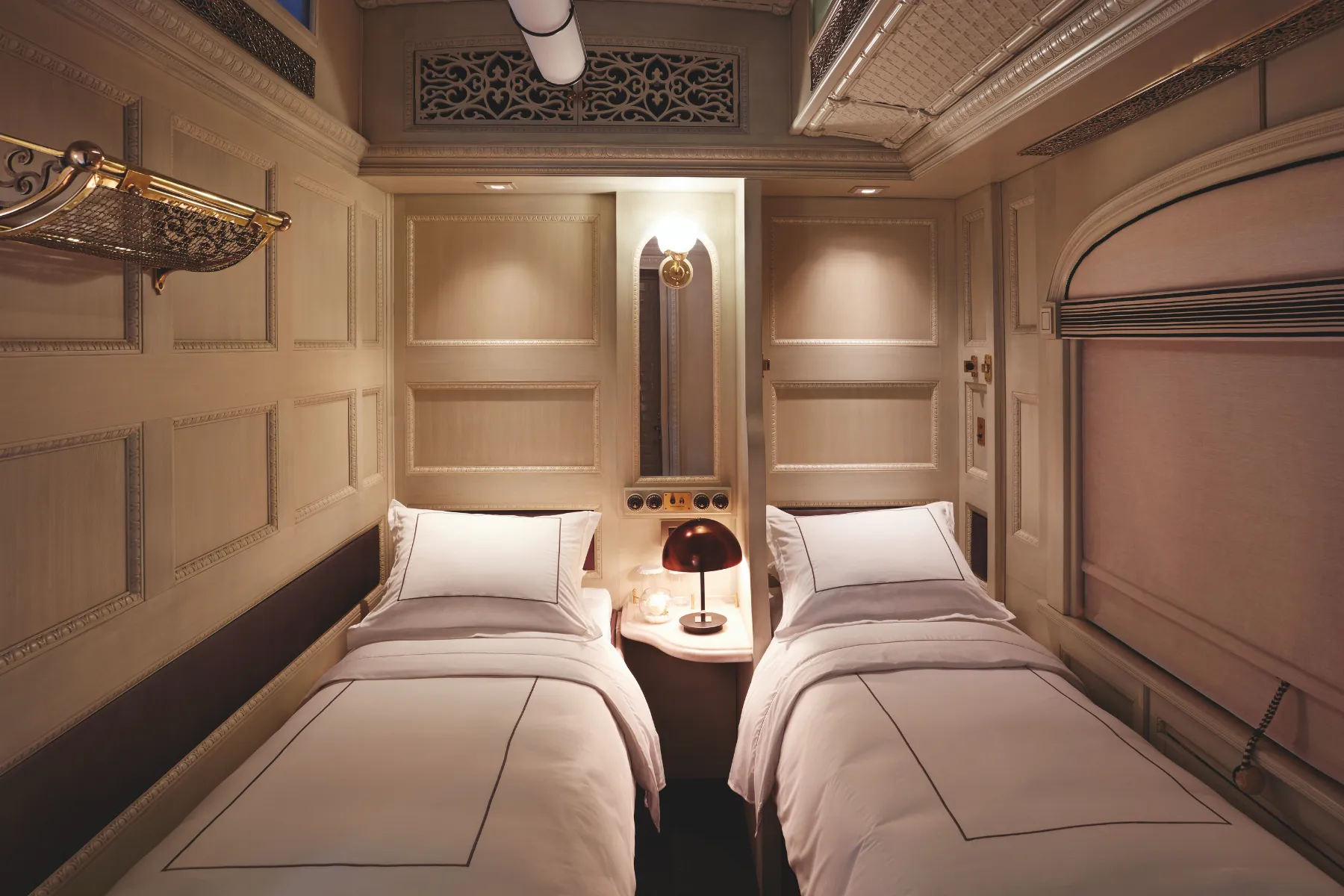
Muza Lab designed the brass cabin key in the shape of a chakana, a stepped Andean cross. It is a small, solid object to carry down a narrow corridor, a Peruvian detail on carriages that once ran in Australia as the Great South Pacific Express. When the London studio of Inge Moore and Nathan Hutchins refitted them for Peru, the designers worked with woven textiles and locally made pieces, keeping the timber panelling and painting it in pale linen shades.
In the compartments, the fabrics are close enough to examine at leisure. A patterned cushion takes up very little space, a consideration in a cabin that has to change jobs halfway through the day. In the twin, a long banquette offers somewhere to sit by the window. Stewards turn the compartment into two single beds for the night. The bunk cabin stacks the berths. Both have private showers. The suite has a permanent double bed, two chairs and a table, enough room for one person to read while the other watches the valley.
There is a recognisably British touch in the grey tweed of the Piano Bar Car, where a black grand piano sits among the sofas. Farther along, in the observation car, deep teal ceramic lamps and embossed leather chairs sit just inside the door to the open deck. The upholstery there draws on traditional Peruvian clothing. Outside, over the scrolled ironwork, you can follow a bend in the track all the way back to where it disappears.
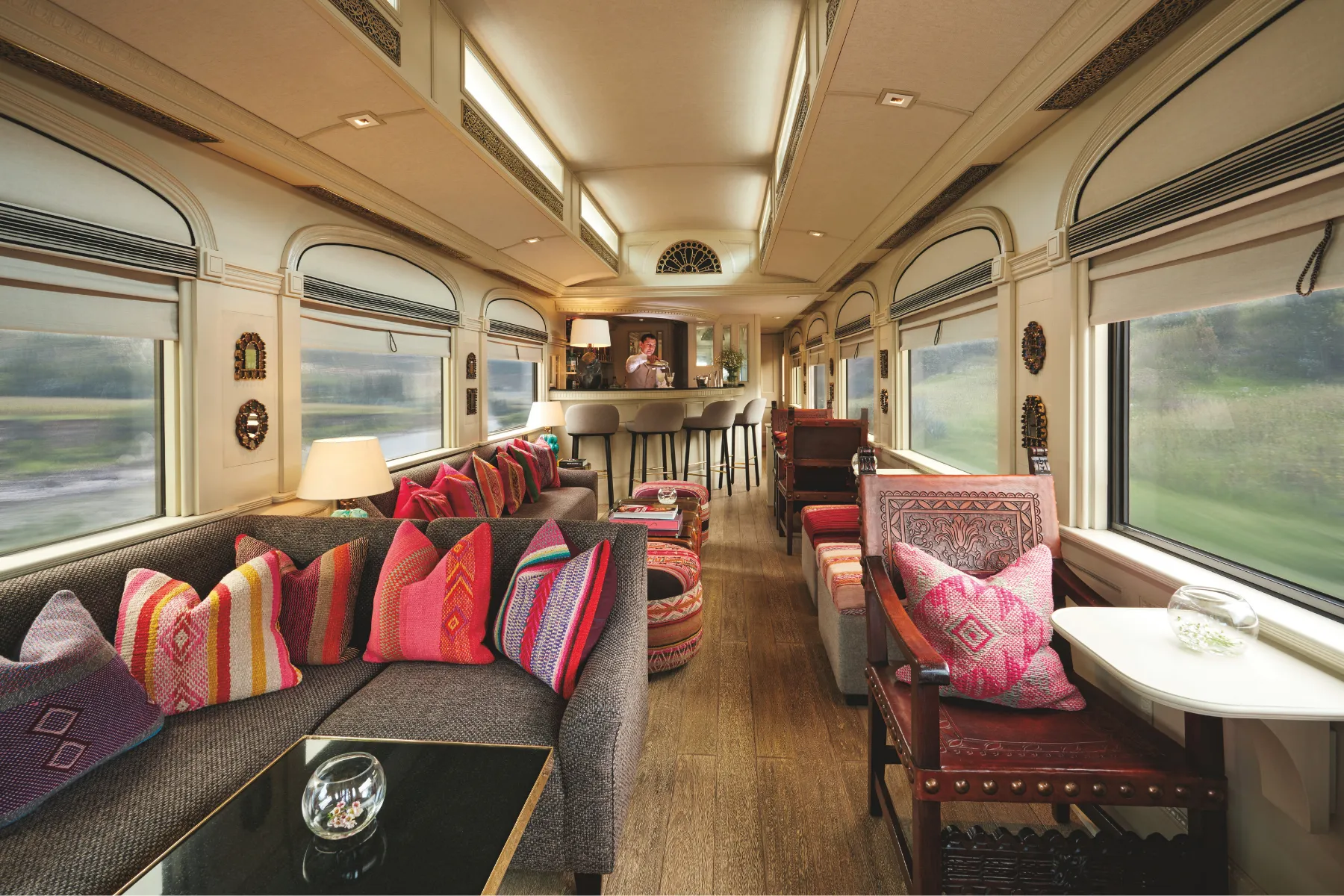
A few minutes on the deck also make sense of the room just inside it. At altitude the air can be sharp enough to send you back to an upholstered chair before you’ve had your fill of the view. From there the window holds a different sort of attention. Small changes become visible when there is time to watch for them, the last stand of trees or the point at which the fields give out. By the time the crew serves canapés in the piano car, the windows have gone dark. At dinner, the kitchen has its own account of the country outside.
3. The country on the plate
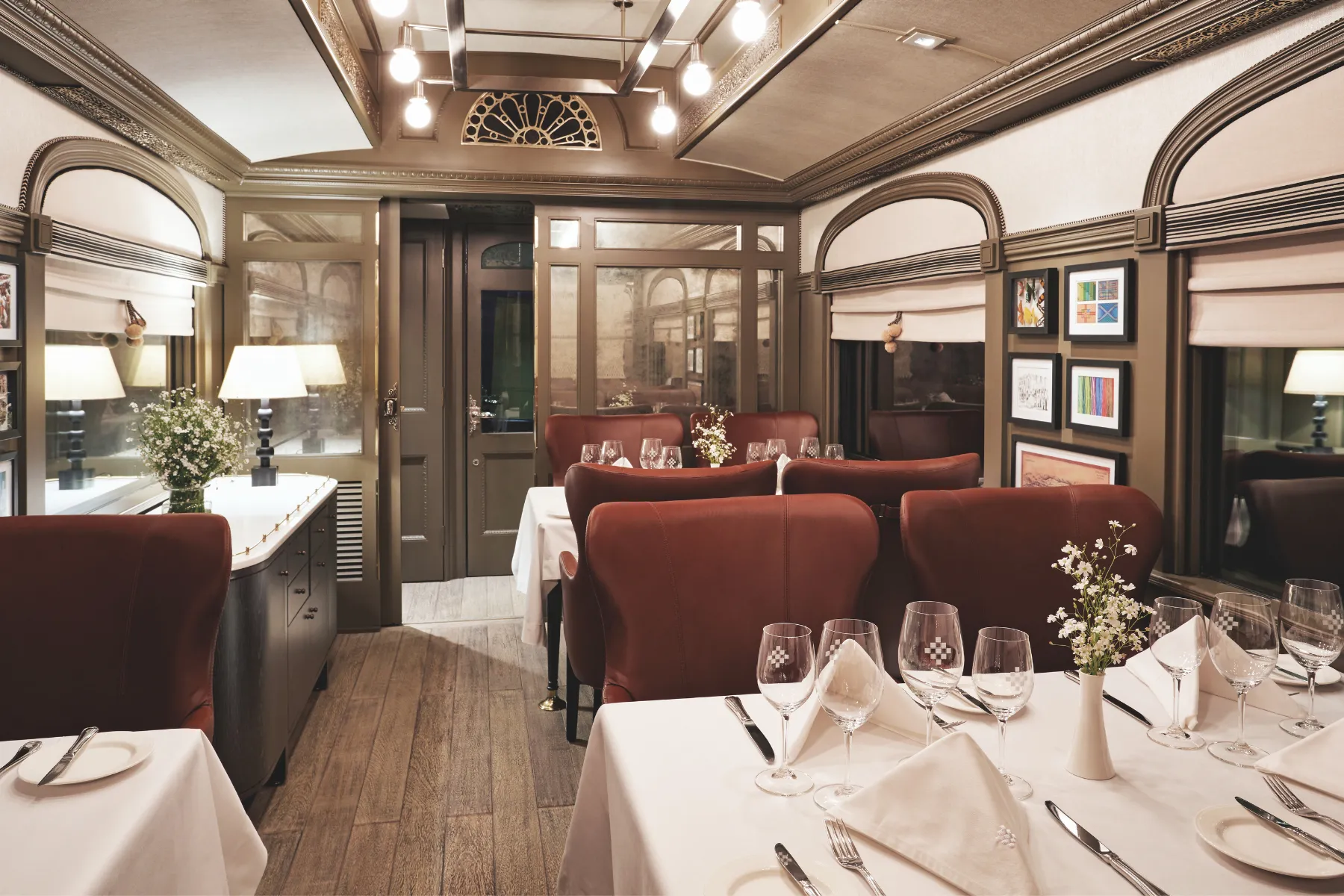
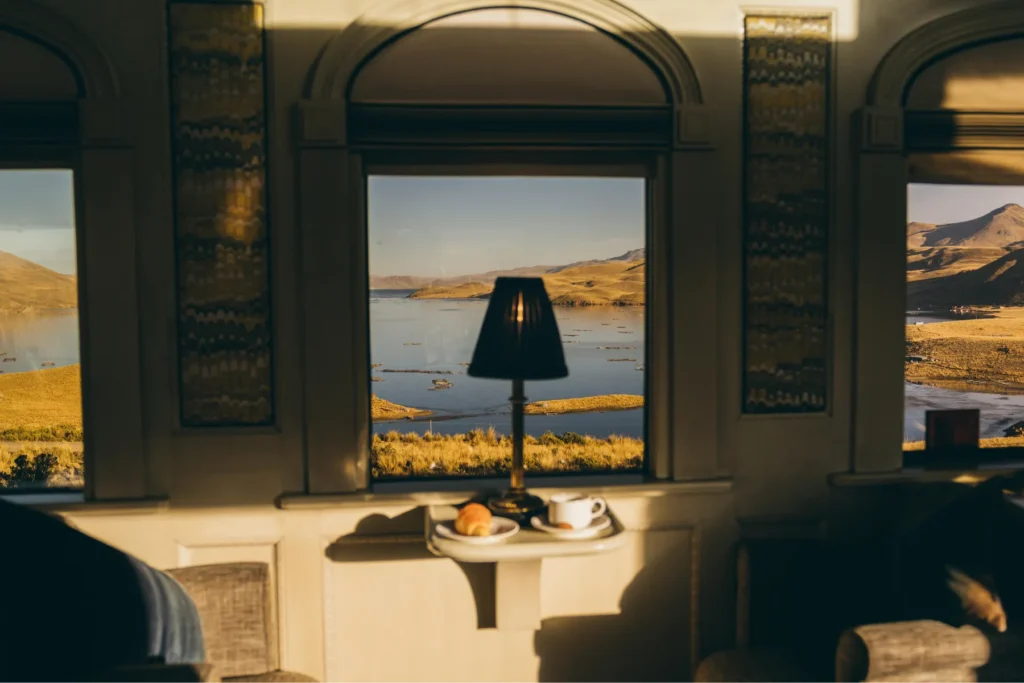
After La Raya, there comes a point when the dining-car window gives back the table. A glass has its double, as does the lamp above it. The first evening’s dinner is served while the train is still moving towards Puno. In Llama and Muña, the two restaurant carriages, the kitchen cooks with seasonal Andean ingredients. One published menu opens with cured trout, served with chestnut milk and trout roe. The seasoning is there in the ingredients themselves, in the salt of the roe and the savour of Parmesan.
The dishes that tell you most about the highlands are often the ones a menu gives the least space. Olluco, a tuber that grows alongside potatoes and oca in the Andes, turns up pickled beside a creamy corn purée and mushrooms dressed with teriyaki. The pickles have a job to do, cutting through the corn’s sweetness and the richness of the mushrooms. At another meal, Andean tubers are the substance of a kapchi. The name also belongs to a traditional highland stew made with broad beans. Here it turns up on the lunch menu with seaweed. You could eat twice in the same carriage and take away quite different ideas of what grows at these elevations.
There is an advance introduction to Arequipa in one lunch dessert. The kitchen borrows its queso helado, a milk ice perfumed with cinnamon, for a pavlova served with lúcuma. Anyone used to a soft-centred meringue under a drift of summer berries will recognise the form. The flavours belong to the other end of the railway. The choice of lúcuma, a fruit with a sweet, dense pulp, brings a mellow sweetness to the crisp meringue.
By morning the train has come to a standstill at the dock. Breakfast can be as familiar as eggs and toast, though the rotating menus also make room for a cold native potato from Puno with fried paria cheese and uchucuta, a chilli sauce. That is the breakfast to linger over if it’s offered. There is a little time between the first light on the lake and the boat departure, enough for a hot cup of coffee and a view of the shore the train reached in the dark.
4. Morning on Lake Titicaca
From Puno Muelle, the first daylight restores the depth that went out of the carriage windows the previous evening. The dock is close, then there is a stretch of water, then hills far enough away to seem only lightly attached to the land. Titicaca lies about 3,810 metres above sea level, with Peru on its western side and Bolivia to the east. The railway spends the night at the shore. In the morning the itinerary leaves it there, and the scale of the lake starts to become apparent from the boat.
Closer to Puno, the boat approaches islands made of the plant that grows in the shallows. The Uros build with totora. Blocks of its densely matted roots provide buoyancy, and layers of dried reeds, laid in alternating directions, make the surface people walk on. The upper reeds are replenished as those underneath decay. Ropes secure the islands to anchors in the lakebed. From the boat, the striking thing is how much of the settlement has the same pale colour. The reeds underfoot and the walls of a house begin as the same material, gathered from the water. Bundled and bound tightly together, those same reeds can be shaped into boats.
At Taquile, farther out on the lake, stone terraces step down the slopes. The published itinerary allows for lunch on the island and a visit to Collata beach. Some of the island’s most intricate work is worn. The chullo, a knitted hat with earflaps, and the wide woven calendar belt are among Taquile’s most distinctive garments. The belt carries motifs that mark agricultural and ceremonial cycles. Knitting and weaving are part of everyday life, and the cloth is worn on the island. In a few inches of a belt there is room to record the work that goes into a year.
Late in the afternoon, the train leaves Puno. The lake is broad enough that the morning’s crossing and the return can feel like journeys in their own right. Back in the carriage, a seat and a pane of glass change the view once again. There is still time before dinner to watch the land draw close as the line turns west. The next stop is Lake Saracocha, where the train is due well after dark.
5. After dark at Saracocha
Dinner is served before the Andean Explorer reaches Saracocha. The train spends its second night here, beside a lake with little artificial light around it. Titicaca announced itself by degrees at dawn. At Saracocha the most revealing thing to do, on a clear night, is to look up. The timetable leaves room for stargazing if the weather allows. It takes a few minutes for the eyes to adjust after the lit carriage, and the cold can make those minutes feel rather longer. A bright moon changes what there is to see.
In Misminay, a Quechua community near Cusco, residents described to the anthropologist Gary Urton a llama that takes shape in a dark stretch of the Milky Way. Two bright stars mark its eyes. Much of the animal is traced in the dark, where the stars thin out to the eye. It takes a particular sort of attention to recognise a figure that way. On a railway journey that has spent much of the previous day following the lines of shores and terraces, it is a good exercise in looking.
By breakfast the lake has a shoreline again. The train still has a morning in the high country before it makes for Arequipa, with a stop for the Sumbay caves in the Salinas and Aguada Blanca National Reserve. At about 4,100 metres, the site sits inland behind Misti. The cave paintings, made thousands of years ago, include human figures and animals in shades of white, cream, ochre and red. The pale outlines are the ones to look for first. Peru’s tourism inventory identifies vicuñas, guanacos, pumas and rheas. Several of the animals are shown in motion.
Farther along the line, there is a chance of seeing a vicuña in the open, a small, long-necked animal that can all but disappear into dry grass. The reserve protects its habitat as well as the country around the caves. At kilometre 93, passengers bound independently for the Colca Canyon can leave the train. For those staying on, there is lunch and the last stretch to Arequipa. A morning that starts beside a still lake can take you to a painted cave wall high in the Andes and back to a laid table by half past twelve.
6. Into Arequipa, the White City
On the approach to Arequipa, the broad high pastures begin to give way to the outskirts of a city. There may still be a volcano in the window when the first buildings crowd into view. The train is due at Arequipa station in the middle of Saturday afternoon, with time to reach the Plaza de Armas before the light goes. From the shade of the arcades, it is possible to watch that light move across the cathedral façade without having to go anywhere at all.
The stone that gives the White City its name is sillar, a volcanic rock that comes in pink as well as white. Look at the depth of an archway or the thickness of a wall and it becomes easier to see how the city has learnt to live with earthquakes. The same material takes the fine carving of a Baroque façade. Indigenous and European building traditions meet in that combination of heavy construction and intricate surfaces. A walk begun for the view across the square can slow to the pace of looking at a single doorway.
That change of scale is particularly clear at Santa Catalina. Behind the monastery walls runs a network of small streets, courtyards and cells. Some of the cells had their own kitchens, a domestic detail easily missed in a building of such size. In the Cloister of the Orange Trees, indigo walls meet the green of the leaves. The pale stone is still visible beneath the arches. After days in which the view has been framed by a train window, here it is the thickness of the walls that governs what can be seen at any one time.
Stay through Sunday morning and Arequipa offers another way of telling the time. At La Mundial, a traditional picantería, Sunday service begins early with adobo, a pork stew. There is also the city’s chicha de güiñapo, made from fermented black maize. The dining car made room for a taste of Arequipa a day or two before the city itself came into view. Here, the meal follows a local calendar, with a dish for Sunday and others for the working week. After two nights of measuring the days by lakes and railway stops, a bowl of stew can tell you both the place and the day of the week.
Pre-departure stay
Palacio del Inka, Cusco
Stone archways and gilded antiques fill this five-century-old mansion opposite Qorikancha, the Inca Temple of the Sun. Wanchaq station is about eleven minutes away on foot. An evening here gives Cusco’s stonework its due before the railway carries you south to Raqchi.