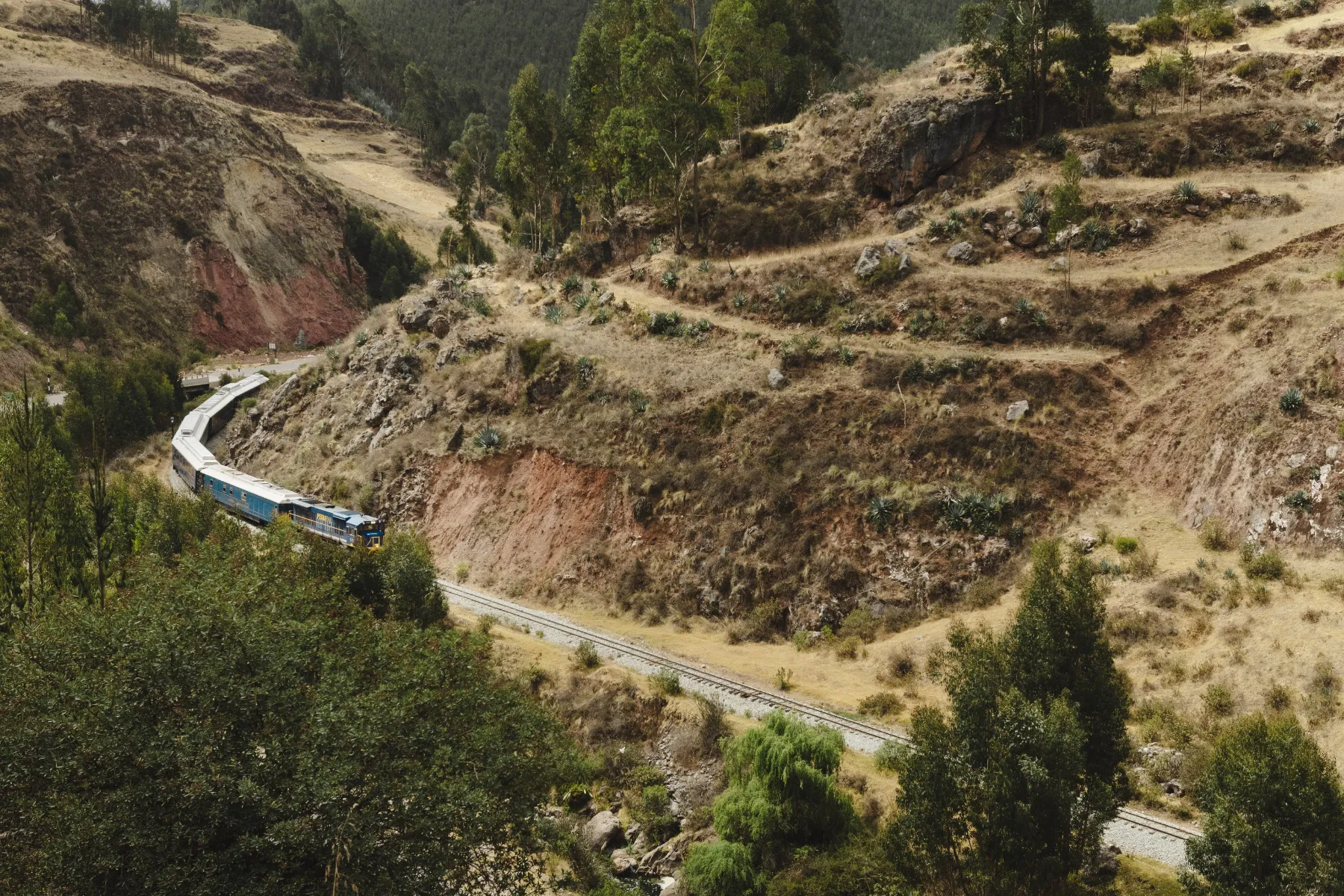
Belmond Hiram Bingham: The Art of Arriving Slowly
High in the Peruvian Andes, the Belmond Hiram Bingham exchanges haste for polished wood, white linen and the quiet theatre of railway travel. Following the Urubamba River towards Machu Picchu, this intimate Pullman-style train reveals a landscape best appreciated at the measured pace of the rails.
JOURNEY AT A GLANCE
Hiram Bingham, A Belmond Train
ROUTE
Poroy (Cusco) – Sacred Valley – Machu Picchu Pueblo (Aguas Calientes), with a seasonal service via Rio Sagrado, Urubamba, and selected one-way alternatives.
BEST SEASON
May to September for generally drier, clearer conditions; April and October for fewer visitors and more variable weather.
DURATION
Approximately 3 hours 20 minutes outbound from Poroy; a full return excursion of approximately 12 hours. The seasonal Rio Sagrado return excursion takes approximately 11 hours.
STARTING FARE
Approximately £840 per person return, converted from a published 2026 starting reference of US$1,100. Includes onboard dining, selected drinks, live music, observation carriage access, and scheduled Machu Picchu excursion services. Entrance is subject to ticket availability.
A Blue Departure from the Andes
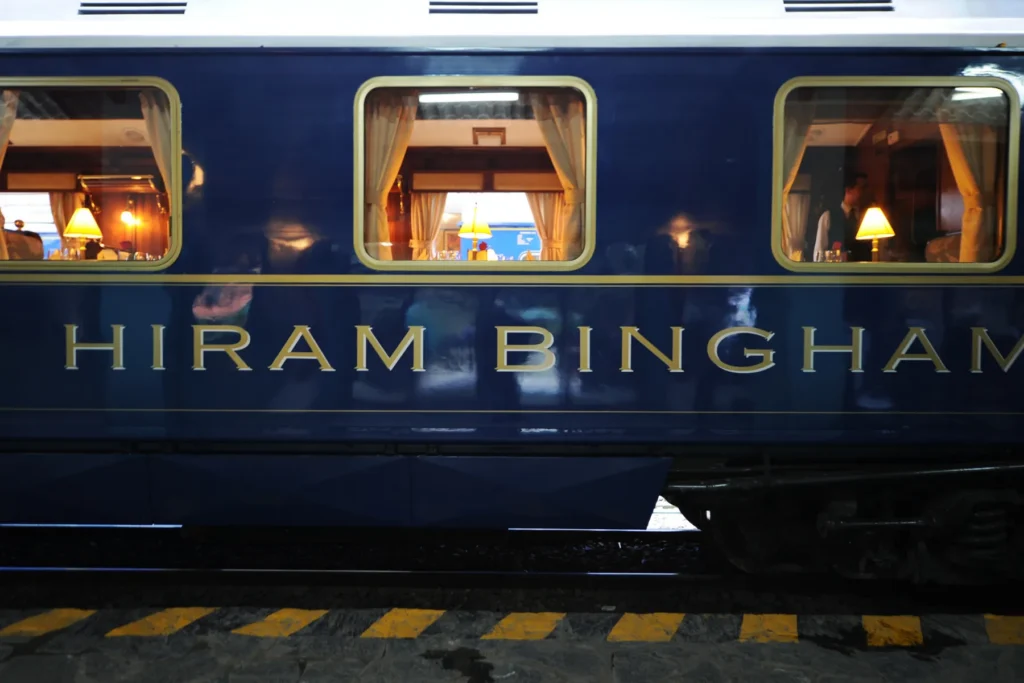
The carriages are an improbable shade of blue against the Peruvian mountains.
At Poroy station, beyond the crowded streets and red-tiled rooftops of Cusco, the Belmond Hiram Bingham stands on the platform with the composure of a train belonging to another age. Its dark blue livery, gold lettering and broad windows suggest a world in which departure was once an occasion, rather than a minor inconvenience between security checks and boarding announcements.
There is something pleasingly theatrical about it all. The mountain air carries a morning chill. Somewhere beyond the platform, the hills rise in dusty folds, their contours sharpened by the Andean light. Here, at an altitude of almost 3,500 metres, even the simple business of boarding a train feels a little removed from ordinary travel.
The Hiram Bingham takes its name from the American explorer whose 1911 expedition brought Machu Picchu to international attention. The association is not without complications. The Inca city was never entirely unknown to local people, and its modern history belongs as much to the Quechua communities of the region as to the foreign expeditions that subsequently popularised it.
It is a distinction worth remembering. The railway may borrow the language of early twentieth-century exploration, but the country through which it passes has a history infinitely older and more sophisticated than the train’s nostalgic appearance might suggest.
Once aboard, the immediate pleasure is one of contrast.
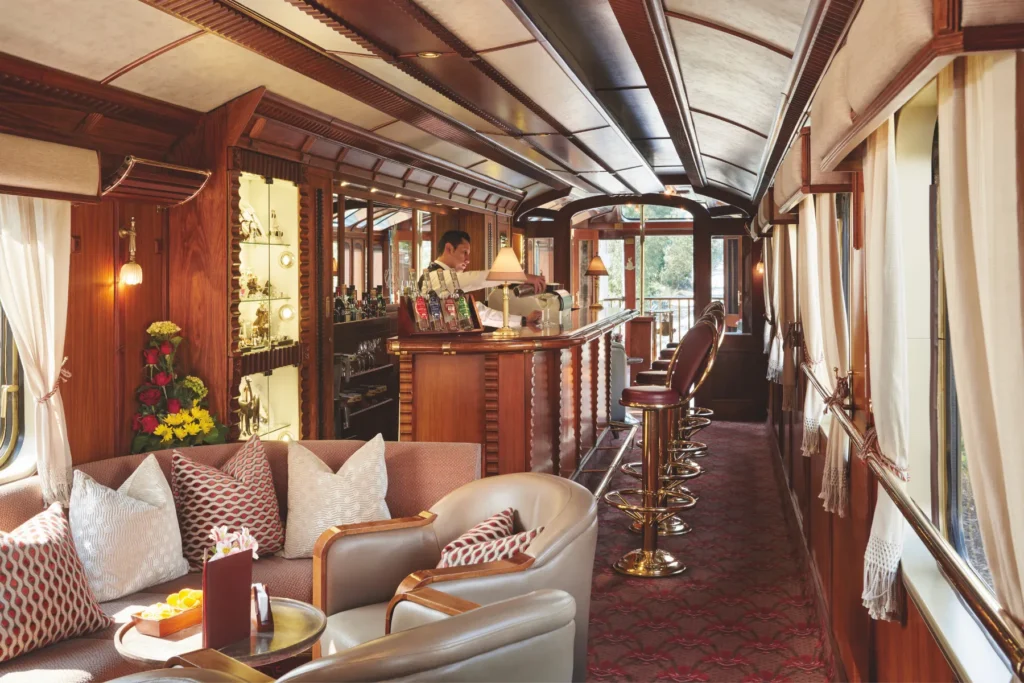
Outside lie steep mountains, cultivated terraces and settlements shaped by centuries of Andean life. Inside, there are upholstered armchairs, small shaded lamps and the restrained gleam of polished timber. The atmosphere recalls the great Pullman carriages of Britain, although the landscape beyond the glass could hardly be less English.
The comparison is architectural rather than historical. Unlike an original Edwardian train, the Hiram Bingham is a modern experience styled in the manner of the 1920s, a carefully composed tribute to the period when railway journeys were occasions for dressing properly, lingering over lunch and looking out of the window.
And looking out is precisely the point.
As the train leaves Poroy, the urban edges of Cusco fall away. The railway negotiates the descending terrain towards the Sacred Valley, where the Urubamba River will eventually become its travelling companion. The landscape begins to open, revealing fields, scattered houses and mountain walls that seem to change colour as the sun moves across them.
There is no particular reason to reach for a telephone.
For the next few hours, the finest entertainment is already passing the window.
The Art of Travelling in Another Century
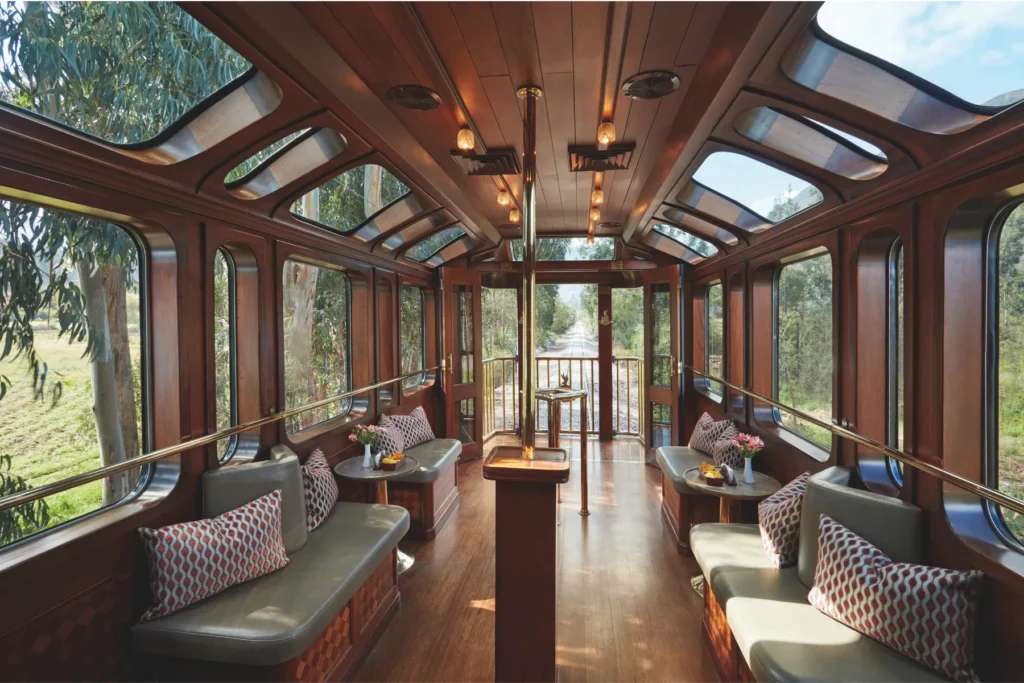
The first thing one notices inside the Hiram Bingham is the wood.
Not simply its abundance, but the way it has been used. Polished panelling runs along the carriage walls; decorative marquetry introduces a more intricate grain; brass fittings catch the daylight without demanding attention. Against the timber, the upholstered seats and pale curtains bring a softness that keeps the interiors from becoming an elaborate exercise in nostalgia.
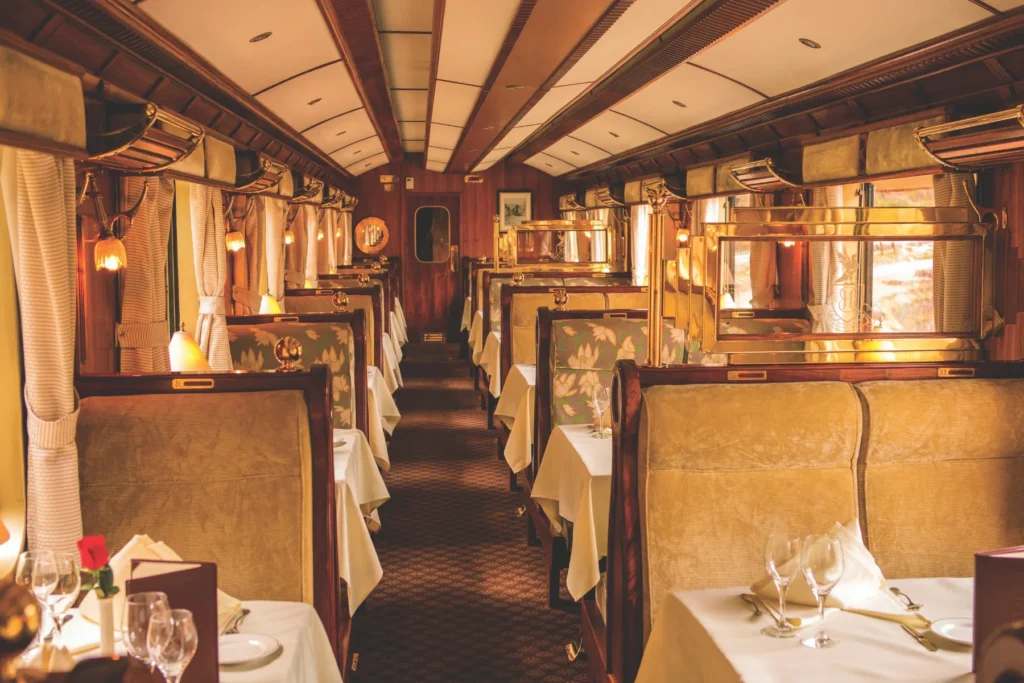
The effect is closer to a well-preserved private club than a contemporary train.
Small lamps sit beside the windows, their warm pools of light lending the tables an intimacy unusual in railway travel. White linen is arranged with unhurried precision. Glassware is delicate, the cutlery reassuringly substantial. There is a sense that somebody has considered not merely where passengers will sit, but how they might wish to spend the hours once seated.
It is a distinction easily overlooked in an age when railway interiors are generally judged by the number of charging sockets and the reliability of the wireless connection.
Belmond’s carriages take their inspiration from the Pullman tradition that once shaped some of Britain’s most celebrated trains. The reference is unmistakable, although there is no attempt to reproduce the formality of an English dining carriage in its entirety. The setting is decidedly South American, its atmosphere animated by Peruvian hospitality and the music that forms part of the journey.
Indeed, the Hiram Bingham is not a train particularly suited to solitary contemplation throughout.
Its restaurant carriages encourage conversation, while the bar offers a more informal meeting place. Live musicians introduce another dimension to the experience, and the rhythm of the journey can become distinctly convivial. Those expecting the silence of a private sleeper compartment may find the atmosphere more spirited than anticipated.
Yet the most compelling space aboard is arguably the observation carriage.
Here, the arrangement of windows and the open-air viewing platform allow the landscape to assert itself more completely. The Urubamba Valley is not scenery that submits easily to a conventional frame. Its scale requires movement: a glance upstream, a turn towards the mountains, the sudden appearance of a settlement on the opposite bank.
From the platform, the railway’s physical character becomes apparent. The carriages lean gently into the curves. The wheels maintain their persistent metallic conversation with the track. Mountain air moves freely through the space, carrying the earthy scent of vegetation and, occasionally, the sharper freshness of river water.
It is an unusually immediate way to experience a landscape that might otherwise be reduced to photographs.
The observation platform also restores something that modern travel has largely misplaced: the pleasure of standing between departure and arrival, with no useful occupation beyond watching the world pass.
There are no sleeping compartments aboard the Hiram Bingham, nor is there any pretence that this is a transcontinental expedition. The train is a relatively brief passage through the Andes, its principal purpose to connect the ancient city of Cusco and the Sacred Valley with the extraordinary archaeological site of Machu Picchu.
Its achievement lies in making those intervening hours feel important in their own right.
For all the polished brass and immaculate linen, the real sophistication is not in the furnishings. It is in the understanding that a journey need not be long to deserve our full attention.
And somewhere beyond the next bend, the river is waiting.
Where the Urubamba Sets the Pace
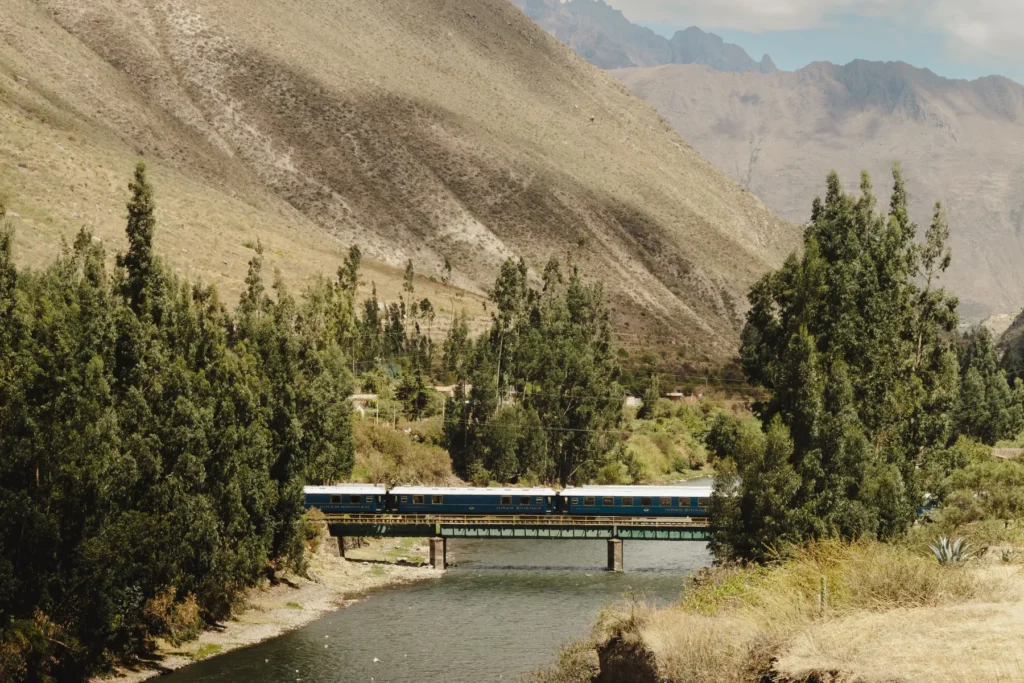
The river appears almost without ceremony.
One moment, the train is threading its way between cultivated fields and the steep shoulders of the Andes; the next, the Urubamba is running alongside the tracks, its pale, restless water catching the afternoon light. It is not a river inclined towards stillness. Fed by the mountains, it moves with an urgency entirely at odds with the measured progress of the Hiram Bingham.
For much of the journey towards Machu Picchu, the railway follows the river’s course through a landscape that changes almost imperceptibly at first, then with remarkable speed.
The Sacred Valley is often described in terms of its Inca remains, and understandably so. Yet its agricultural character is equally revealing. Fields occupy the flatter ground, while terraces climb the hillsides in neat, improbable steps. Small settlements appear between stands of eucalyptus, their adobe walls and red roofs suggesting a continuity of daily life that the train, for all its elaborate comforts, merely passes through.
This is a working landscape, not a decorative backdrop.
The railway itself is part of a more recent chapter in the valley’s history. The line connecting Cusco with Machu Picchu developed during the twentieth century, opening a route through terrain that had previously demanded considerably more effort to cross. Its construction altered the relationship between the mountains and the outside world, eventually making one of South America’s most celebrated archaeological sites accessible to an international audience.
Through the observation carriage windows, that history becomes a matter of geography.
Mountains rise almost vertically from the valley floor. Their lower slopes are green and heavily textured, while the higher ridges disappear into layers of cloud. At certain bends, the river presses close enough to the railway for its turbulence to become briefly audible above the wheels.
The changing vegetation provides another measure of the descent. The relatively open Andean countryside gradually yields to denser foliage, moss-covered rock and the humid exuberance of the cloud forest. Ferns emerge beside the tracks. Trees lean across the river. The light becomes softer, filtered through leaves and the shadows of increasingly steep valley walls.
The transition is surprisingly intimate. Rather than surveying the mountains from a distant viewpoint, passengers travel through their changing environments, observing details that would disappear at greater speed.
There is a particular satisfaction in watching the landscape without trying to identify every peak or settlement. The scenery does not require constant interpretation. Sometimes a stretch of river, a patch of sunlight on an agricultural terrace or the sight of a solitary house is sufficient.
The Hiram Bingham provides ample opportunities for photographs, but its most enduring impressions are likely to be those that resist the camera: the smell of damp earth, the changing temperature of the air, the momentary darkness beneath an overhanging cliff.
In the Andes, distance is deceptive. Mountains that appear close remain stubbornly beyond reach, while the railway continually reveals another bend, another valley, another unexpected opening in the landscape.
The train moves onwards, and the river keeps pace.
Dining Between Mountain and River
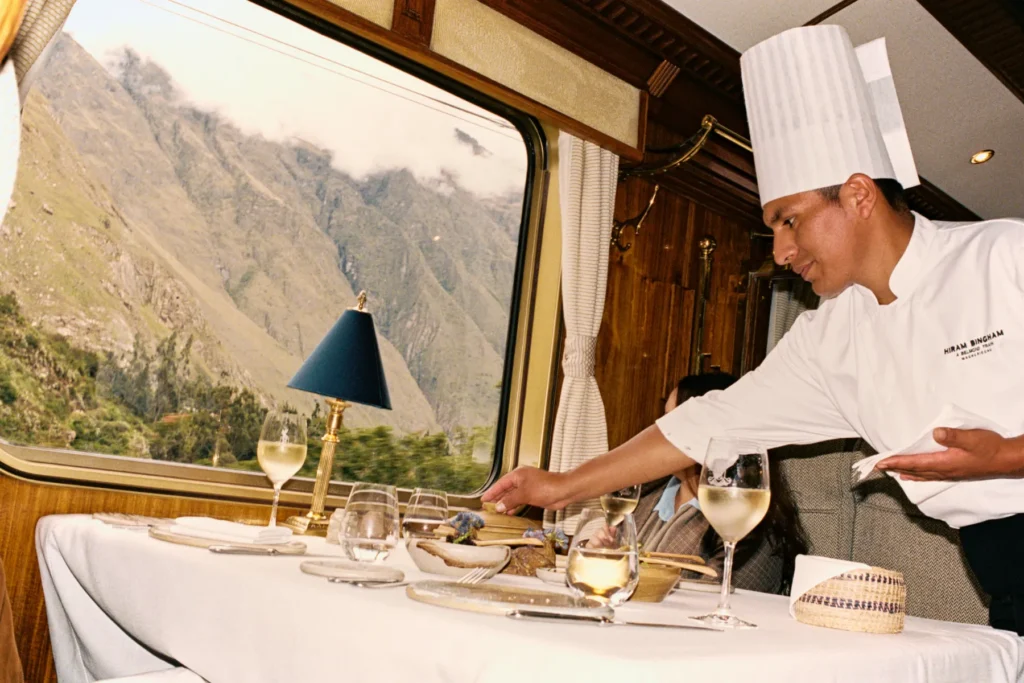
Lunch aboard the Hiram Bingham begins with the gentle choreography of a dining carriage finding its rhythm.
Glasses are arranged, napkins unfolded, and the quiet movements of the service team become part of the journey’s background music. Beyond the window, the mountains continue their slow procession. Inside, the atmosphere is more intimate, softened by table lamps and the warm tones of the polished wood.
There is something particularly satisfying about eating properly on a train.
Perhaps it is the contrast between movement and ceremony: the knowledge that the table is travelling through the Andes while everything upon it has been arranged as though in a stationary restaurant. The occasional sway of the carriage introduces a small degree of unpredictability, which only makes the precision of the service more impressive.
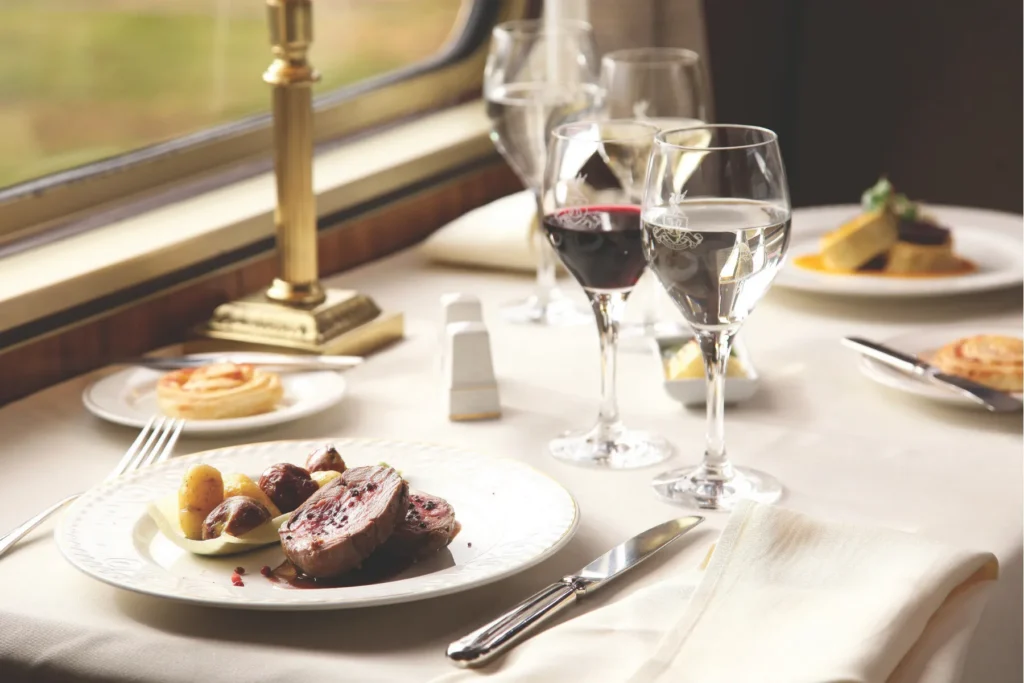
The Hiram Bingham’s dining experience draws upon Peru’s considerable culinary heritage, presenting regional ingredients through a contemporary fine-dining approach. The menu changes, but its underlying inspiration is unmistakably Peruvian.
Andean potatoes, cultivated in an astonishing variety of colours and textures, belong to a food culture developed over thousands of years. Quinoa, once central to the diets of highland communities, has travelled far beyond its origins. Peruvian corn, with its substantial kernels and distinctive sweetness, offers another reminder that the country’s culinary identity begins with its remarkable agricultural diversity.
Such ingredients need little embellishment when handled thoughtfully.
Peruvian gastronomy has become internationally fashionable, particularly through Lima’s influential restaurant scene, but its foundations remain deeply regional. The cooking of the highlands differs considerably from that of the Pacific coast, while the Amazon contributes an entirely different collection of ingredients and traditions.
A journey between Cusco and Machu Picchu offers a particularly appropriate setting in which to appreciate this diversity. The surrounding landscape is not merely scenery; it is part of the agricultural and cultural geography from which much of the country’s food originates.
The drinks service introduces its own distinctly Peruvian character.
Pisco, the grape spirit at the heart of the country’s most recognisable cocktail, is a natural starting point. A well-made pisco sour balances citrus, sweetness and the spirit’s aromatic warmth with a delicacy that belies its apparent simplicity. Peruvian wines may also feature, alongside international selections chosen to complement the meal.
Yet it would be a mistake to approach dining aboard the Hiram Bingham as a conventional restaurant review. The kitchen operates within the practical limitations of a moving train, and the experience is inseparable from its setting.
A beautifully presented dish is one pleasure. Looking up from it to discover that the carriage is passing between two immense mountain walls is quite another.
There is time to linger, to watch the changing light and to allow conversation to wander away from the business of the day. The service is attentive without requiring passengers to participate in an elaborate performance of refinement.
For those accustomed to railway journeys measured in sandwiches and hurried cups of coffee, the experience offers a gentle correction.
The finest part of lunch may not be a particular course at all, but the luxury of having nowhere else to be.
Eventually, plates are cleared, glasses emptied and the landscape begins to demand attention once more. The valley narrows, the vegetation grows denser, and the train continues towards the small mountain town of Aguas Calientes.
Machu Picchu is drawing closer.
For the moment, however, there is still a river to follow, another bend to negotiate and perhaps time for one final coffee before the journey enters its last remarkable stretch.
The Mountain Beyond the Last Station
The final approach to Machu Picchu is a lesson in the art of concealment.
For much of the journey, the railway has followed the Urubamba River through a succession of increasingly narrow valleys. Now the mountains seem to close around the train. The vegetation grows dense, the air takes on the damp warmth of the cloud forest, and the river disappears intermittently behind great outcrops of dark stone.
There is little to suggest that one of the world’s most extraordinary archaeological sites lies somewhere above.
The Hiram Bingham arrives at Machu Picchu Pueblo, more commonly known as Aguas Calientes, a compact riverside town where railway tracks, restaurants and steep green mountains compete for space. It is an unlikely gateway to an ancient royal estate, but then Machu Picchu has always been a place that resists ordinary expectations.
The journey continues by road, climbing through the forest towards the archaeological sanctuary. At each turn, the valley falls further away. The river becomes a distant thread, and the mountains rise in densely wooded folds, their summits frequently concealed by moving cloud.
Then, quite suddenly, the ancient city comes into view.
No photograph entirely prepares one for the relationship between architecture and landscape. The terraces appear to descend into empty space, while stone buildings occupy a narrow ridge between mountains whose scale makes the structures seem impossibly delicate.
Yet there is nothing fragile about the engineering.
Constructed during the fifteenth century, probably under the Inca ruler Pachacuti, Machu Picchu demonstrates an extraordinary understanding of drainage, agriculture and stone construction. Its buildings were adapted to the mountain rather than imposed upon it, their carefully fitted masonry accommodating both difficult terrain and a region prone to seismic activity.
The more closely one looks, the less mysterious the place becomes, and the more impressive.
Its modern international reputation is inseparable from Hiram Bingham’s 1911 expedition. But the familiar story of an American explorer discovering a forgotten city requires considerable qualification. Local residents knew of the ruins, and the site had been visited before Bingham arrived, guided by people with knowledge of the surrounding mountains.
Today, Peruvian archaeologists, historians and conservation specialists continue to reshape understanding of the citadel and its place within the wider Inca world.
Such context matters particularly on a journey whose train bears Bingham’s name. The romance of exploration is an attractive inheritance, but it should never obscure the knowledge, labour and cultural history of the people who lived here.
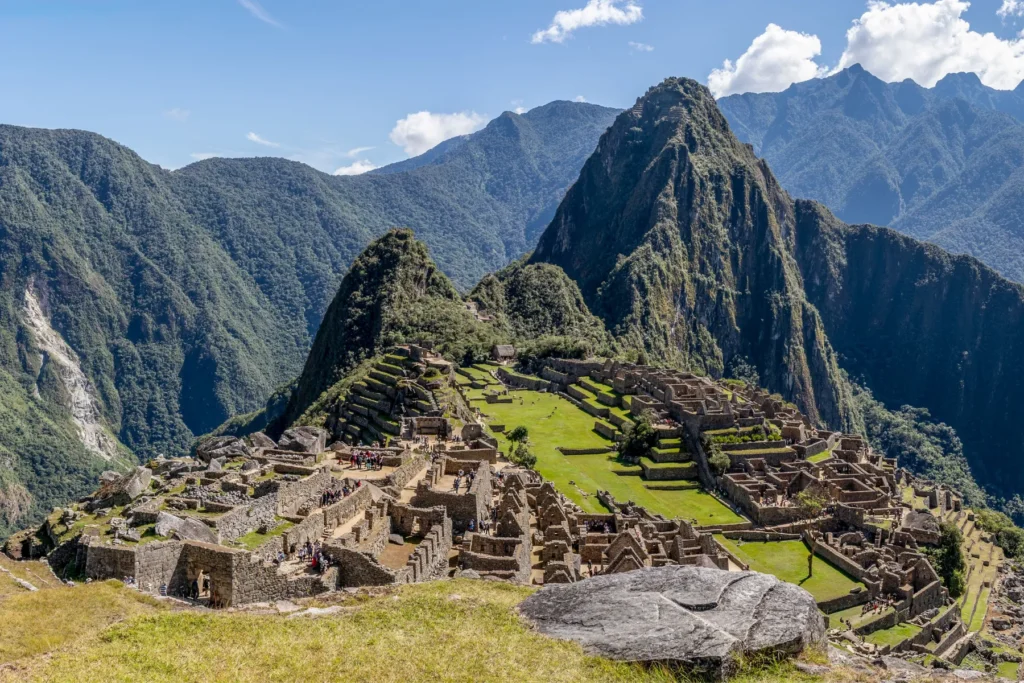
Time at Machu Picchu is necessarily structured. Visitor numbers are controlled, and access follows designated circuits, limiting the freedom to wander that earlier generations of travellers enjoyed. Yet these restrictions serve an essential purpose in protecting a site exposed to the considerable pressures of international tourism.
There is still space for a quieter encounter.
A wall of precisely cut stone. A staircase disappearing between terraces. The movement of cloud across the neighbouring peaks.
Beyond the famous viewpoint, it is often these smaller details that remain.
A Different Kind of Return
By the time the Hiram Bingham begins its return journey, the mountains have become silhouettes.
The day has been spent among stone terraces and ancient walls, negotiating the steep approaches to Machu Picchu and trying, with limited success, to comprehend the scale of the Inca achievement. Now there is an altogether different task at hand: settling into a comfortable chair and allowing the railway to carry the evening forwards.
Outside, the last light withdraws from the valley.
Inside, the dining carriages acquire a more intimate character. Small lamps illuminate the tables, glassware catches occasional reflections, and the polished wood seems darker and richer than it did in the morning. Beyond the windows, the river is reduced to a presence rather than a view, its course sometimes suggested by the pale movement of water beneath the night sky.
Dinner is served as the train makes its way back through the Sacred Valley.
The return meal is a more elaborate affair, with several courses providing a leisurely framework for the evening. There is pleasure in the small rituals: the arrival of a plate, a glass replenished, a conversation resumed after a brief interruption from the movement of the carriage.
It is dining without the usual distractions of a restaurant.
There is no neighbouring street to observe, no procession of late arrivals, no temptation to consult the time between courses. The world beyond the glass is largely dark, and the attention naturally returns to the people around the table.
Elsewhere aboard, the atmosphere becomes livelier.
The Hiram Bingham’s musicians bring a distinctly Peruvian character to the journey, and the bar carriage offers an opportunity to exchange the formality of the dining table for something more sociable. A pisco sour feels entirely appropriate, although the pleasure lies as much in the conversation as in the drink itself.
Not every passenger will welcome the music with equal enthusiasm. Those who favour the restrained silence of a traditional sleeping car may find the evening more exuberant than expected. Yet this is part of the train’s particular personality. The Hiram Bingham is less an exercise in private seclusion than a shared celebration of travel.
And there is something rather appealing about that distinction.
The great European trains of the past understood that railway journeys could be social occasions, their dining and lounge carriages offering encounters that ordinary life rarely arranged. On the Hiram Bingham, this tradition survives in a warmer, less ceremonious form, accompanied by Andean landscapes and Peruvian hospitality.
As the train approaches its final station, the evening begins to gather itself into memory.
The day has been comparatively brief, certainly when measured against the great transcontinental journeys. There have been no sleeping compartments, no dawn arrivals in unfamiliar cities, no leisurely mornings watching the countryside emerge from behind a cup of tea.
Yet the absence of these familiar ingredients has not diminished the experience.
The Hiram Bingham demonstrates that slow travel is not necessarily a question of distance or duration. It is an attitude towards the hours between places, an acknowledgement that the journey deserves attention rather than merely endurance.
The polished timber, the dining service and the carefully preserved railway rituals are all part of the pleasure. But what remains longest is something less tangible: the movement of the Urubamba through the mountains, the changing light on the terraces, the brief sensation of standing on an observation platform with the wind moving past one’s shoulders.
Eventually, the train returns to the station and the outside world resumes its ordinary demands.
For a few hours, however, there has been no particular reason to hurry.
And that, perhaps, is the finest thing it offers.
Pre-departure stay
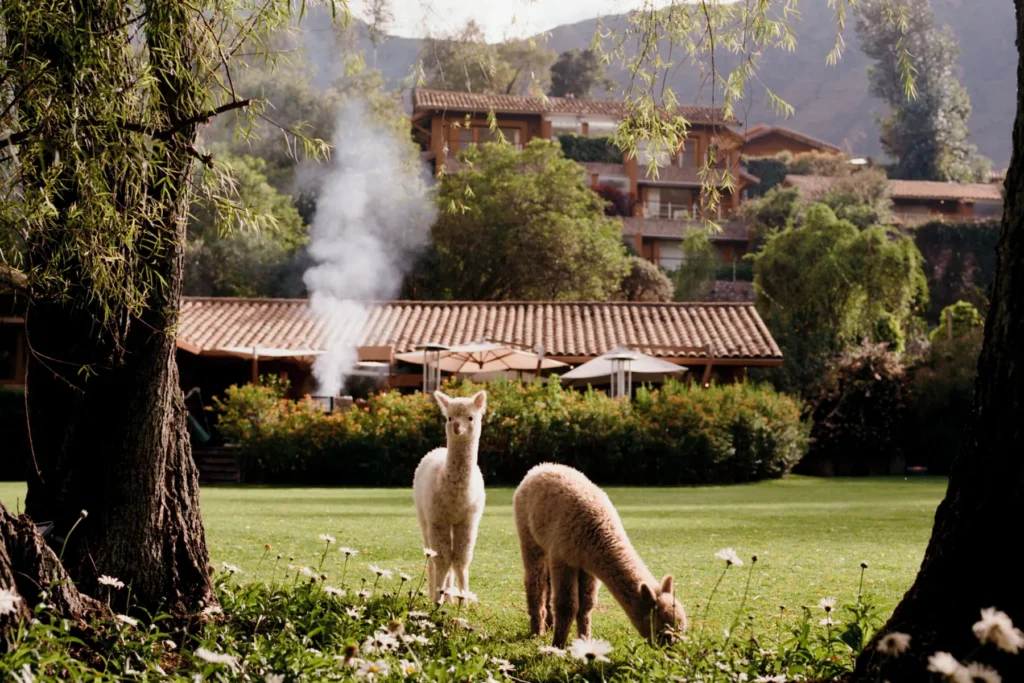
Rio Sagrado, A Belmond Hotel
Set amid terraced gardens beside the Urubamba River, Rio Sagrado combines understated Andean architecture with an exceptional railway convenience: its own private Hiram Bingham station. Morning begins among mountain views before the journey continues directly from the hotel’s grounds.
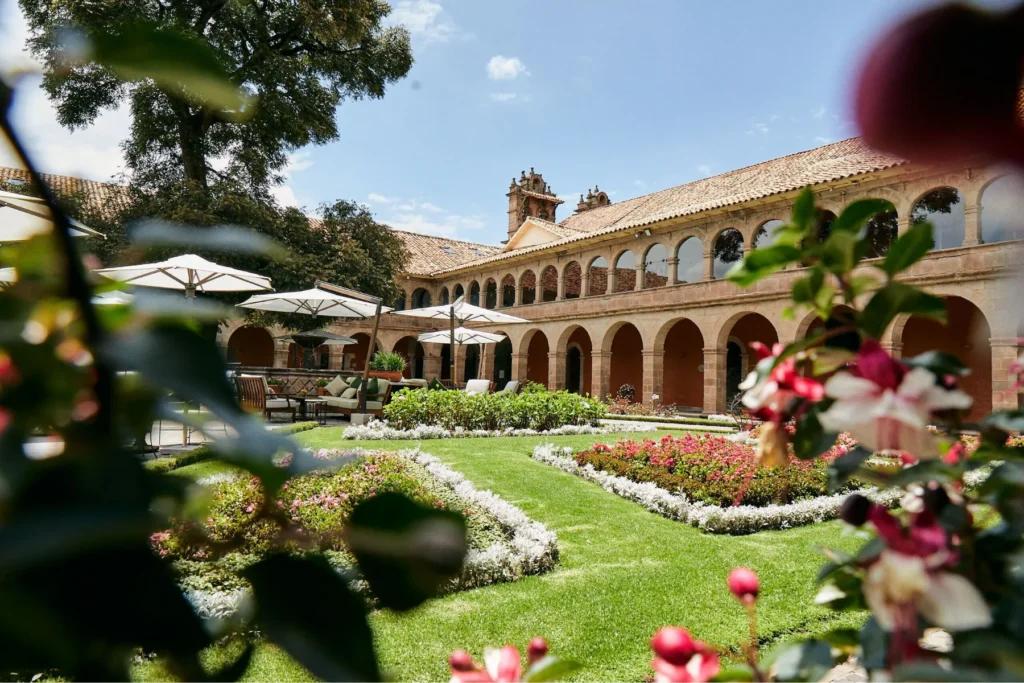
Monasterio, A Belmond Hotel
Occupying a former sixteenth-century monastery near Cusco’s Plaza de Armas, Monasterio offers cloistered courtyards, colonial paintings and centuries of architectural character. A pre-arranged road transfer to Poroy station makes this historic retreat a fitting prelude to the railway journey.