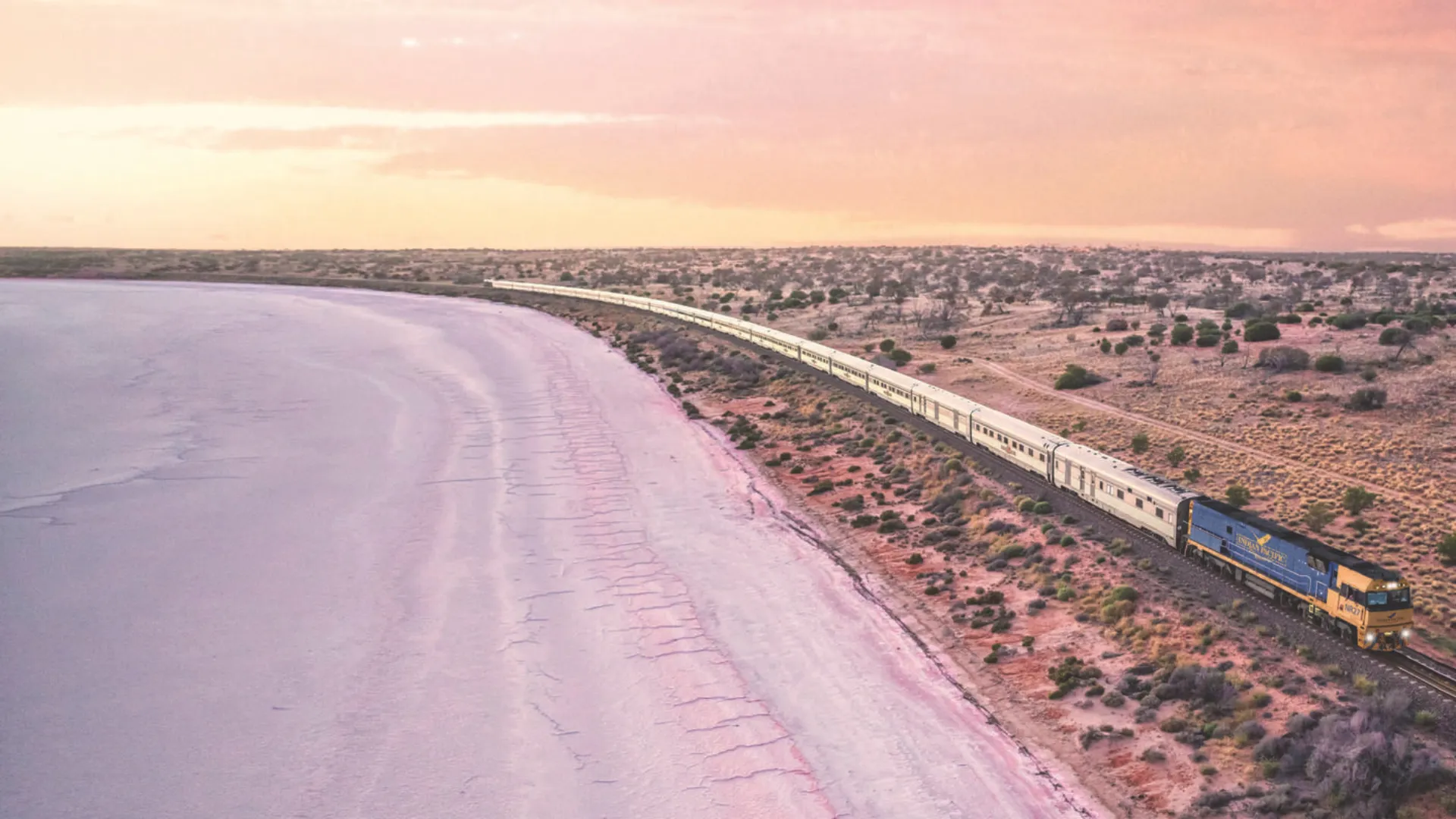
Indian Pacific: The Long Way to the Other Ocean
Between Sydney’s sandstone platforms and the western edge of Australia, the Indian Pacific crosses a continent in four days. Beyond the walnut interiors and carefully laid tables lies its greatest pleasure: watching a country change slowly enough to begin to understand the distance.
JOURNEY AT A GLANCE
Indian Pacific — Sydney to Perth
ROUTE
Sydney Central–Blue Mountains–Broken Hill–Adelaide–Cook–Rawlinna–East Perth Terminal. Westbound services operate year-round. Rawlinna’s outdoor dinner is scheduled September–May, with bonfire drinks and canapés in the cooler months, subject to weather. Eastbound journeys follow a different excursion programme.
BEST SEASON
March–April or September–October are the editorial recommendation for generally comfortable sightseeing conditions and the seasonal Rawlinna dinner. Pack for temperature changes throughout the crossing.
DURATION
Four days, three nights westbound; five days, four nights eastbound. Shorter sectors connecting with Adelaide are also available.
STARTING FARE
Starting Fare: Approximately £1,528 per person in Gold Single, or £1,630 per person sharing Gold Twin, based on the current published June–July 2027 Advance Purchase fares of A$2,990 and A$3,190 respectively. Includes three nights aboard, scheduled meals, the included drinks selection and off-train experiences; excludes flights and additional hotel nights. Sterling conversions use A$1 = £0.5110, checked on 17 November 2026. Subject to availability and fare conditions. These current website prices supersede the lower brochure figures quoted in the initial research notes.
Under the Clock at Sydney Central
Above Sydney Central, the sandstone clock tower keeps time for people who have considerably less of it. Below, commuters consult screens and hurry towards platforms. The Indian Pacific has another proposition: Perth, four days away. Its silver carriages suggest the scale of the undertaking before a wheel has turned.
Central’s main building opened in 1906; the tower followed in 1921. There is something reassuringly Edwardian about this architecture of departure, its conviction that a railway station should lend consequence to the act of going somewhere. The sandstone has the appropriate gravity for a journey of 4,352 kilometres.
The route leads west through the Blue Mountains, then towards Broken Hill, Adelaide and the Nullarbor before entering Western Australia. Sydney’s harbour does not provide a ceremonial farewell from the window. Instead, the city must be worked through: tracks, suburbs, the accumulated edges of a metropolis. Only gradually does the landscape acquire room to breathe. The progression matters. Australia’s interior deserves an approach.
For all its associations with grand railway travel, the Indian Pacific belongs to a comparatively recent chapter. Its inaugural departure from Sydney was on 23 February 1970, following the completion of a continuous standard-gauge connection across the country. Previously, incompatible railway gauges had complicated the crossing. The achievement was wonderfully practical: passengers could finally travel between these distant coasts without changing trains because the rails had changed their minds about their width.
That history gives the journey its particular character. The silver exterior suits a train born in an age of engineering confidence. Its romance comes from the line itself: the possibility of sitting down in one city and remaining aboard while an entire continent passes.
Beyond the suburban railway, the climb towards the mountains begins to establish a different relationship with the window. Buildings cease to supply the principal interest. Cuttings, wooded slopes and the depth of the country beyond them take over.
There will be meals to attend, excursions to join, a bed to unfold. For now, the useful occupation is looking. A book can remain open at the same page for quite some time without anyone feeling that the afternoon has been wasted.
A Room Measured in Horizons
A sleeping compartment teaches a particular kind of domestic discipline. Possessions need a place; a corridor requires courtesy; the decision to bring another pair of shoes begins to look faintly extravagant. On the Indian Pacific, choosing a cabin means deciding how much room you want around the central pleasure of watching the country pass.
Gold Twin provides the traditional arrangement: a three-seat lounge by day, upper and lower sleeping berths at night, and a private en suite. Gold Single is a different proposition, with a seat converting into a bed and shared shower and lavatory facilities at the end of the carriage. These distinctions deserve attention before booking. Three nights give even small preferences time to become significant.
Gold Premium introduces a warmer, more contemporary decorative language. Walnut timber, polished brass and upholstery incorporating Indigenous prints bring colour and texture into the compartment. Journey Beyond describes the interiors as drawing on the Australian outback; the materials give that intention a tangible form, from the grain of the timber to the small brightness of the metalwork.
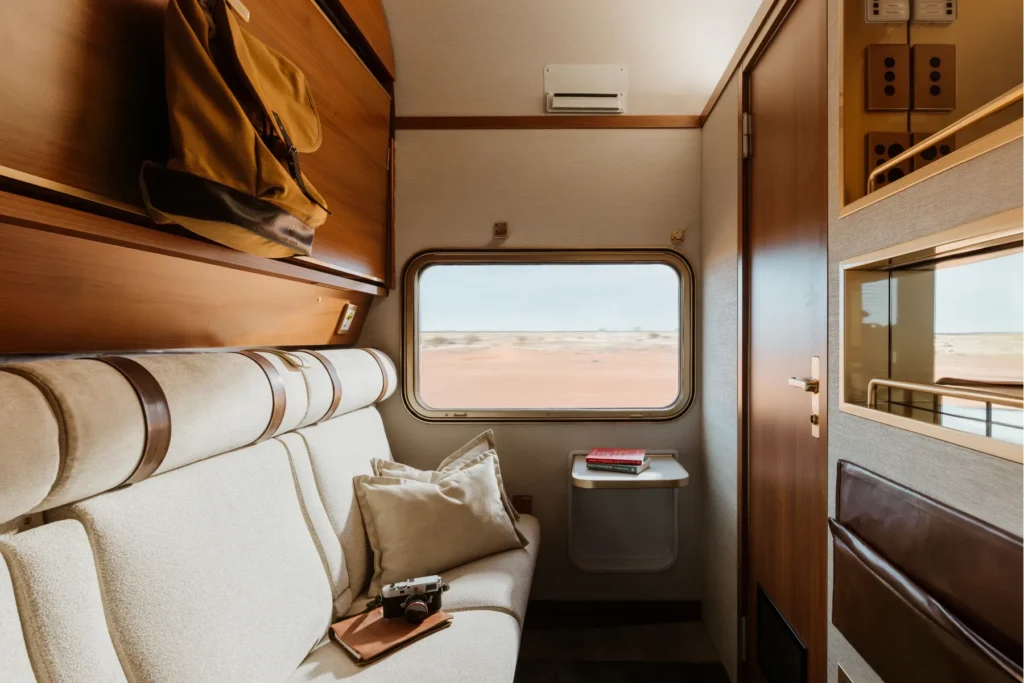
Against those settled surfaces, the window supplies continuous movement. A cabin can retain precisely the same arrangement while its light changes completely: cooler among wooded slopes, harder across open country, briefly golden as the day lowers. The interior becomes familiar remarkably quickly. Outside, familiarity is repeatedly withdrawn.
There is practical choreography beneath the decorative finish. Gold Premium Twin still uses upper and lower berths, so an upgrade should be understood in terms of its actual layout and amenities. Its benefits extend beyond the compartment to dedicated lounge and dining carriages, a private en suite and an enhanced food and drinks offering.
The shared spaces matter because a railway carriage makes an agreeable halfway house between company and solitude. Gold guests have the Outback Explorer Lounge and Queen Adelaide Restaurant; Gold Premium guests have their own corresponding spaces. A drink provides a reason to leave the cabin. The passing view supplies an easy opening for conversation.
Eventually, the corridor leads back to your door. The compartment has become a small, legible home, its few objects reassuringly close to hand. Somewhere beyond the glass, the landscape is still changing. You can follow it for another hour, or draw the blind and let the railway carry on without your supervision.
Broken Hill: Silver Country, Before Breakfast
Broken Hill interrupts the first morning with the evidence of work. Above the town, the Line of Lode carries the physical consequences of extracting silver, lead and zinc: a landscape shifted, sorted and piled by generations of mining. After the enclosed intimacy of a sleeping compartment, the scale is bracing. Here is a city whose reason for existing remains visible on its skyline.
The ore discovery of 1883 helped set in motion one of Australia’s great industrial stories. Broken Hill’s mineral wealth contributed to the country’s development; its labour disputes helped shape the conditions under which that wealth was earned. The city’s inclusion on the National Heritage List recognises both the mining and the community formed around it. There is considerable human history beneath the familiar phrase ‘Silver City’.
On the westbound itinerary, one morning excursion explores this mining legacy and includes the Miners’ Memorial. It is a worthwhile choice. The journey’s comforts acquire a different weight when set beside the labour that made remote settlements viable, and the lives lost in keeping them productive. Another published option introduces Broken Hill through local drag performer Shelita Buffet: an indication that the town has never restricted its energies to what lies underground.
Art offers another way of understanding the place, even when a brief railway visit leaves little time to pursue it. Pro Hart, born in Broken Hill and once employed as a miner, made outback life the subject of paintings full of colour and incident. His career joins two occupations that a passing visitor might otherwise keep in separate compartments: digging into the country and looking closely at it.
Back aboard, breakfast follows the excursion. There is pleasure in this small reversal of ordinary routine: having already stepped into another city before settling down to the meal that usually begins the day.
The route continues into South Australia, passing the southern tip of the Flinders Ranges on its way towards Adelaide. Breakfast gives way to lunch; the window holds your attention between courses. Distances that look straightforward on a map acquire texture through the hours required to cross them.
By late afternoon, there is another city to enter. Broken Hill has supplied the morning’s industrial history; Adelaide and its surrounding food and wine country will occupy the evening. The same day has room for both.
The Geography of Dinner
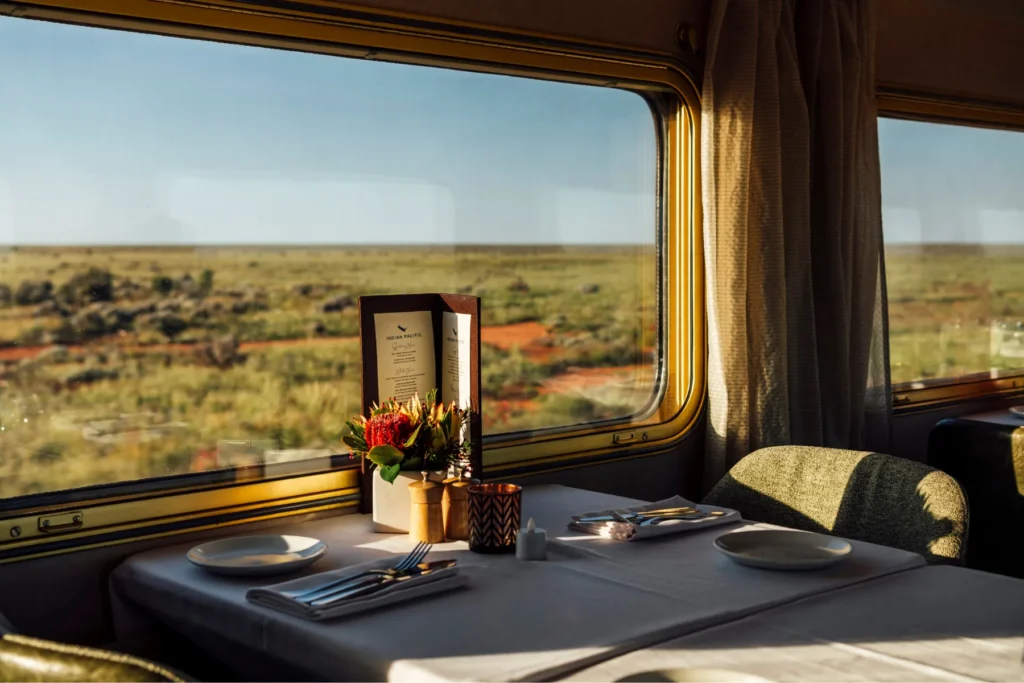
The Queen Adelaide Restaurant carries a small piece of British royal history across Australia. Its name recalls the consort of William IV, after whom South Australia’s capital was named. The Art Deco references belong to the established vocabulary of railway dining: a composed interior, a proper table, the agreeable expectation that lunch deserves your attention.
The menu looks closer to home. Journey Beyond’s culinary team works with Australian suppliers, farmers and producers to develop regionally inspired dishes. The intention is to give the country outside the window some presence on the plate. That requires judgement: a continent this large cannot sensibly be reduced to a succession of edible landmarks.
Published examples for the Queen Adelaide Restaurant include saltwater barramundi and grilled kangaroo fillet, though menus change with the season. These are useful indications of its Australian accent, rather than promises of a particular dinner. Gold service includes breakfast, a two-course lunch and a three-course dinner, accompanied by the included selection of wines and other drinks.
Gold Premium adds a fourth course at dinner and its own dining carriage, with contemporary interiors that retain Art Deco influences. Yet the most persuasive aspect of eating on a train is shared across categories: the room moves while the meal proceeds. Cutlery makes its small sounds against crockery; the changing light reaches the table; conversation pauses because something outside has become more interesting.
Meals also give the day a shape. Between them, there is little need to account for the hours. Lunch can be anticipated without being hurried towards, and an afternoon drink becomes an occasion rather than something fitted between appointments. The timetable takes responsibility for progress.
Adelaide extends that relationship between food and place beyond the carriage. The published westbound choices include dinner with local wines in McLaren Vale, an Adelaide Hills outing combining gin, cheese and German cooking at Haus, or a guided visit to Adelaide Central Market followed by a private sit-down dinner. Each provides a different introduction to the region’s appetites.
Returning to the train afterwards gives the evening a satisfying final movement. Your compartment is waiting; there is no unfamiliar hotel corridor to negotiate. Beyond Adelaide, the railway leads towards more sparsely settled country. For the next stretch, the dining carriage will become a particularly welcome address.
Across the Nullarbor, Where the Line Forgets to Bend
For 478 kilometres across the Nullarbor, the railway runs without a curve. The figure is remarkable on paper; through a carriage window, its meaning takes longer to emerge. There is no approaching bend to reveal the train ahead, no valley obligingly arranging the view. The horizon stays level. Small differences begin to command attention.
Low vegetation, pale ground, a change in the cloud cover: the eye adjusts to a landscape that offers few obvious instructions about where to look. After the visual density of Sydney and the industrial skyline of Broken Hill, this requires a different kind of attention. Put the camera down occasionally. The view benefits from being allowed to continue beyond the edges of a photograph.
Cook provides a human measure of the distance. Established in 1917 to support the railway, the settlement once housed the people whose work kept the tracks serviceable. Its remaining buildings give the stop a particular poignancy: evidence of domestic routines in a place most passengers encounter only briefly. A railway crossing depends on much more than the train that makes it.
Walking here interrupts the comfortable abstraction of the window. The ground is beneath your shoes; the carriage is an object standing beside you. Its length and silver flanks become newly conspicuous against the low country. Soon enough, everyone will climb aboard and the settlement will recede.
Further west comes Rawlinna, a remote railway outpost beside an immense pastoral property. The evening experience changes with the season. From September to May, the programme offers dinner beneath the open sky; winter brings drinks and canapés around a bonfire instead. Weather can alter either arrangement.
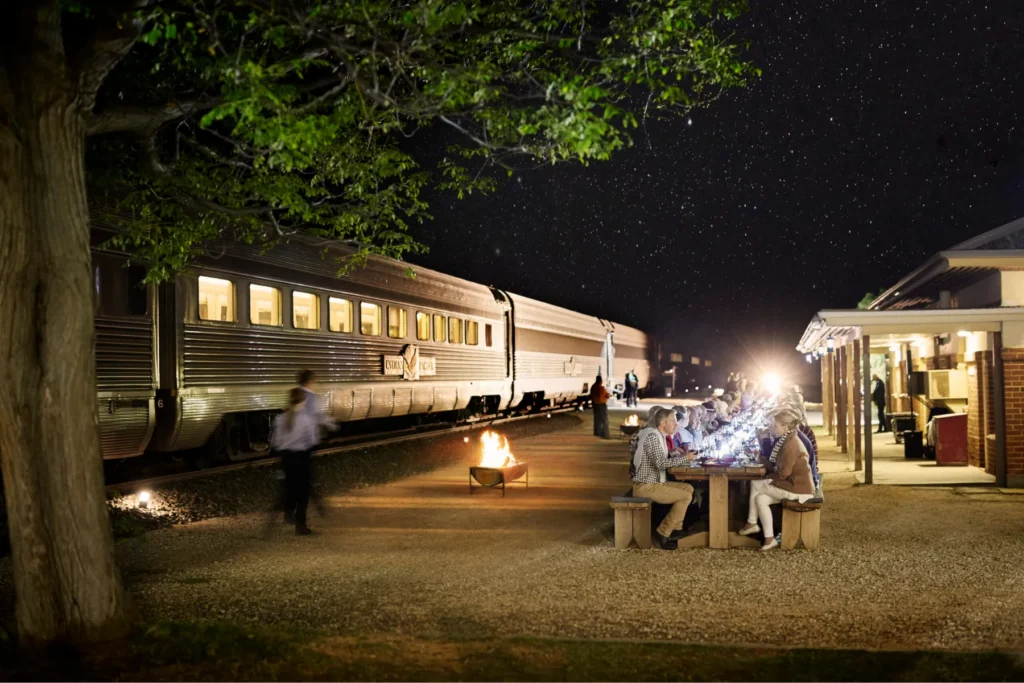
An outdoor table makes a subtle adjustment to the journey’s hospitality. Inside, the restaurant carriage frames the landscape and regulates the temperature. Here, the air reaches the table directly. As daylight diminishes, the train becomes the most substantial enclosure nearby, a place of beds and running water waiting a short walk away.
Take a warm layer, even if the afternoon has encouraged optimism. The operator advises that winter nights around these outposts can fall to about five degrees.
Returning aboard, the familiar corridor feels especially companionable. Beyond the blind lies the country through which the railway will continue all night. For once, leaving the curtains open seems more tempting than finishing the book.
The Return of Trees
On the final morning, the Avon Valley restores depth to the view. Hills interrupt the long horizontal line; trees give the eye something taller to follow. The published itinerary places a leisurely brunch on this approach to Perth, an appropriately civilised arrangement for the last hours aboard.
After the Nullarbor, vegetation seems almost extravagant. Its colour will depend on the season, but the change in structure is enough: slopes, branches, land that folds and conceals what comes next. The window has recovered some of the visual busyness with which the journey began. You notice it more readily now.
There is packing to do. Objects that found their proper places three nights earlier must be collected from shelves and corners. The compartment begins to lose its domestic character as belongings return to bags. A small room that initially required adjustment has become sufficiently familiar for leaving it to feel premature.
The Indian Pacific arrives at East Perth Terminal on West Parade, roughly two and a half kilometres from the city centre. It is worth retaining that precise destination when arranging onward transport. Perth’s central station serves a different railway world, with different platforms and a rather different pace.
Nor does the journey conclude with an Indian Ocean panorama from the train. The ocean that supplies half its name lies beyond the terminus. There is something pleasing about having to seek it out afterwards: a walk beside the water, perhaps, once the luggage has been deposited and the sensation of movement has subsided.
Allowing a night or two in Perth gives the crossing room to settle. An immediate flight would impose another set of clocks just when the railway has loosened their hold. There is no particular need to be efficient about the first afternoon ashore.
Four days have made Australia’s width more intelligible. Between the two cities are places with their own livelihoods, histories and reasons for enduring: Broken Hill’s mineral wealth, South Australia’s food country, the settlements that sustained the railway. Distance has acquired names.
Later, facing the ocean, the departure from Sydney may feel surprisingly remote. You can still picture the sandstone tower and the silver carriages beneath it. Between that memory and this shore lie three nights, several properly observed meals, and a long stretch of railway on which the line never bent.
Pre-departure stay
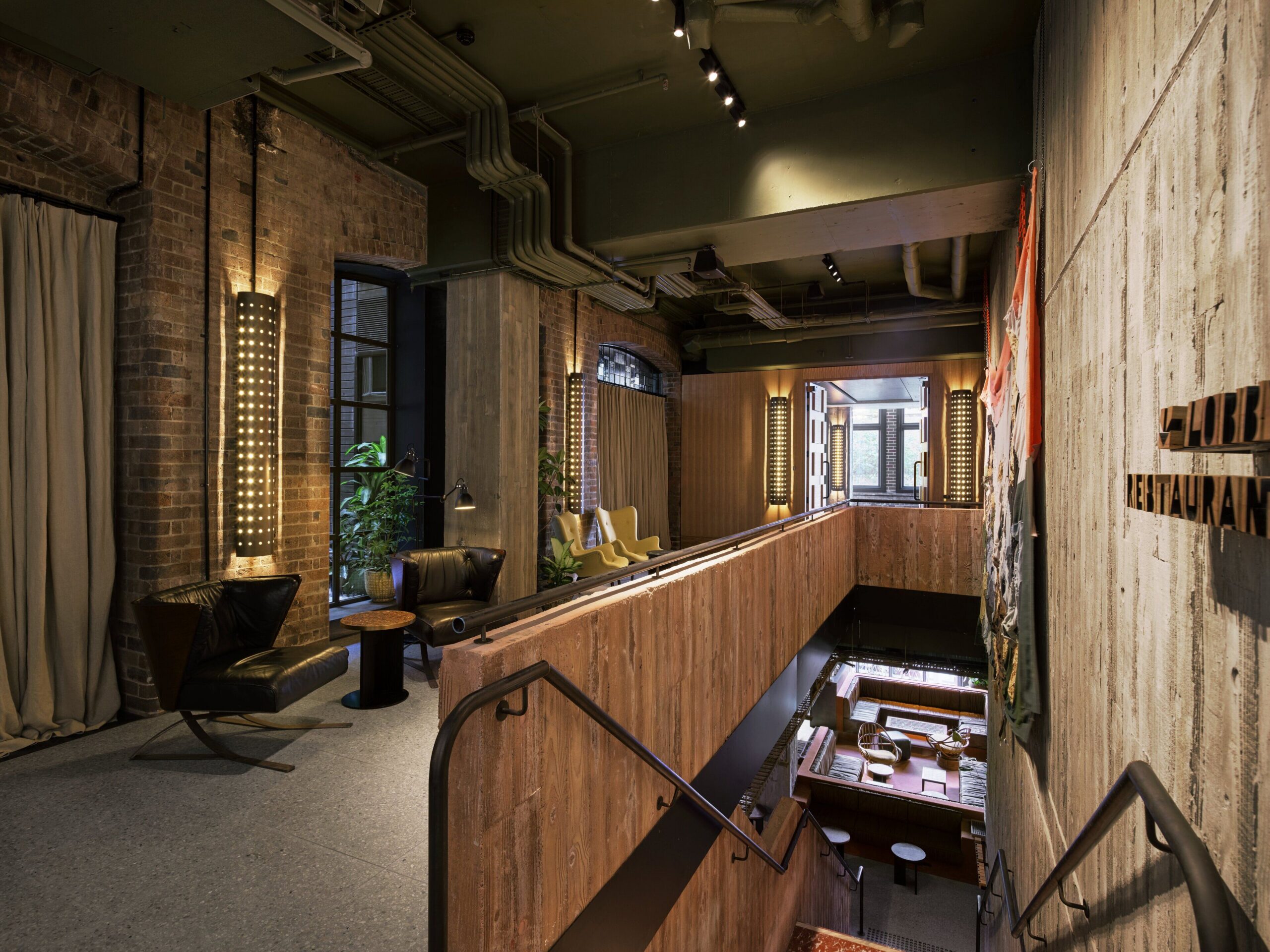
Ace Hotel Sydney
Behind the preserved façade of 1916 Tyne House, Ace brings industrial heritage into conversation with Australian art and desert-toned interiors. Central Station is approximately eight minutes away on foot: a characterful Surry Hills prelude, with time for coffee before boarding.