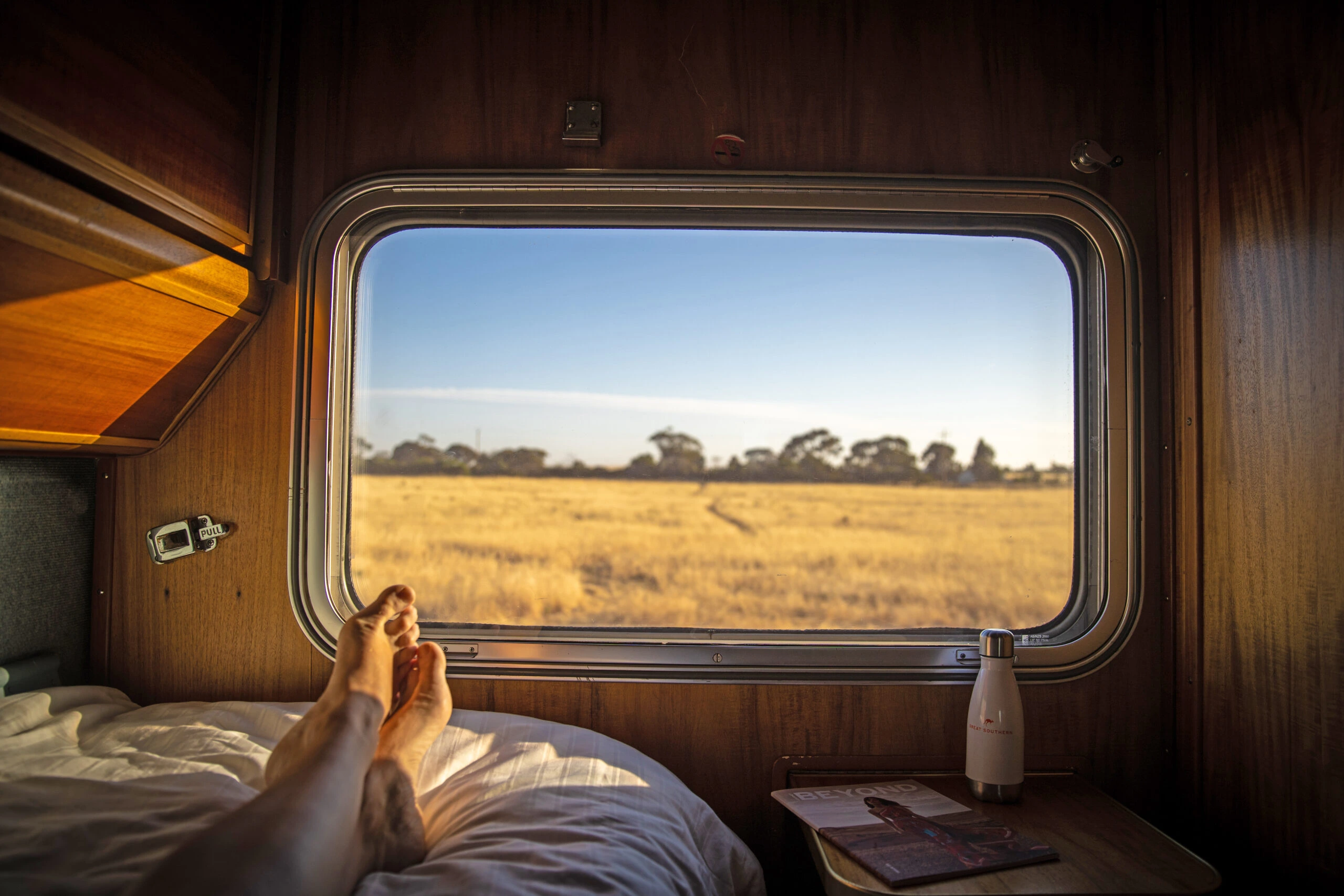
Across Australia at window height on The Ghan
The Ghan takes four days to cross Australia from Adelaide to Darwin. There is Clare Valley Riesling in a former shearing shed, a bunk that folds out after dark and a dawn stop on the red earth at Marla, where the scale of the journey begins to register.
JOURNEY AT A GLANCE
The Legendary Ghan
ROUTE
Adelaide Parklands Terminal to Darwin Berrimah Terminal via the Clare Valley, Southern Flinders Ranges, Marla, Alice Springs and Katherine. In 2027, Saturdays run March to November, with Tuesdays added April to October. The southbound Ghan Expedition runs from Darwin to Adelaide via Katherine, Alice Springs and Manguri for Coober Pedy, on Wednesdays from March to November and Saturdays from April to October.
BEST SEASON
May to September for the full crossing. May and September offer a good balance of milder days in the Red Centre and dry-season weather in Darwin.
DURATION
Four days and three nights in either direction. Adelaide to Alice Springs takes three days and two nights. Alice Springs to Darwin takes two days and one night.
STARTING FARE
From approximately £1,577 for Gold Single (A$3,090), or £1,833 per person sharing Gold Twin (A$3,590), on advertised northbound advance-purchase fares for March or November 2027. Includes three nights aboard, meals, drinks and scheduled off-train experiences. Sterling conversions use the 18 November 2026 mid-market rate. Fares are subject to availability.
The camel at the head of the train
A camel rides the nose of The Ghan’s red locomotive. Its rider is small enough to miss from halfway down the platform at Adelaide Parklands Terminal, where the eye goes first to the long line of silver carriages. Come closer and the outline resolves. A train built to carry its passengers across the middle of Australia wears the image of a man who could do it with an animal and a saddle.
The animal is a dromedary. The rider stands for the cameleers who arrived from Afghanistan and parts of British India from the nineteenth century onwards, collectively known in Australia as ‘Afghans’. Their camel trains carried supplies through the interior and worked sections of the route between Oodnadatta and Alice Springs, where Aboriginal people also took part in the carrying trade. The name fits neatly on a locomotive. The history takes longer to tell.
The railway took its time, too. The first Ghan passenger service left Adelaide for Alice Springs in 1929. The through train to Darwin followed in 2004. That gap of 75 years puts the length of the platform in perspective. In 2027 the northbound train covers the crossing in four days, giving over its first evening to the Clare Valley and the following day to the Southern Flinders Ranges. Darwin may be printed on the ticket, but on the opening afternoon the next appointment is dinner.
The scheduled departure is at three. In a Gold Twin cabin, the daytime seat runs along the wall beneath the window. It gives two people room to sit shoulder to shoulder, a better arrangement for watching the outskirts thin into open country than facing one another across a table. A line of trees can occupy the window for a surprisingly long time. Fences close to the track go by in quick succession, while a distant ridge scarcely seems to move. There will be plenty of time to discover which distance the eye prefers.
By early evening the train is due at Long Plains. The dinner carriage can wait. A coach takes passengers into the Clare Valley, where the first glass of the journey’s first dinner will be poured under the roof of an old shearing shed.
Riesling before the desert

At Penobscot Farm, near Watervale, the nineteenth-century shearing shed has acquired a second life as a dining room. The first evening of the journey belongs to Nicola Palmer and her kitchen, which builds the meal around what the farm is producing that season. The menu can change with the harvest. The local Riesling has a more recognisable signature, often lean and lime-scented, with an acidity that makes a persuasive case for another mouthful. There are Clare Valley reds at the table, too.
There is something pleasingly agricultural about beginning a long train journey this way. A woolshed was built for work, and Palmer’s dinner still depends on what the land yields in a given week. From the train, the country north of Adelaide comes by in long views. At the table it comes down to the scale of a glass and a plate. The little coach journey from Long Plains, easily overlooked in the itinerary, matters for that change of scale.
Back aboard, the cabin makes its own change of scale. In Gold Twin, the broad daytime seat gives way to upper and lower berths, and the shower and basin fit into a compact en suite. The room rewards a small overnight bag and an early agreement about who is taking the top bunk. In Gold Premium, walnut and gold-toned fittings bring a different finish to the same useful principle of a room that changes purpose after dark. The operator credits the colours of the country painted by the Western Arrernte artist Albert Namatjira as an influence on the interiors. His watercolours make pale trunks and long bands of shadow as arresting as the red rock. They are good company for the view ahead.
After dark, the glass gives back the reading light and the outline of the berth. It takes a moment for the eye to give up looking through its own reflection. The sound of the wheels, so easy to overlook over a drink or a conversation, comes forward as the carriage settles for the night. By breakfast the train is due at Port Augusta, with a full day out in the Flinders Ranges ahead. For the moment, there is the narrow bed, the weight of the bedlinen and the agreeable fact that the train can get on with the crossing while its passengers sleep.
A day in the folded hills
At Port Augusta, the morning begins with breakfast aboard and a day’s leave from the railway. The Southern Flinders Ranges take a little time to read. From a distance, the ridges seem to follow one another in an orderly succession. Up close, the rock has other ideas. Bands of stone tilt across the hillside, gullies interrupt the slopes, and the red deepens where a gorge cuts into shadow. An afternoon at the carriage window gives you the shape of the country. A day on the ground gives you its grain.
Quorn makes a natural place to stop for lunch. In 1879, the narrow-gauge line reached the town from Port Augusta through the Pichi Richi Pass. It would eventually carry the old Ghan towards Alice Springs. Volunteers still run heritage trains along part of that route. Even on a day when the rails are quiet, the station yard gives some sense of how much room a railway once needed to keep itself going. Lunch on the 2027 itinerary comes with gin made in town. The distillery occupies a former stable, another South Australian building still earning its keep.
The second woolshed of the journey is at Kanyaka Station, north of Quorn. Its surviving stonework belongs to a sheep run whose shearing floor once accommodated 24 men working with blades. Nearby are the remains of a sixteen-room homestead and part of the wall that protected its garden. Hugh Proby, the third son of the Earl of Carysfort, established the run and drowned crossing a flooded creek in 1852. A little over a decade later, drought hit the station hard enough for it to be abandoned for a year. The creek and the garden wall put the story of water here in unusually plain terms.
Look beyond the ruins and there is a low, raised strip of ground where the narrow-gauge railway once ran. It is easy to pass over with the eye, especially after Quorn’s station buildings. Yet that slight embankment is the day’s clearest link to the train waiting at Port Augusta. By dinner the ridges are back beyond a pane of glass. After a day spent among the folds and cuts of the range, it takes longer for them to recede.
First light at Marla
At Marla, The Ghan stops in the dark. The first hot thing of the day is a mug of coffee, with a bacon-and-egg roll for anyone whose appetite keeps railway hours. There is a fire to stand beside. For a while the carriage windows are the brightest things in view, and the ground is visible chiefly where people gather. Then the horizon begins to separate from the sky. The red that looks so emphatic in photographs comes into the morning by degrees.
Marla is still in South Australia, around 160 kilometres short of the Northern Territory border. By the time brunch is served, there is a whole morning of country to pass through before Alice Springs. This is a good stretch to give the window your undivided attention. From a distance, a red plain can look all of a piece. Then a patch of scrub breaks its surface, or the light catches one flank of a low ridge and leaves the other in shade. The longer you look, the less there is to gain by asking how much further.
By early afternoon the train reaches Alice Springs, or Mparntwe, the town on Central Arrernte Country. There are several ways to spend the stop. Alice Springs Desert Park makes distinctions that are easy to miss at speed, with paths through sand country, desert river habitats and woodland. At Simpsons Gap, in the West MacDonnell Ranges, ghost gums give the rock a measure of scale. There is a permanent waterhole here and, for the patient, the possibility of a black-footed rock wallaby among the stones.
The other excursion into the ranges goes to Standley Chasm, or Angkerle Atwatye. Here the view narrows to a passage between high walls of rock. The Western Arrernte community owns and runs the site through the Iwupataka Land Trust, and the chasm is a place of cultural significance. Walking in from the gums along Angkerle Creek gives the visit a different pace from the morning’s long views. There is time to notice the shade and the small variations in the rock, and to learn who cares for the place and what it means to them.
Back in the cabin, there is time to wash the dust from your ankles before dinner. The train has another night’s running ahead. For now the country outside is still the country of the afternoon, gradually losing its colour in the glass as the lights come on in the dining carriage.
Dinner as the country turns green
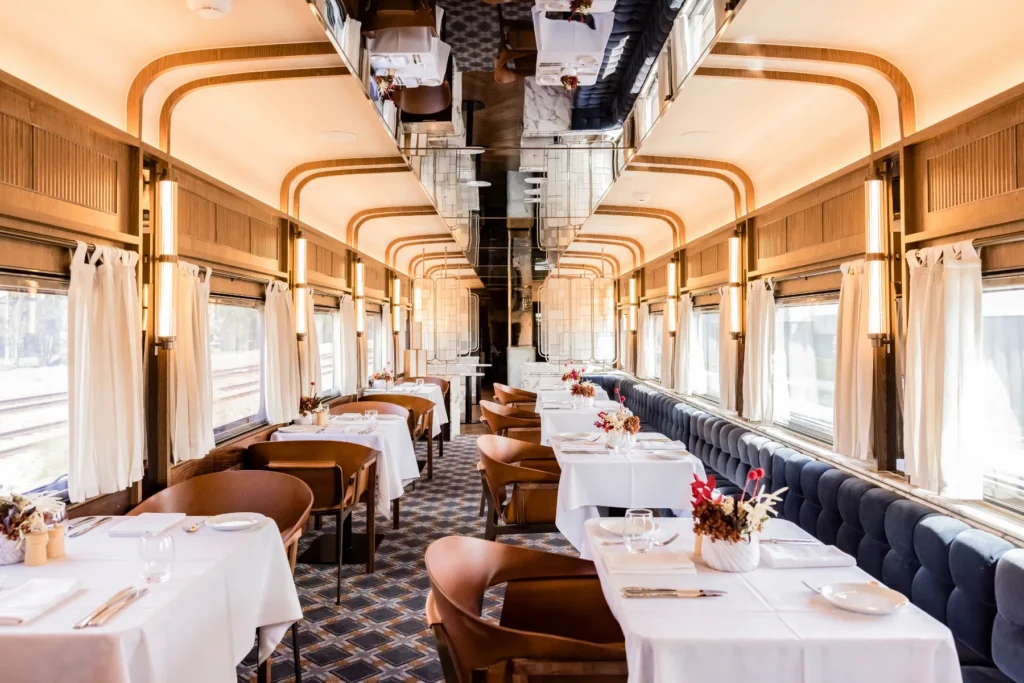
The Queen Adelaide Restaurant takes its name from the same queen as the city where the journey began. This far north, the name has a pleasing formality. The Gold dining carriage is Art Deco in manner, and the proportions are still those of a railway carriage. The aisle is close, the windows are large, and everyone has the same reason to let a conversation lapse for a moment. In the last of the light, a low ridge can hold the attention of an entire table. Once it disappears, the window becomes a mirror and the room seems to draw a little closer.
The menus move with the seasons. Journey Beyond gives saltwater barramundi and grilled kangaroo fillet as examples of what its chefs serve in the Queen Adelaide. The fish is a particularly apt prospect on the night before Katherine, with the waters of the Top End still ahead. It also brings to mind the first dinner in the Clare Valley. There, the produce came from a farm just outside the door. Here, the kitchen has to do its work in the space a railway gives it, with ingredients drawn from suppliers along the route. The achievement is that by the time a plate reaches the table, the dimensions of the kitchen are the last thing on anyone’s mind.
There are different ways to spend the hours around dinner. The Outback Explorer Lounge is the gathering place for Gold passengers, where a drink can turn into a comparison of afternoons at Simpsons Gap and Angkerle Atwatye. Gold Premium has its own lounge and restaurant, with leather banquettes and chairs that swivel towards the view. In the Platinum Club, the details are quartzite, timber and brass. The differences matter most at the beginning of the evening, when there is still something to see. After dark, the best seat depends rather more on who is sitting next to it.
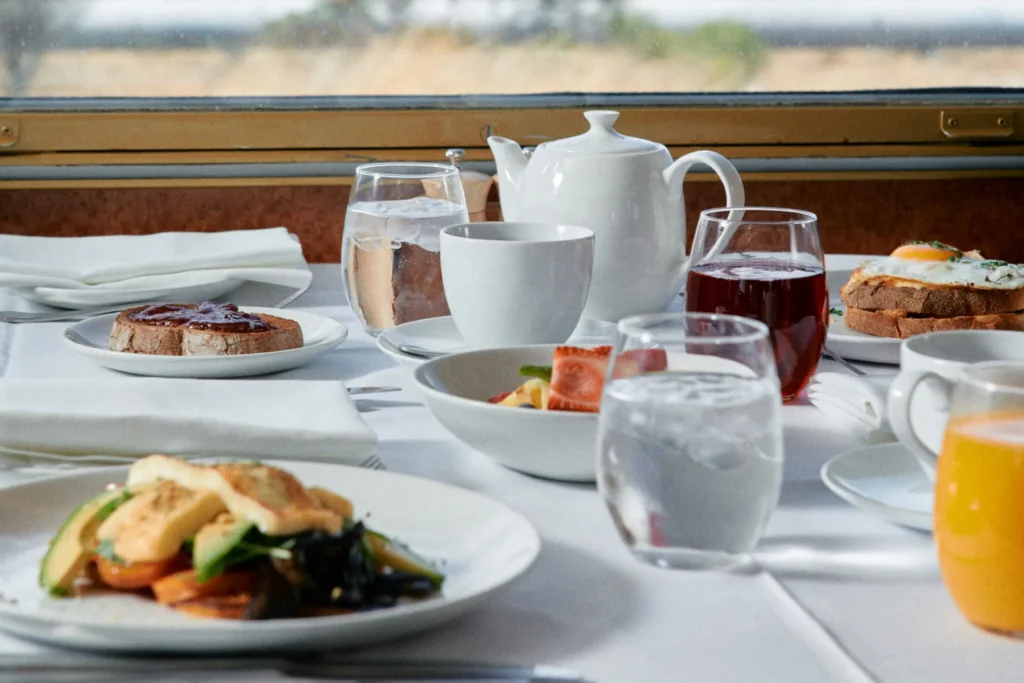
By breakfast, in the country around Katherine, there is more tree cover and a different cast to the light. The third night has taken the train out of the Red Centre and into the tropical north. Green is a relative term in the dry season. The grasses can be pale and the ground dusty, but the trees and the promise of water change the view. The menu’s barramundi suddenly feels less like a choice made in a dining carriage and more like a clue to where the railway was heading.
Where the sandstone holds the river
At Nitmiluk Gorge, the Katherine River runs between sandstone walls. From the boat, the upper edges of those walls can sit in full sun while the water below holds their shadow. After two days spent looking side-on at Australia through a carriage window, there is a small pleasure in having to look up. The gaze follows a seam in the rock until it disappears around a bend. A boat has its own pace. There is time for a ripple to reach the foot of the cliff and come back.
Nitmiluk means ‘Cicada Place’ in the Jawoyn language. The Jawoyn account of its naming tells of Nabilil, who heard the cicadas as he travelled through the gorge. The sound belongs to the name, and knowing that gives a boat ride a second thing to attend to beyond the height of the cliffs. The Jawoyn people own the national park and manage it jointly with the Northern Territory’s parks authority. Their account of the gorge gives it a much longer history than any railway timetable can hold.
There is lunch back aboard and a final stretch of railway through the Top End. After the confined view from the boat, the horizontal sweep of country comes as a surprise again. The temptation on a last afternoon is to keep looking for some definitive sign of arrival. In practice, there is time to finish a cup of tea, put away a book and see how much more country passes before there is any need to zip up the bag. The Saturday departure is scheduled to reach Darwin at 5.30 pm on Tuesday. The Tuesday train is due in at 7.50 pm on Friday.
Darwin arrives at Berrimah Terminal in East Arm, some 17.5 kilometres from the city centre. There is still a road journey between the railway and the city. After four days spent letting the view come to you, that last transfer can feel brisk. The things that stay with you may be smaller than the distance suggests. There is the width of the old railbed at Kanyaka, the warmth of a mug at Marla and the strip of shade at the foot of the sandstone. Each belongs to a particular place. Taking four days over the crossing gives each one time to become familiar.
Pre-Departure stay
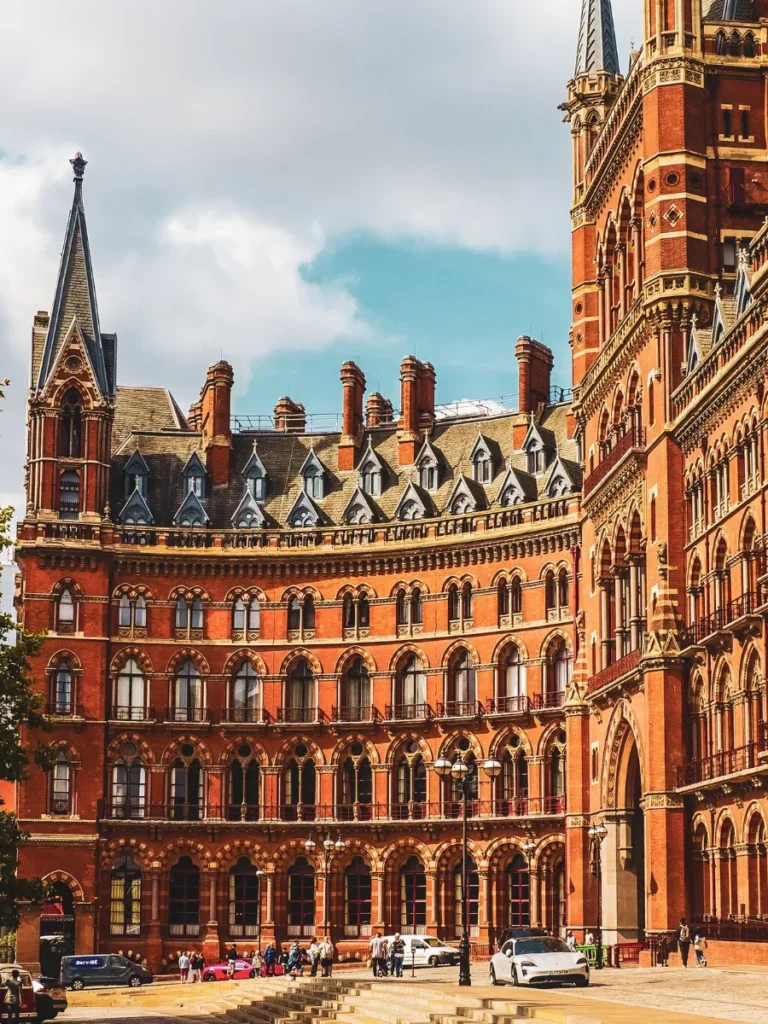
The Franklin Hotel, Adelaide
Seven rooms sit above this heritage-listed Adelaide pub, with local art and a shared verandah dating from 1912. Spend the morning at Central Market, then take a short taxi ride to Adelaide Parklands Terminal for the afternoon departure.