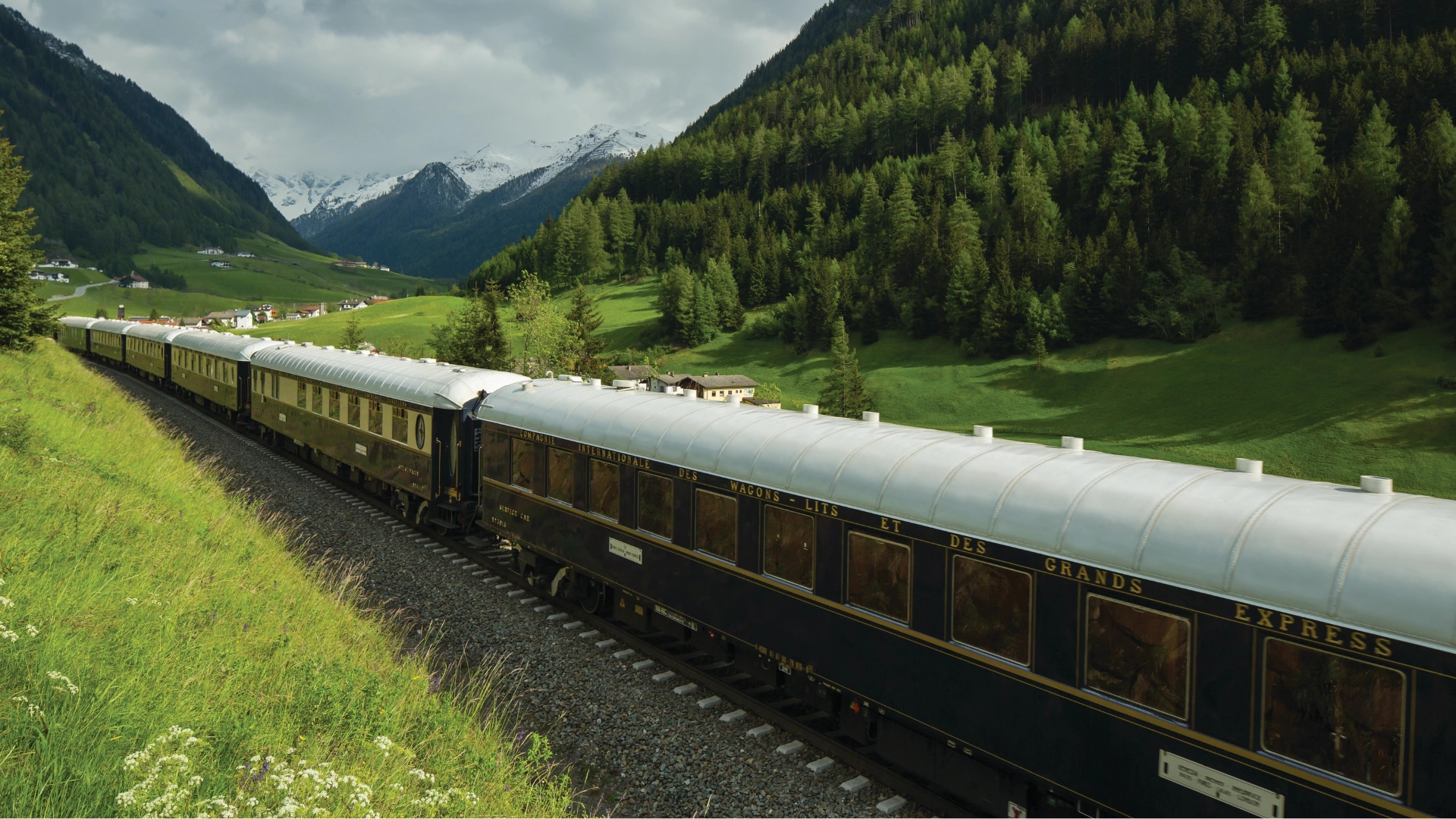
The long way to Paris on the Venice Simplon-Orient-Express
From the steps of Venezia Santa Lucia to Paris the following day, the Venice Simplon-Orient-Express gives Europe time to change outside the window. Inside its blue carriages, Lalique glass catches the light, a steward turns a banquette into two beds, and dinner keeps its own hours.
JOURNEY AT A GLANCE
Venice Simplon-Orient-Express — Venice to Paris
ROUTE
Venezia Santa Lucia to Paris, with boarding at Verona Porta Nuova on flagship departures. Selected 2027 journeys run via Florence. Belmond specifies the Paris terminal in the individual itinerary.
BEST SEASON
May and June for longer daylight on board, or late September for milder days in Venice before departure.
DURATION
One night, typically around 26 hours. The usual schedule is 11.00 from Venice to 13.00 the following day in Paris.
STARTING FARE
From approximately £3,757 per adult for a Historic Cabin based on two sharing. Belmond quotes €4,510 for 28 October 2027, converted here at the ECB reference rate on 17 November 2026. The fare includes the overnight cabin, steward service, three-course lunch, four-course dinner with the sommelier’s wines and French breakfast. Subject to availability. www.belmond.com
The last of the lagoon
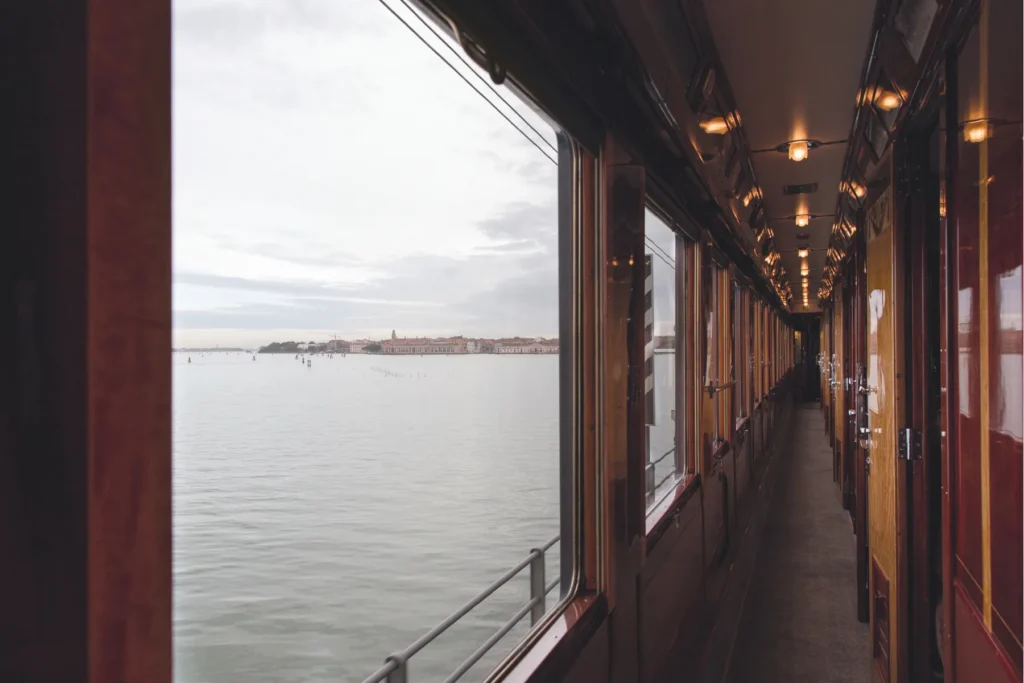
At Venezia Santa Lucia, the Grand Canal comes almost to the foot of the station steps. A vaporetto draws away from its landing, its engine note rising as the wake works back against the stone. A few minutes’ walk away, under the station roof, stands a train in midnight blue and gold. Seen here, among ordinary departures and people wheeling their cases to the platforms, the Venice Simplon-Orient-Express has the slightly formal air of someone who has dressed for dinner at eleven in the morning.
Eleven is the usual hour of departure for Paris, a city the train is due to reach at about one the following afternoon. It is an unusually civilised time to leave Venice. There is room for a coffee before boarding, and for one last look across the canal from the top of the steps. The journey begins with two quite different views of water. The first is the canal, with buildings close enough on the opposite bank to make out their window shutters. The second, from the railway causeway, is a broad, low stretch of lagoon that seems to bring the sky down to the level of the carriage.
Then comes Mestre, and with it the mainland’s abrupt return to business. Sidings and the backs of buildings succeed the open water. Beyond the built-up stretches, the Venetian plain affords a longer view, interrupted by the occasional platform or the blank flank of a warehouse. This is a part of Italy many visitors cross on their way to somewhere else. There is a particular pleasure in giving it the first hour of a journey whose most celebrated scenery lies farther on.
Verona Porta Nuova is a further boarding point on the flagship run. The station sits in the working city, a little distance from the streets of rosy stone and the bends of the Adige that furnish Verona’s more familiar portraits. Here there are platforms, announcements and, for a moment, the stillness in which the window ceases to be a view and becomes a pane of glass again. The pause is brief in the scale of the journey. Yet it marks the point at which leaving Venice gives way to the more agreeable business of being aboard.
Lalique glass and the art of the Pullman
In the Côte d’Azur restaurant car, pale glass figures hold bunches of grapes. René Lalique designed the panels for the Pullman carriage in 1929, and their faint blue is most apparent when the light falls across them. Stand close and the grapes resolve into individual berries. From a table, the relief is quieter, a pattern that emerges and fades as the carriage changes direction. The panels have had plenty of opportunity to catch different light. Car 4141 worked on the Côte d’Azur Pullman and the Deauville Express before joining the Flèche d’Or, the French boat train that formed part of the rail-and-sea journey between Paris and London.
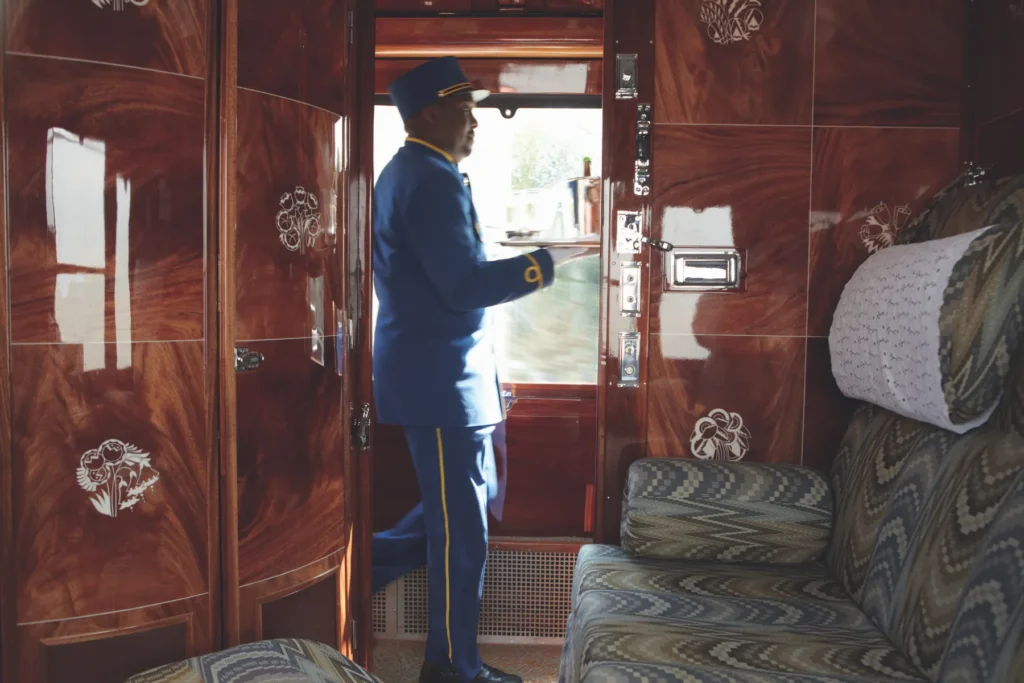
The most British thing in the next dining car may be the least obvious. Étoile du Nord has floral marquetry and a name that places it comfortably on the Continent. Its carriage was built in Birmingham in 1927. It went on to work the Paris–Amsterdam service and the Edelweiss, which ran towards Switzerland. Those histories give each room its own character. The dark lacquer of L’Oriental absorbs the light that Lalique’s glass picks up, while the wood in Étoile du Nord rewards a closer look at the joins between the different grains. When James Sherwood assembled and restored the fleet that entered service in 1982, one of the marquetry specialists he called on was Bob Dunn, whose grandfather had worked on the original carriages.
In a Historic Cabin, craftsmanship is a matter of fitting a remarkable amount into 3.3 square metres. A washbasin sits inside a cabinet. The banquette makes the window the natural place to spend the afternoon, then gives way to upper and lower berths made up in damask. The lavatory is shared, at the end of the carriage. The arrangement has the economy of a well-designed boat cabin, and much of its charm comes from seeing the same small space do two jobs so neatly.
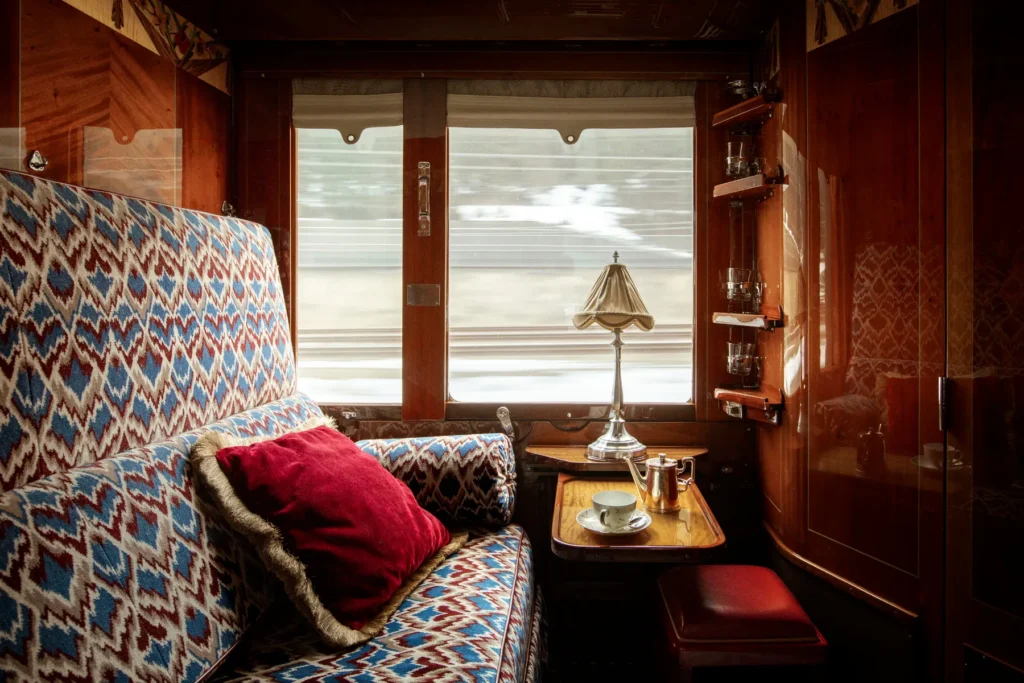
The newer Suites take some cues from the country outside. La Forêt has walnut panelling and russet velvet, colours that seem particularly well chosen when the afternoon begins to dim. The Historic Cabin offers a smaller pleasure. Sit back against the banquette and the window is already where you want it. A book can wait. There will be another page, and there may be only a few seconds to see what lies beyond the next line of trees.
A kitchen in motion
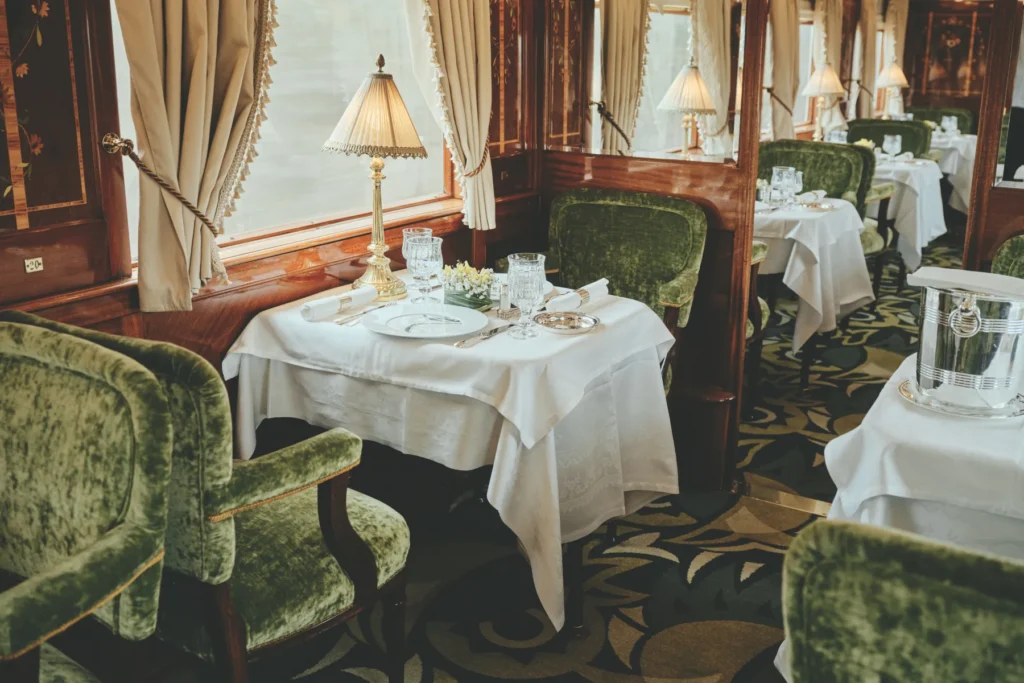
The dining table is laid close enough to the window for the countryside to occupy one side of it. At lunch, a passing cutting can put the whole table in shade. Then the train clears it and the stems of the wine glasses cast long, slender shadows across the cloth. Outside, the distances keep changing. Inside, someone has set the cutlery precisely parallel to the edge of the table, an order the railway will spend the next hour gently testing.
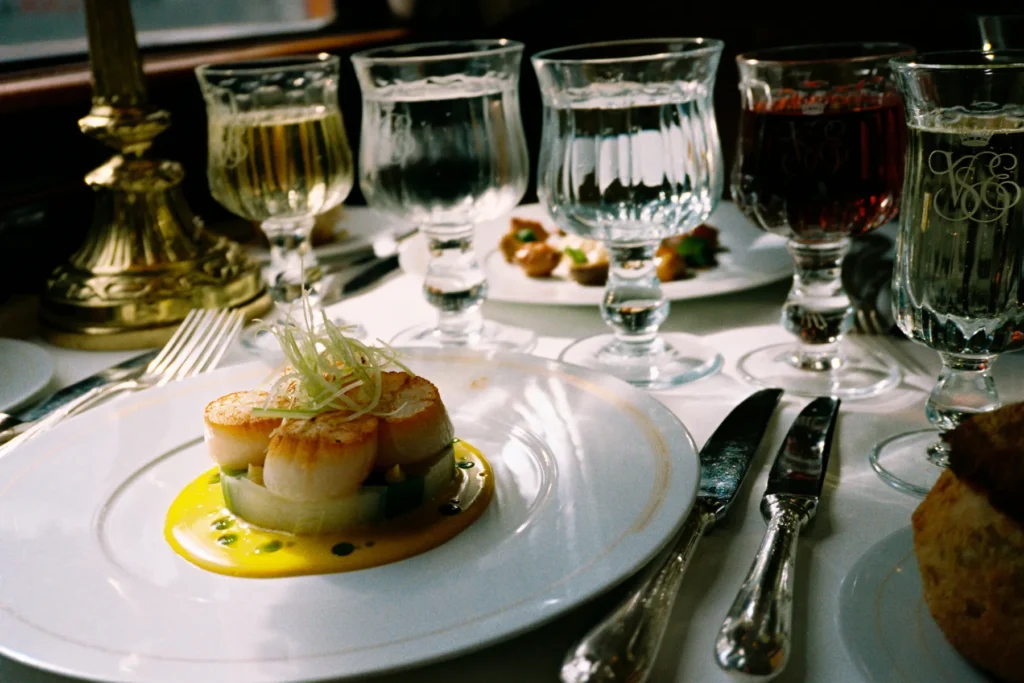
Belmond’s sample lunch menu runs from scallops to chicken ballotine and caramelised brioche with poached pear. It reads like the menu of a small French restaurant with a particular affection for the poaching pan. On board, the kitchen has to turn out a three-course lunch while the train is moving, using seasonal produce gathered along the route. Consider the ballotine. The chicken has to be rolled tightly enough to hold its shape, cooked evenly and cut cleanly for service. By the time it reaches the table, the mechanics of the thing are a matter of a few neat slices.
Between lunch and dinner there is the goûter, the French afternoon pause for something sweet, served in the cabin. Here the distance from the banquette to the tray is scarcely an arm’s length. The change of scale gives the afternoon its own character. A meal in the dining car has the ceremony of being shown to a table. Tea in the cabin belongs to whoever has the window, and to whatever patch of country happens to be outside while it is still hot.
Dinner is the longest sitting, four courses with wines chosen by the sommelier. Foie gras and lobster appear on Belmond’s sample menu, with Petrossian caviar available as an addition. These are familiar ingredients from the grand dining room. What feels particular to the train is the way the room itself changes over the course of the meal. The last of the daylight can hold for a while in the window, then give way to the reflected lamps and the other tables. Beyond the glass, a line of village lights may be the only indication of how quickly the train is moving. At the table, there is still another course to come.
The view after Verona
On the Alpine routing through the Brenner Pass, the country beyond Verona begins to gather itself around the railway. The Adige valley draws the view in. Vineyards occupy the lower slopes in rows that register for a moment before the angle changes and they flatten into stripes. A church spire gives the eye something to hold on to. Then, on a bend, a hillside that looked comfortably distant fills most of the window. The train’s long blue sides occasionally come into view ahead, a rare chance to see the length of the thing from within it.
The pleasure of this stretch is in watching the valley change by degrees. On the Venetian plain there is usually enough room to see a town approaching, pick out its edges and watch it recede. In the mountains the foreground intervenes. A retaining wall suddenly takes up the whole window, followed by a gap wide enough to see a road, a river and houses spaced out along the valley floor. In a tunnel, the glass returns a close view of the cabin. The farther it is possible to see when daylight comes back, the more striking the interval has been.
The exact line belongs to the departure. Belmond publishes the Venice and Paris timings and lists a separate itinerary via Florence. One documented Venice–Paris run was routed through Verona and Rome before heading towards Chiasso on the Swiss border, taking in stretches of Adriatic coast and the hills of Umbria along the way. If there is a particular pass you want to see, the route and the hour at which the train expects to reach it are worth checking together. A mountain crossing around dinner in June can still offer a view long after the same stretch would have disappeared in October.
Even a whole afternoon at the window is made up of small interruptions. A cup has to be put down. A bend that promises a better view can take the train behind a stand of trees. A station briefly brings the eye level with people going home from work. Then the train pulls away and there is time again to follow a road on the other side of the valley until it slips out of sight. By dusk, when the lamps inside begin to show in the glass, the window can hold the last of the landscape and the room behind you at once.
The piano and the upper berth
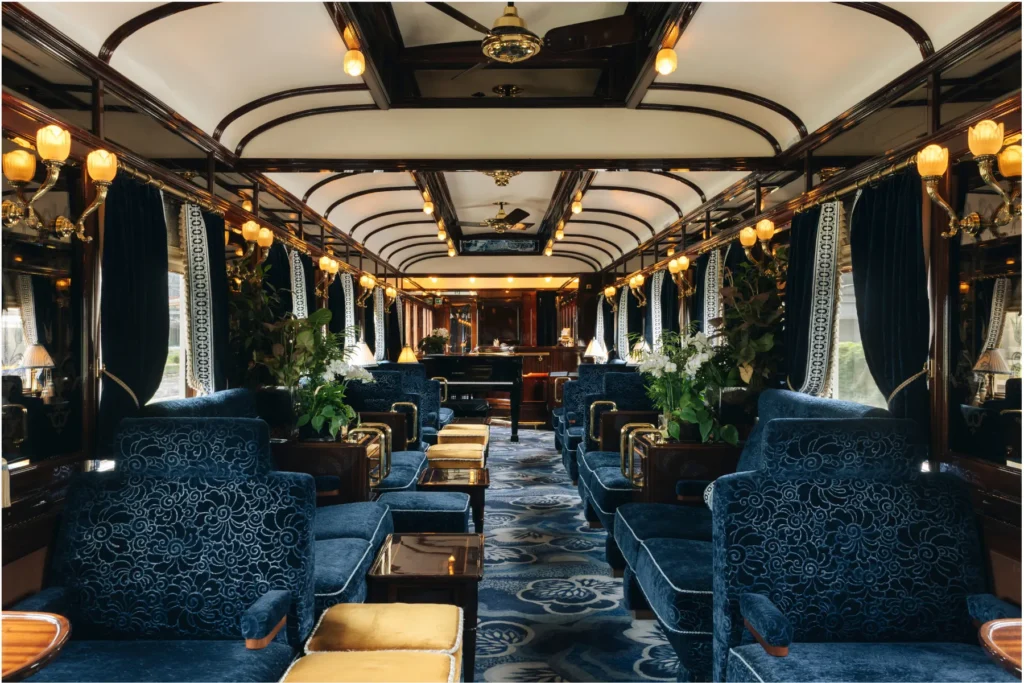
The number on the bar car is 3674. Before it had a piano and its midnight-blue banquettes, the carriage worked domestic services in France during the German occupation. After the war it ran on the Sud Express as far as Irun, on the Spanish border. There is something rather pleasing about finding such a workaday number attached to a room where people go to order a martini in evening clothes. The number is the permanent part. The purpose of the carriage has changed with the people using it.
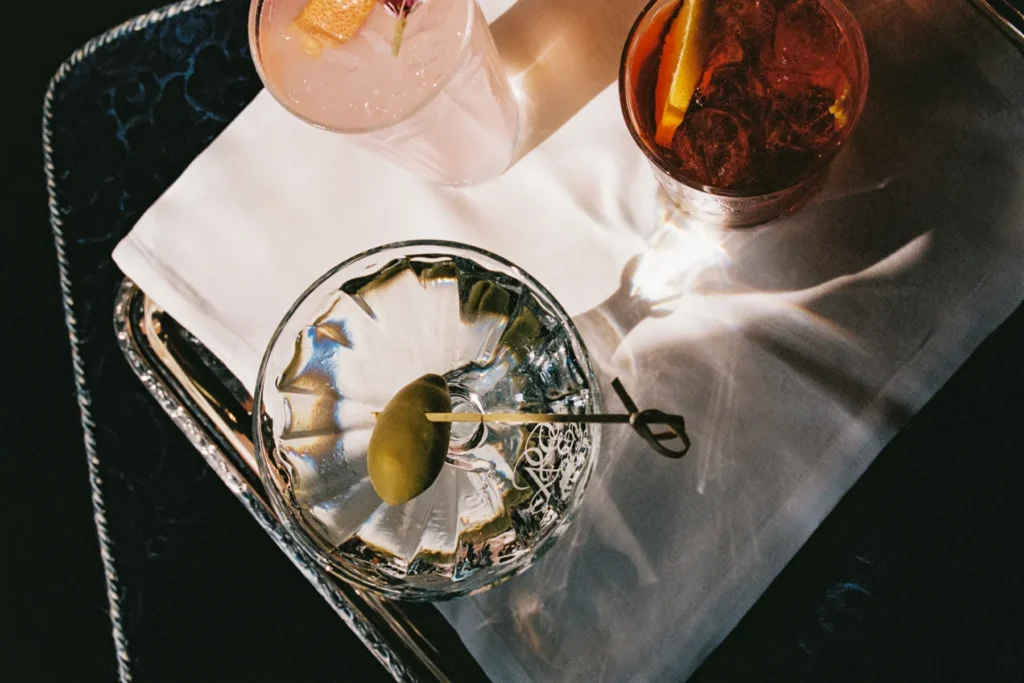
After dinner, the bar offers a different sort of company. At table, conversation belongs to the people within reach of the bread basket. Here, there is the latitude to sit near the pianist, order something short and listen for as long as you like. A pair of passengers on a banquette can remain absorbed in an exchange of their own. At the bar, a question about where someone boarded can establish how differently two people have spent the same day. One has come from Venice and watched the lagoon open out. Another got on at Verona and went almost straight to lunch.
Back in a Historic Cabin, the steward has made up the berths. The arrangement asks a little of its occupants. Two people getting ready for bed in 3.3 square metres must take turns at the washbasin. A jacket needs somewhere to go. Whoever has drawn the upper berth has the small adventure of getting into it, and a good reason to put anything needed before breakfast within reach. By morning the room will have the dimensions it had at departure, though its usefulness as a bedroom may make the daytime cabin seem larger than you remember.
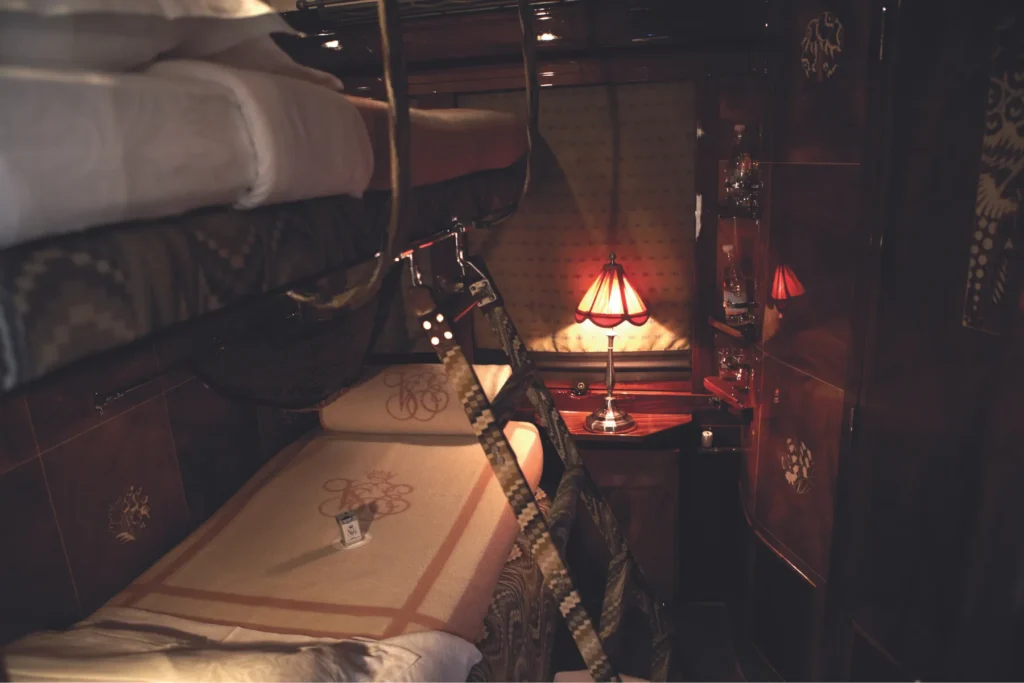
The rhythm of a sleeper is easiest to hear once the conversation and the piano are behind you. There is the even sound of the wheels at speed, and the change in note when the train takes a set of points. A station can announce itself as a brief wash of light at the edge of the blind. By the time you have thought to lift it, the platform may already be gone.
Paris before the afternoon
French breakfast can come to the cabin. The tray is a modest piece of domestic business after the previous evening’s dinner, and in a small room the smell of coffee soon reaches every corner. Outside, it can take a while to get your bearings. The blind may go up on wet fields, a cluster of roofs or another train keeping pace briefly on the next track. The habit of watching returns quite naturally after sleep. There is time to hold the cup in both hands and let the country supply the first occupation of the day.
The approach to Paris takes place by increments. The gaps between buildings shorten. There are more tracks alongside, then more platforms and more people on them. For most of the journey, a railway station has been a fleeting interruption in the view. Now stations are part of the city coming into focus. Somewhere in the last stretch, attention turns back to the cabin. A washbasin door clicks shut. Shoes that have spent the night out of the way have to be found again. The things taken out of a case in Venice have acquired places of their own in a room you have occupied for a single night.
Belmond’s usual arrival is around one in the afternoon, an hour that gives the journey an unexpectedly generous ending. Paris still has most of the afternoon ahead of it. There is time to walk a few streets, stop for a coffee and get used to sitting by a window with a fixed view. At a pavement table, the person crossing the street can be watched all the way to the other side. The buildings stay where they are. It takes a little while for this to feel ordinary again.
The small shock is how quickly the train has become familiar. Yesterday it was the long blue line at Santa Lucia, conspicuous among the morning departures. By Paris, you know the few steps between the cabin and the corridor, the height of the armrest by the window and the sound the door makes when it closes. The crossing took about a day. All the same, when you step down to the platform, there is that odd feeling of leaving a room you had only just learnt how to live in.
Pre-departure stay
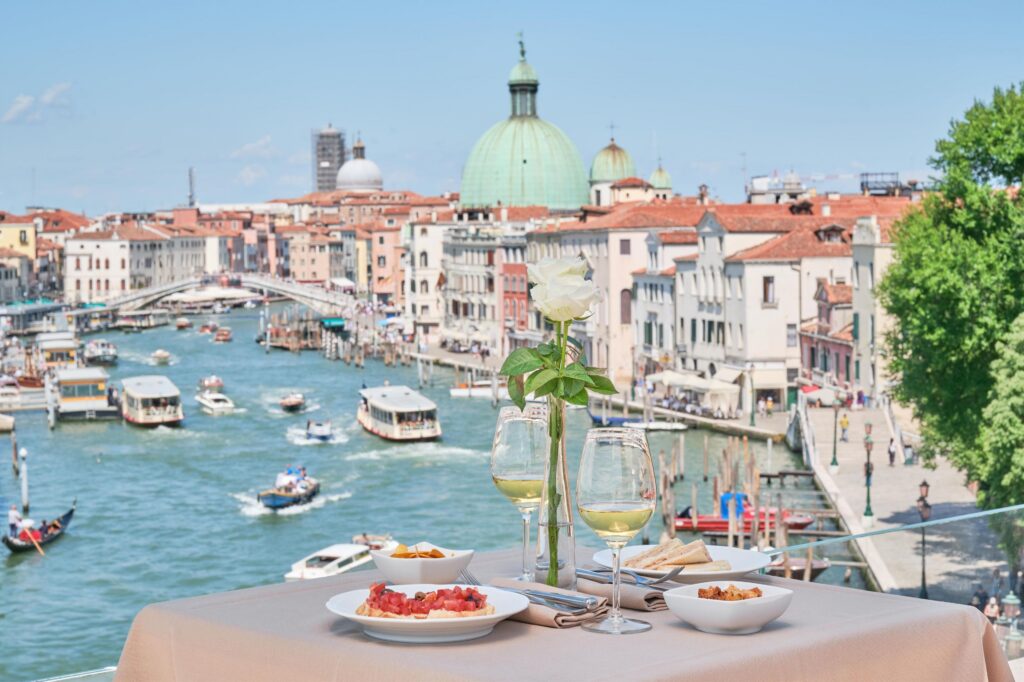
Hotel Santa Chiara, Venice
A former 16th-century monastery at the Grand Canal’s western end, Santa Chiara is a two-minute walk from Venezia Santa Lucia across the Ponte della Costituzione. Take coffee overlooking the water and leave just enough time to cross the bridge before boarding.
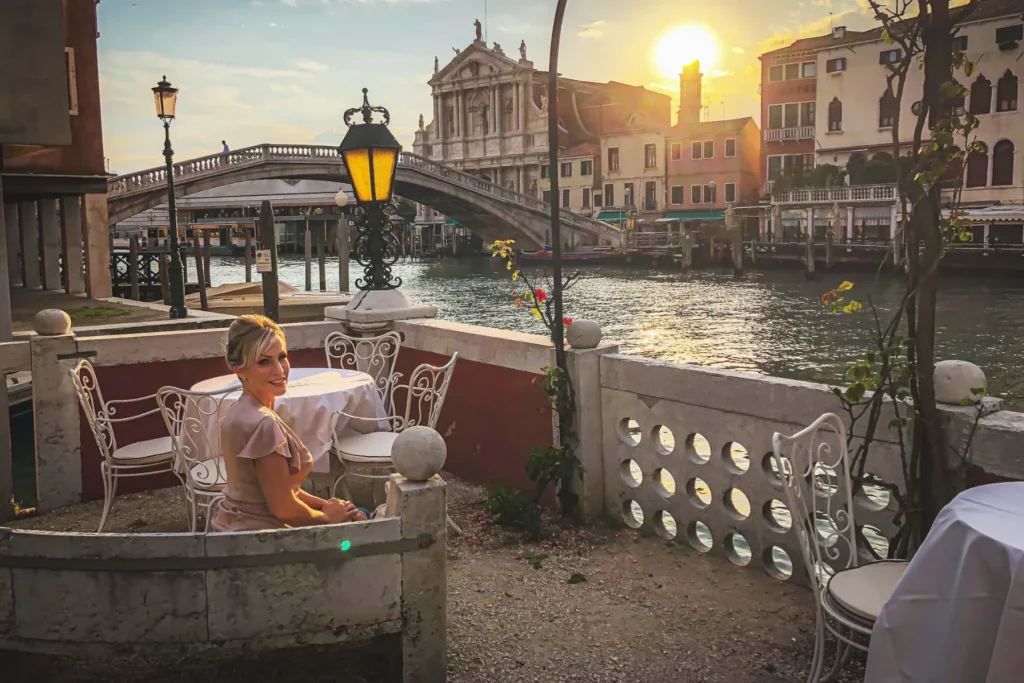
Ca’ Nigra Lagoon Resort, Venice
The former home of diplomat Costantino Nigra has a Byzantine-Gothic façade, Istrian stone and a rose garden on the Grand Canal. Spend the previous evening by the water and leave in the morning by the Ponte degli Scalzi, a five-minute walk to Venezia Santa Lucia.
Beyond Venice: the Venice Simplon-Orient-Express to Istanbul
On the second day out of Paris, the Venice Simplon-Orient-Express trades the dining car for the Danube. There is a cruise in Budapest, a night in the city and, farther east, time to step off again for the wooded slopes of Sinaia and the turrets of Peleș Castle. It takes six days to reach Istanbul. The stops are much of the pleasure.
Paris to Istanbul via Budapest and Bucharest
When the original Orient Express left Paris in 1883, passengers bound for Constantinople completed the journey by sea. A direct rail service followed in 1889. Belmond’s modern journey borrows the two endpoints and gives the cities in between room of their own. Of its five nights, three are spent aboard the train and two in hotels, one in Budapest and one in Bucharest. There are guided visits in both capitals, and the excursion to Peleș takes the journey into the Romanian Carpathians before the final stretch to Istanbul.
2027 departures.
The 31 May departure is listed as sold out. The 1 October journey is advertised from €20,940 per person in a Historic Cabin, subject to availability. Belmond also runs the journey westbound, with Istanbul–Paris departures scheduled for 7 June and 8 October.
A night towards Prague, or the Riviera
Paris to Prague via Vienna fits two Central European capitals into an overnight itinerary. For more time ashore, the Paris–Budapest round trip allows four nights, split evenly between the train and the Hungarian capital.
Paris to Venice via Cannes and Monte Carlo takes the coastal railway along the Côte d’Azur on 10 May 2027, the train’s first scheduled call in Monaco. The Italian hotel journeys have a different rhythm. One night aboard leads into two ashore, with departures for Portofino, Florence and the Amalfi Coast. At Splendido in Portofino, the view from the window finally stays put.