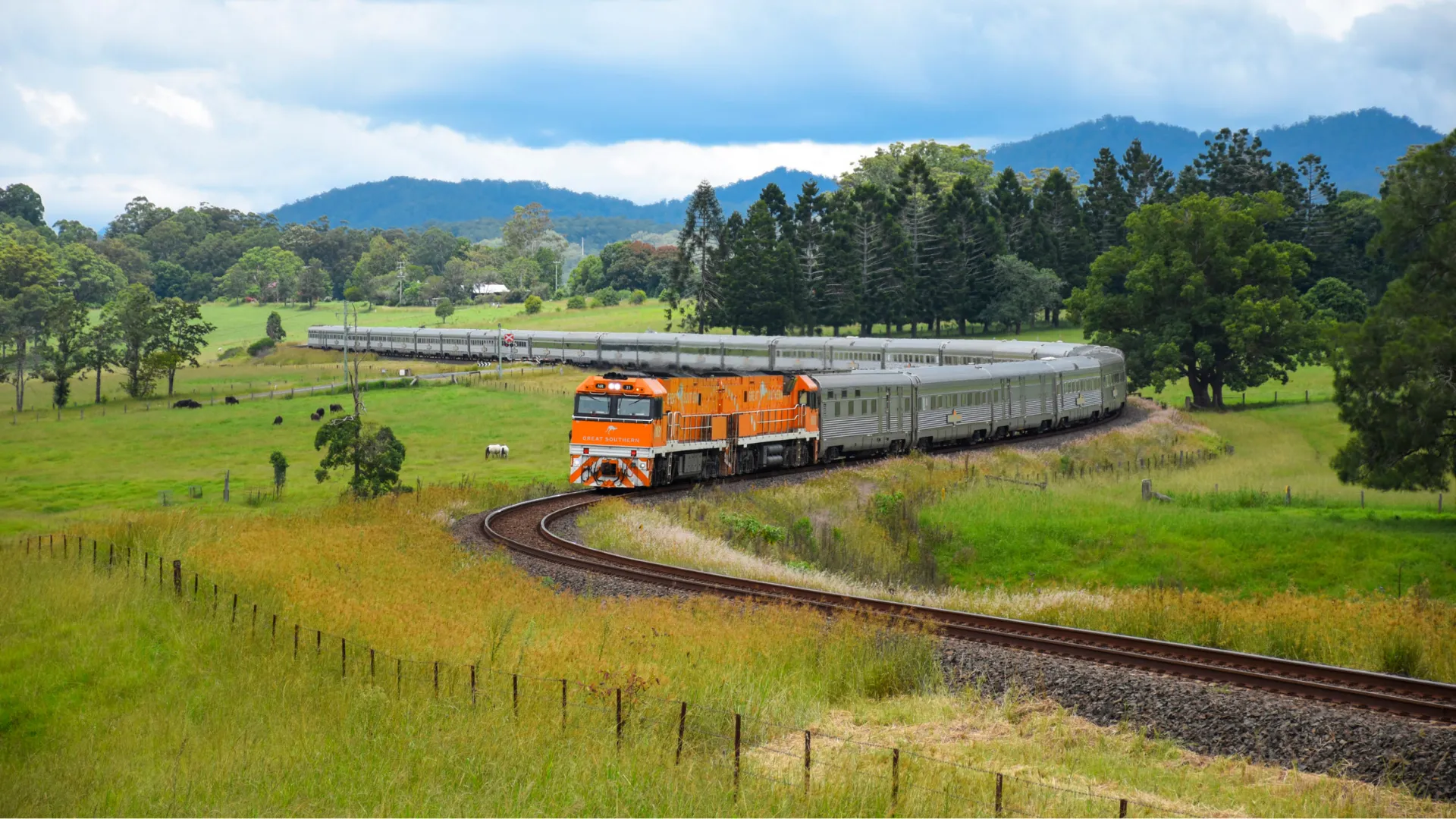
The Great Southern: Australia’s Summer, Seen from the Rails
From Queensland’s subtropical fringes to the vineyards and cultivated landscapes of southern Australia, the Great Southern offers a distinctly different perspective on a vast continent. Over four leisurely days, coastal dining, regional wines and the quiet pleasures of railway travel become as compelling as the country passing beyond the glass.
JOURNEY AT A GLANCE
Great Southern — Coastlines & Capital Cities
ROUTE
Brisbane → Coffs Harbour → Hunter Valley region → Melbourne or regional Victoria → Adelaide. Reverse itinerary via the Grampians, Canberra region and Coffs Harbour. Brisbane–Melbourne also offered.
BEST SEASON
December–February, the train’s seasonal operating period. January and February offer the classic Australian summer experience.
DURATION
Brisbane–Adelaide: 4 days / 3 nights. Adelaide–Brisbane or
Brisbane–Melbourne: 3 days / 2 nights.
STARTING FARE
From approximately £1,724 per person, based on A$3,390 for selected 2027 festive departures, Gold Twin Advance Purchase, twin-share. Other January, February and December departures start at A$3,990 (approximately £2,029) on the same fare type. Includes sleeper accommodation, onboard meals, selected drinks and scheduled excursions. Subject to availability and fare conditions.
A Different Kind of Australian Crossing
The light changes first. Beyond the carriage window, Brisbane’s outer suburbs loosen their grip on the railway, giving way to open paddocks, stands of eucalyptus and the soft green contours of southern Queensland. The city has not so much disappeared as gradually surrendered to the countryside. Somewhere ahead lies the Pacific, and beyond that, several days of travelling at a pace dictated by the rails rather than the clock.
This is not the Australia of endless red horizons.
The Great Southern belongs to a different railway tradition, one in which the journey is defined less by distance conquered than by the variety of places encountered along the way. Operated by Journey Beyond during the Australian summer, it travels between Brisbane and Adelaide, with shorter itineraries connecting Adelaide to Brisbane and Brisbane to Melbourne.
The four-day southbound journey is particularly rewarding in its contrasts. Queensland’s subtropical warmth gives way to the wooded hills and maritime atmosphere of New South Wales, before the train continues towards the more temperate landscapes of Victoria and South Australia. Coastal settlements, vineyards and great cities punctuate a journey otherwise measured in meals, conversations and changing light.
There is something pleasingly old-fashioned about the arrangement.
Britain’s railway heritage has long associated the dining carriage and sleeping compartment with a particular kind of civilised travel. Yet Australia introduces an entirely different sense of scale. Distances are considerable, the horizons often immense, and the railway offers an opportunity to observe the subtle geographical transitions that air travel so efficiently conceals.
The Great Southern is not a conventional sleeper service with an unusually good restaurant attached. Its itinerary incorporates carefully organised excursions, allowing guests to leave the train for a coastal dinner, explore historic wine regions or discover the architecture and culture of regional cities.
These excursions form part of the journey rather than interrupting it.
And then there is the train itself: a succession of private cabins, convivial lounges and dining carriages that become, over several days, a small and pleasantly self-contained world.
Outside, Australia changes almost imperceptibly.
Inside, a more agreeable rhythm begins to establish itself. Lunch leads into the afternoon. The first drink is poured. Conversations begin between people who, only hours earlier, were strangers.
Nobody appears to be in any particular hurry.
The Quiet Theatre of Life on Board

The most revealing detail in a well-appointed railway carriage is often the window.
Not the upholstery, the polished fittings or even the carefully arranged bed, but the simple fact that the landscape is never quite still. A glass of wine rests on the table while the world beyond it continues its steady passage. Light moves across the compartment. A distant ridge appears, holds the horizon for a few minutes, and disappears.
Life aboard the Great Southern is organised around this gentle instability.
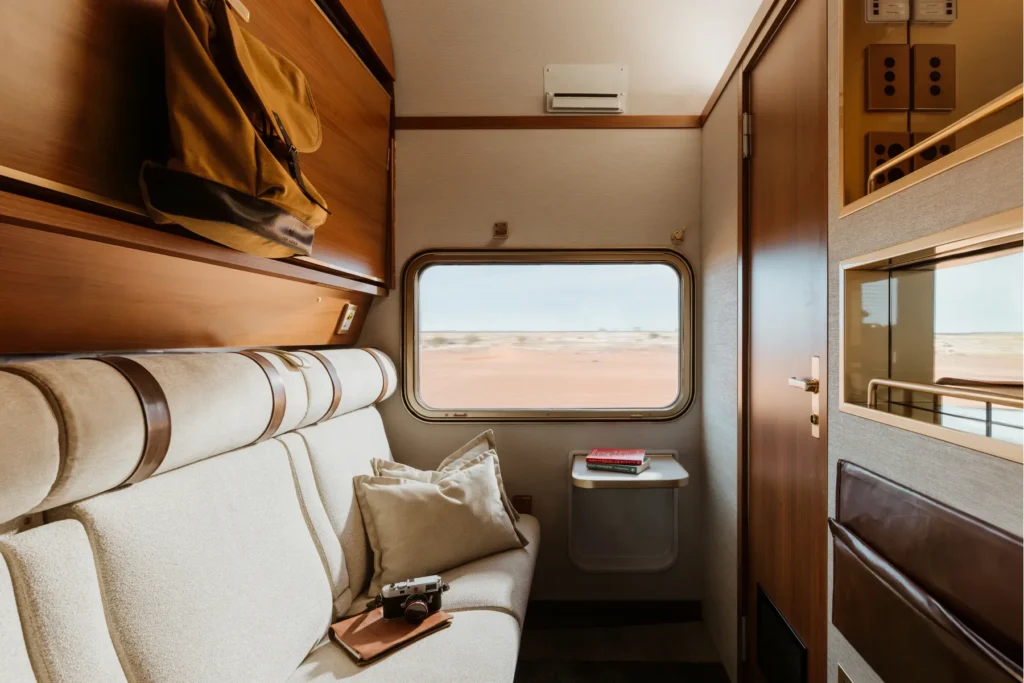
In Gold Service, the classic twin cabin is a compact exercise in practical design. Seating converts into sleeping accommodation at night, while an en-suite bathroom provides the privacy expected of a contemporary railway journey. The cabin does not pretend to be a hotel suite. Its appeal lies in the economical arrangement of familiar comforts within a space that is perpetually moving.
Gold Premium offers a more spacious interpretation, with an enhanced cabin interior and a separate dining and lounge environment. Platinum accommodation introduces another level of room and personal service. Across the train, the guiding principle remains the same: the railway should be experienced, not disguised.
There is pleasure in the small rituals.
Returning to find a cabin prepared for the evening. Following the corridor towards dinner. Meeting familiar faces over a drink and discovering that a conversation begun at lunch can resume, without ceremony, several hours later.
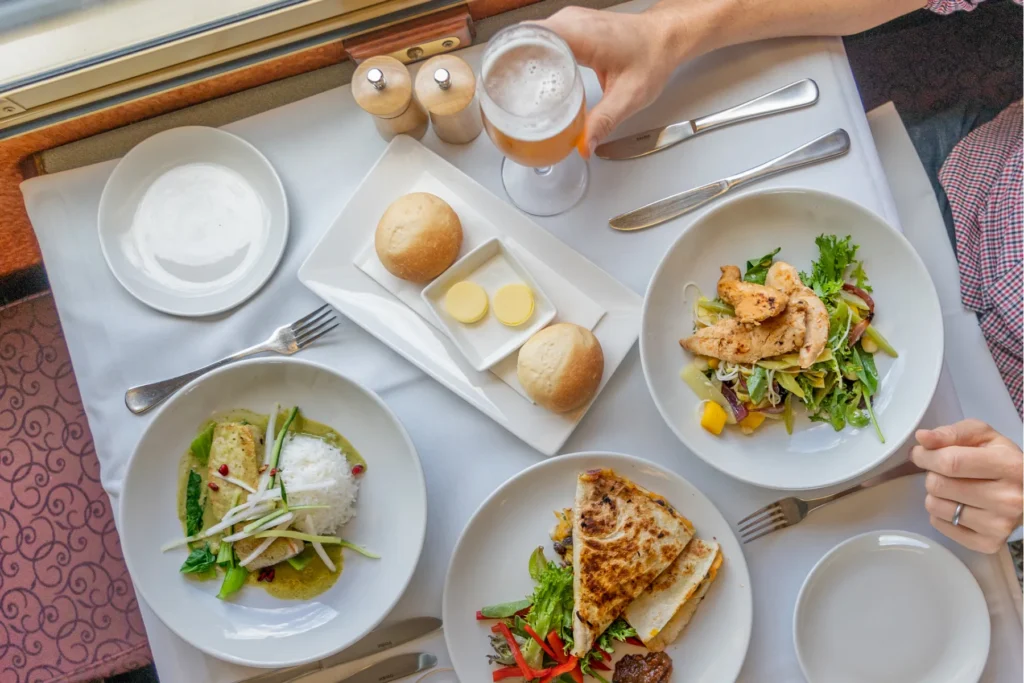
The dining carriage provides much of the social life.
Here, the geography outside finds an expression on the plate. Journey Beyond’s menus draw on Australian produce and regional culinary traditions, accompanied by a selection of wines that reflects the country’s remarkable diversity of growing regions.
Australian gastronomy has developed its own assured character, moving well beyond the old conventions of British colonial dining. Contemporary kitchens are increasingly attentive to provenance, seasonality and the distinctive ingredients of the continent.
Aboard the Great Southern, that culinary identity becomes particularly meaningful. Food is not merely sustenance between destinations; it offers another way of understanding the places through which the train travels.
The tempo matters as much as the menu.
A proper meal is afforded proper time. There is no need to calculate a connection or glance repeatedly at a departure board. The journey continues while the table is cleared, and another stretch of countryside appears beyond the glass.
After dinner, the lounge offers a different sort of entertainment. Conversation drifts between travel, wine and the peculiar pleasures of a railway holiday. Elsewhere, guests return to their compartments as the train carries on through the Australian night.
The sounds become more pronounced in the darkness: the muted vibration of the carriage, the occasional movement of crockery, the low mechanical murmur beneath the floor.
Such details are part of the experience, not imperfections to be eliminated.
Sleep on a train has always required a small accommodation with the railway itself. In return, there is the singular pleasure of waking somewhere entirely different from the place where one closed one’s eyes.
Morning arrives gradually.
A curtain is drawn aside. The landscape has altered again. Somewhere along the corridor, breakfast is being prepared, and another day of Australia’s summer is beginning beyond the window.
Where the Pacific Meets the Table
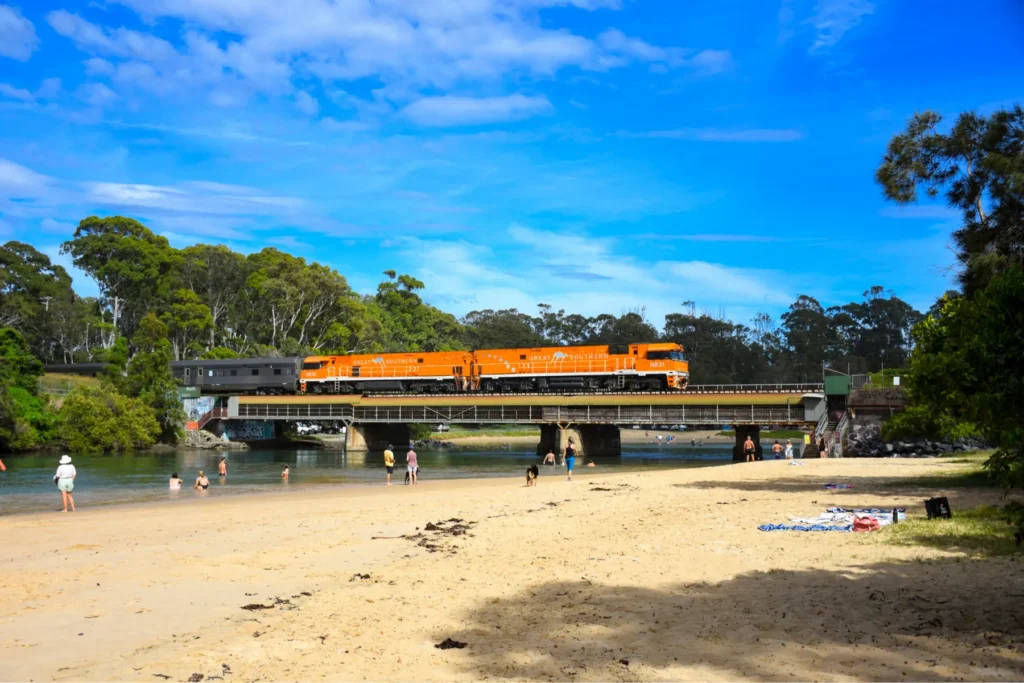
By the time the Great Southern reaches Coffs Harbour, the landscape has acquired a distinctly maritime character. The air is softer, the vegetation more exuberant, and somewhere beyond the trees lies the Pacific, its immense blue presence shaping the character of this stretch of the New South Wales coast.
The railway has brought its passengers to a place where the evening is best spent outdoors.
Coffs Harbour has long occupied an agreeable position between working coastal town and holiday retreat. Its beaches extend beneath wooded headlands, fishing boats come and go from the harbour, and the surrounding countryside remains closely associated with agriculture. There is little of the studied sophistication found in Australia’s more fashionable seaside enclaves. That is part of its appeal.
The Great Southern’s signature beachside dinner is an occasion to appreciate this less theatrical Australia.
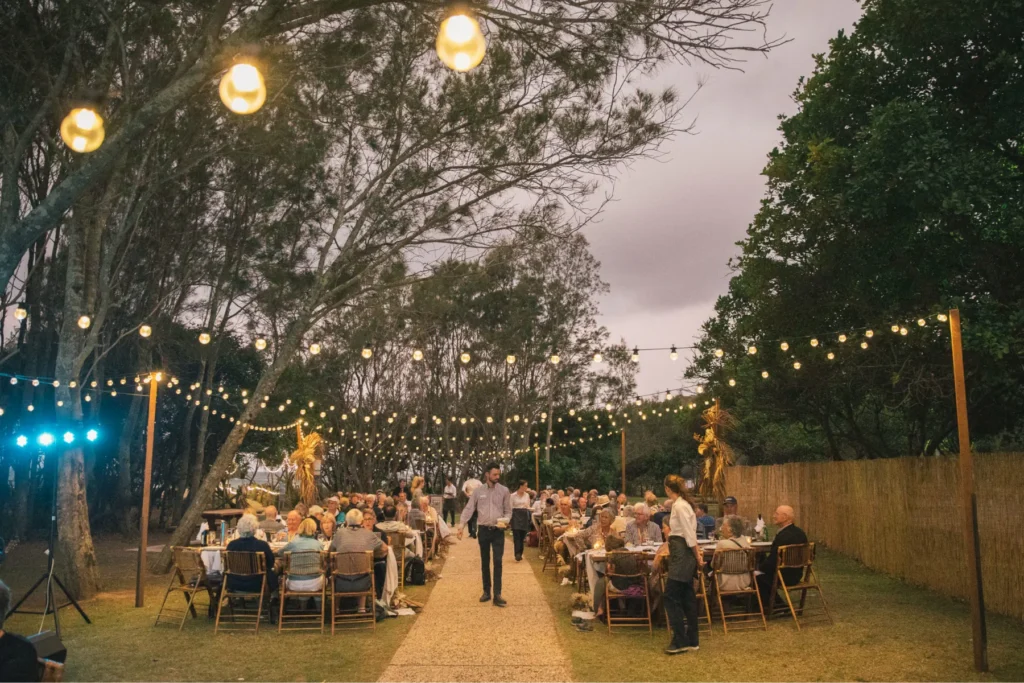
At Charlesworth Bay, the arrangements exchange the familiar enclosure of the dining carriage for the open air. Tables are set near the shore, the Pacific providing its own accompaniment. As daylight begins to fade, the colours of the coast soften into shades of silver and blue.
There is a pleasing contrast between the formality of a carefully prepared dinner and the informality of the setting.
Fresh seafood and regional produce take their place alongside Australian wines, while the sound of the surf replaces the subdued mechanical rhythm of the train. The cooking is intended to reflect the coastal location rather than compete with it. Journey Beyond+1
Australia’s relationship with seafood is both practical and deeply cultural. From the fishing communities of its eastern seaboard to the sophisticated restaurants of Sydney and Melbourne, the country’s culinary identity has been shaped by the proximity of the ocean and the remarkable diversity of its marine environments.
Here, that relationship feels particularly immediate.
The appeal of this evening is not simply the quality of the food. It is the unusual pleasure of having arrived somewhere by rail, stepped away from the timetable, and found oneself dining within earshot of the sea.
For travellers accustomed to European sleeping trains, where dinner generally remains within the confines of a restaurant carriage, the arrangement introduces a different understanding of railway hospitality.
The destination becomes part of the dining room.
Eventually, the evening draws to a close. The guests return to the train, leaving the darkened coastline behind as the Great Southern resumes its southward passage.
There is something satisfying about that departure. The table has been cleared, the ocean has disappeared into the darkness, and the railway once again assumes responsibility for the journey.
By morning, another Australia will be waiting.
Semillon, Sandstone and the Hunter Valley
In the Hunter Valley, Australia’s wine history reveals itself not through grand gestures but through the quiet persistence of vineyards, old homesteads and cellar doors.
The landscape is softer than the more dramatic wine regions of Europe. Low hills rise beyond cultivated rows, eucalyptus trees interrupt the geometry of the vineyards, and sandstone buildings recall an agricultural history that stretches back to the early nineteenth century.
Wine has been produced here since the 1820s, making the Hunter one of Australia’s oldest established wine regions.
Its most distinctive contribution is Semillon, a white grape capable of producing wines of remarkable restraint in their youth and extraordinary complexity with age. Young examples can be bright, citrus-driven and almost austere; given sufficient time in the bottle, they develop notes of toast, honey and lanolin without necessarily having seen the inside of an oak barrel.
It is an intriguing expression of Australia’s capacity for subtlety.
For passengers aboard the Great Southern, the Hunter Valley is one of several possible excursions on the second day. Alternatives include exploring Newcastle’s architectural and industrial heritage or discovering the coastal scenery and waterways of Port Stephens. The choice allows the journey to reflect individual interests rather than imposing a single interpretation of the region. Journey Beyond Rail+1
For those drawn to gastronomy, however, the vineyards have a particular appeal.
The Hunter’s food culture has developed alongside its wines, with restaurants and producers drawing on the agricultural richness of the surrounding countryside. Cheese, seasonal vegetables, carefully raised meats and local ingredients provide a natural counterpart to the region’s celebrated bottles.
A wine tasting here offers more than a familiar sequence of glasses. It provides an introduction to Australia’s distinctive relationship with climate, soil and tradition.
The region’s early European winemakers brought with them knowledge developed in another hemisphere, but the wines that emerged acquired characteristics entirely their own.
The Great Southern’s excursion programme provides an opportunity to encounter this history without the complications of navigating unfamiliar country roads.
There is time to appreciate the setting, the conversations and the peculiar satisfaction of drinking a wine close to the ground on which its grapes were grown.
Those who choose Newcastle encounter another expression of the Australian story: a former industrial powerhouse whose historic streets, ocean baths and lively cultural scene reveal the changing fortunes of a great coastal city.
Port Stephens, meanwhile, offers a more elemental landscape of sheltered water, extensive sand dunes and beaches shaped by the Pacific.
Each excursion introduces a different perspective on New South Wales.
Returning to the Great Southern, the day’s impressions settle into the comfortable rhythms of the train. Another dinner awaits, accompanied perhaps by a wine whose origins now carry rather more meaning than they did the previous evening.
Outside, the countryside begins its gradual transformation towards Victoria.
The journey is moving south, but its real achievement lies in allowing the places along the way sufficient time to make themselves known.
South into Victoria: Another Australia
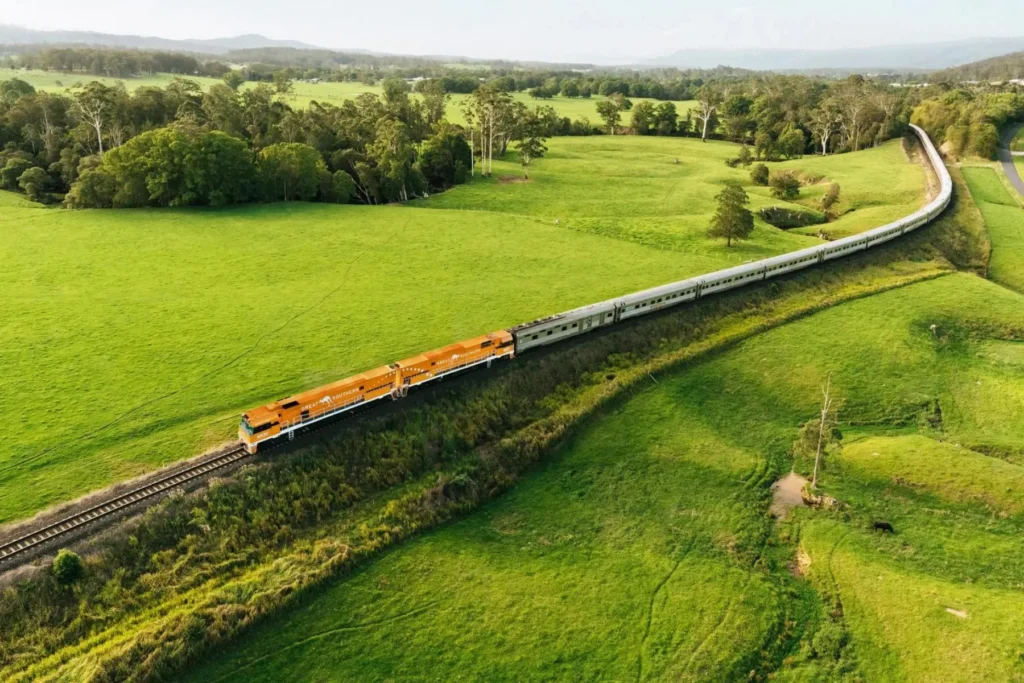
Victoria arrives with a change of temperament.
The subtropical abundance of Queensland and the maritime landscapes of New South Wales have given way to cooler-climate country: rolling pasture, wooded hills and agricultural settlements whose modest railway buildings speak of another period in Australia’s development.
From the carriage window, the country appears increasingly cultivated. Farmhouses stand among sheltering trees, fences divide the paddocks into orderly fields, and the distant hills acquire a muted, almost European softness.
Yet there is little danger of mistaking this for England.
The eucalyptus remains unmistakable, as does the generous Australian light. Even the most familiar agricultural landscape seems to possess a breadth that resists comparison with the neatly enclosed countryside of southern Britain.
On the third day of the Brisbane–Adelaide journey, the Great Southern offers a choice between Melbourne’s cultural attractions and the gastronomic pleasures of regional Victoria.
It is a revealing distinction.
Melbourne has long cultivated a reputation as Australia’s most European city, although its character is far more complicated than that description suggests. Victorian-era architecture, generous public gardens and an enduring affection for trams coexist with an exceptionally diverse restaurant culture and a contemporary arts scene.
The city’s laneways have become destinations in their own right, their cafés and independent shops occupying spaces once associated with warehouses and commercial backstreets.
For Great Southern passengers choosing the Melbourne excursion, the programme introduces several expressions of the city’s identity: Australian art at the National Gallery of Victoria, the sporting heritage of the Melbourne Cricket Ground, and the darker chapters of colonial history associated with the Old Melbourne Gaol.
There is something rather appropriate about travelling across Australia by rail and finding oneself examining the country’s relationship with sport, architecture and history.
Those preferring a quieter afternoon may remain with the train as it continues towards the Moorabool Valley.
Here, at Clyde Park near Inverleigh, Victoria’s cool-climate winemaking traditions provide the setting for a leisurely vineyard lunch. Chardonnay and Pinot Noir take precedence over the Hunter Valley’s Semillon, reflecting a different set of climatic influences and a different approach to Australian wine.
The afternoon becomes a study in contrasts: another region, another table, another interpretation of the landscape.
This is perhaps the Great Southern’s most persuasive quality. It does not attempt to reduce Australia to a single defining experience. Instead, it allows several distinct regions to emerge through their food, their people and the changing countryside.
By evening, the train is travelling towards South Australia.
The vineyards and city streets of Victoria recede into memory, replaced once again by the understated pleasures of the carriage: a final dinner, another conversation, and the familiar rhythm of wheels against rails.
The journey is approaching its conclusion, though there is still another morning to come.
Adelaide and the Art of Arriving Slowly

The final morning is quieter.
Beyond the window, South Australia emerges in the pale light: open agricultural country, scattered stands of trees and the distant contours of hills that announce the approach to Adelaide.
There is breakfast to be taken, luggage to be gathered and the small melancholy of a journey approaching its end.
After several days aboard, the rhythms of the train have become sufficiently familiar to feel almost permanent. The dining carriage has its regular faces. The corridor has acquired a recognisable sequence of doors and windows. Even the occasional sway of the carriage has ceased to demand attention.
And yet the journey was always going to end.
Adelaide makes a fitting conclusion. Founded in 1836 and planned around a distinctive grid of streets and surrounding parklands, the city possesses a measured elegance that contrasts with the greater metropolitan urgency of Sydney and Melbourne.
Its nineteenth-century buildings, shaded terraces and generous public spaces retain traces of the ambitions of its colonial founders. At the same time, contemporary Adelaide has developed an increasingly confident culinary identity, sustained by the vineyards of the Barossa Valley, Adelaide Hills and McLaren Vale, as well as the extraordinary produce of South Australia’s coastline.
For those inclined to linger, it is a city that rewards an additional night or two.
The Great Southern arrives at Adelaide Parklands Terminal, where the experience of travelling through the Australian summer finally gives way to the practicalities of ordinary life.
It is tempting to describe such journeys as belonging to another age. Certainly, there are echoes of the great railway traditions: private sleeping compartments, attentive service, polished dining rituals and the measured progress of an express crossing considerable distances.
But their relevance is distinctly contemporary.
In a world increasingly preoccupied with reaching destinations as efficiently as possible, the Great Southern offers an alternative understanding of travel. The time spent moving is not an inconvenience to be minimised. It is the substance of the experience.
The train’s seasonal operation reinforces that distinction.
Travelling during the Australian summer gives the journey a particular atmosphere: long evenings, coastal light, warm air and regional landscapes whose character changes as the continent moves from subtropical north to temperate south.
The return journey from Adelaide to Brisbane offers a different perspective, taking in the Grampians, Canberra and the New South Wales coast over three days. There is also the shorter Brisbane–Melbourne itinerary, which retains the coastal and wine-country experiences while concluding in Victoria.
Each has its own geographical rhythm.
None needs to compete with the epic desert landscapes of The Ghan or the transcontinental distances of the Indian Pacific. The Great Southern’s distinction lies elsewhere: in its ability to connect the varied cultures and landscapes of eastern Australia through the simple act of travelling slowly.
The finest moments are not necessarily the grandest.
They may be found in the first light across an unfamiliar valley, the unexpected pleasure of a regional wine, or the sight of the Pacific disappearing beyond a darkened carriage window.
By the time the train reaches Adelaide, the distance travelled has become almost incidental.
For those drawn to the greater distances of Australian rail travel, the continent offers two rather different companions to the Great Southern. The Ghan follows the country’s interior between Adelaide and Darwin, while Indian Pacific crosses the continent between Sydney and Perth. Each reveals a different Australia, best appreciated from the unhurried perspective of a railway carriage.
What remains is a different understanding of the country between the two cities.
And perhaps a certain reluctance to travel quite so quickly again.
Pre-departure stay
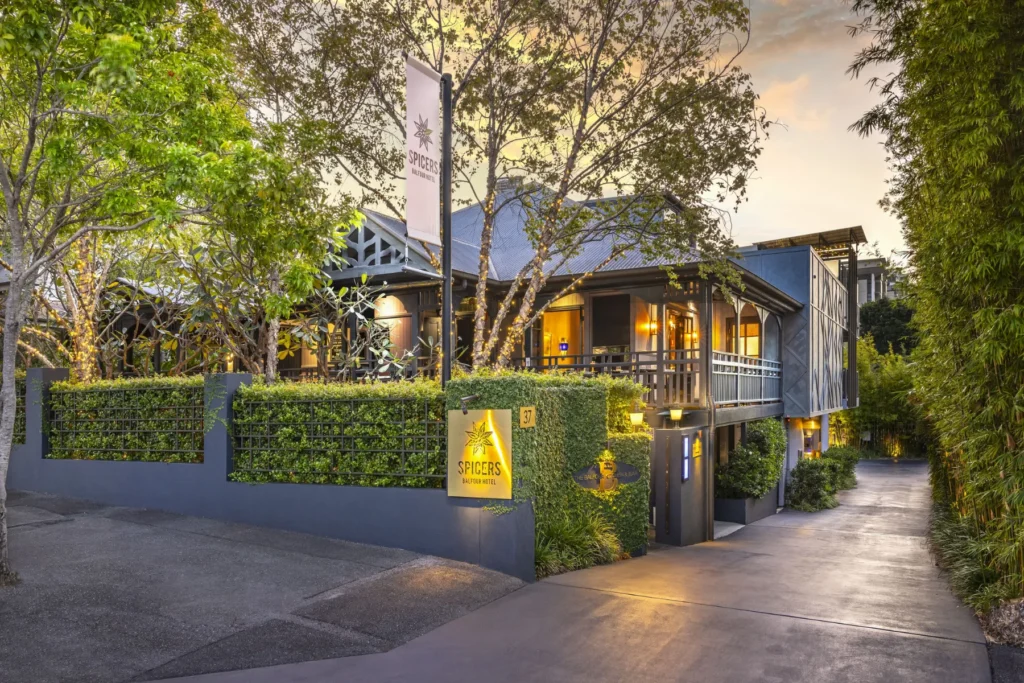
Spicers Balfour Brisbane
Behind the verandahs of a restored Queenslander residence, Spicers Balfour offers an intimate alternative to the city’s grand hotels. Leafy New Farm, thoughtful dining and an easy taxi connection to the Morningside check-in venue make it a particularly agreeable beginning.
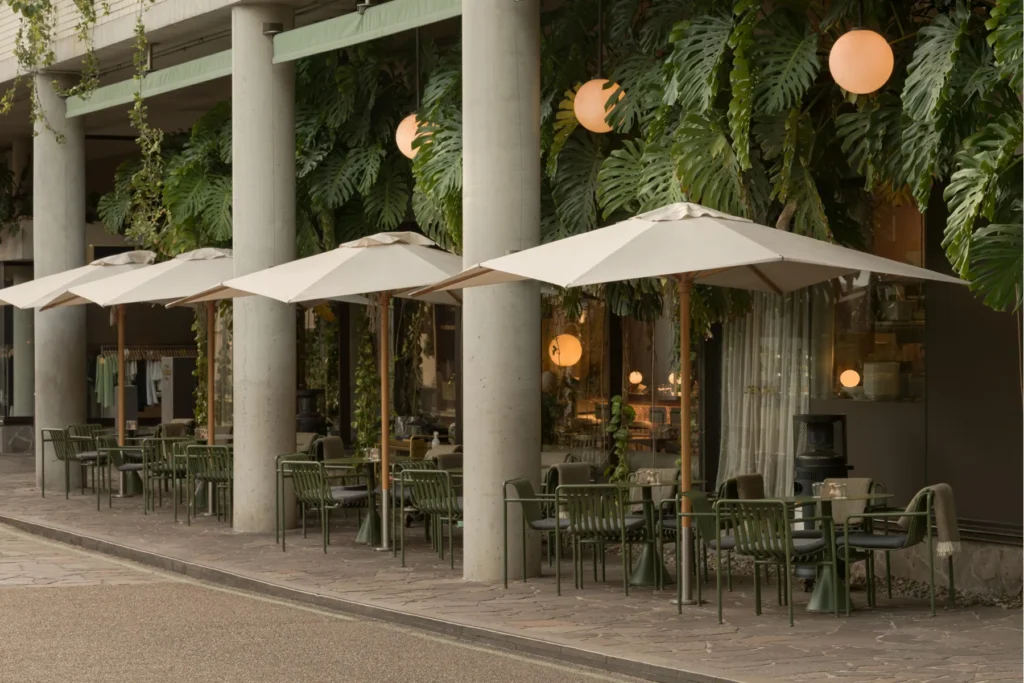
The Calile Hotel
White brick, shaded colonnades and a palm-fringed swimming pool give The Calile its distinctive subtropical modernist character. In Brisbane’s James Street precinct, it offers excellent dining before the journey, followed by a straightforward pre-booked transfer to the railway welcome venue.